Thursday, September 20, 2018

The Lehman’s Limp

By Michael Hudson Wednesday, September 19, 2018 


10 Years Since Lehman Brothers Bankruptcy – Did the Economy Really Recover?

September 19, 2018
MARC STEINER: Welcome to The Real News Network. I’m Marc Steiner. Great to have you with us once again.

On September 15, 2008, the financial meltdown began with the bankruptcy of the Lehman Brothers. That was 10 years ago. The shock waves that hit the economy threw 9 million families out of their homes who could not afford to pay their rising mortgages. So Congress and the president in the 1990s killed Glass-Steagall, written in 1933 to save us from the excesses of the financial industry. And then Congress gave us Dodd-Frank in the wake of the 2008 crisis that bailed out Wall Street, but not America. And now Trump seems to continue the process with killing Dodd-Frank and completely turning over the keys to Wall Street.

Our guest today says in part we must wipe out debt and not bail out the banks. So with that, let me welcome back to Real News Michael Hudson, research professor of economics at the University of Missouri Kansas City, and a research associate at the Levy Economics Institute at Bard College. His latest book is J Is for Junk Economics. Michael, welcome, good to have you with us.

MICHAEL HUDSON: Good to be here.

MARC STEINER: So let’s start there, with this whole idea of what we did wrong in 2008, why we got it wrong, and what we should have done, from your perspective.

MICHAEL HUDSON: Well, you’re talking about September 15. And last weekend, the 10-year anniversary, all that you read in The New York Times and other newspapers was a celebration: We did everything right. We bailed out the banks. There is very little discussion of the fact that this was a disaster for the economy. Nobody has related the fact that we bailed out the banks on their own terms to the fact the economy has not recovered. People simply talk about how slow the recovery has been since 2008.

To put this issue in perspective, almost all of the growth in GDP – the measure they look at – is taken the form of higher bank earnings, which they call financial services, meaning penalty fees, late fees, and interest rates over and above the banks’ cost of funds; and rising rents that homeowners would have to pay themselves if they rented instead of owned their homes. You mentioned 9 million homeowners lost their homes. They now have to rent. Rents are rising, debts are rising. Corporate debt, municipal debt, and student debt are way higher now than 2008.

Most of this is because of the way in which President Obama double-crossed his voters and said, I’m not representing you, I’m representing my donors. He invited the bankers to the White House and said, don’t worry, folks, I’m the only guy standing between you and the mob with pitchforks. Just like Hillary called Donald Trump supporters “deplorables,” he called his supporters the mob with pitchforks. And he stuck it to them.

In my book Killing the Host you have Barney Frank saying that he got the agreement of Secretary of the Treasury Hank Paulson to write down the mortgages to realistic charges: namely, number one, what the mortgage borrowers could afford out of their income, and number two, the carrying charge of the mortgage would be the going rent rate, which is what mortgages historically have tended to approximate.

Obama said, no, I’m representing the bankers, not the debtors. He appointed bank lobbyists such as Tim Geithner as Secretary of the Treasury. Obama basically followed everything that President Clinton’s Secretary of the Treasury Rubin recommended to him. He was handed a list of the people that Wall Street wanted to appoint. And then he washed his hands of it. Instead of doing what normally happens in a crisis – writing down the debts, and writing off the bad savings and the bad loans as a counterpart to the debts, and taking over the insolvent banks – he kept the bad debts on the books.

There was a big argument in the administration. Surprisingly enough, the good guys were the Republicans in this. Sheila Bair was a Republican from the Midwest, and she said, look, Citibank is not only insolvent, it’s a basically a financial fraud organization. We should take it over. It doesn’t have any money. But Obama said, wait a minute, Geithner is a protege of Rubin, and he’s become head of Citigroup. We’ve got to bail out Citigroup. So what Obama did was take the banks that have been the most fraudulent, that have paid the largest amount of civil fines for financial fraud, and said, these are the banks we want to be the leaders. We’re going to make them the biggest banks, and we’re going to make them stronger. And we’re not going to forgive any loans. We’re going to leave the loans in place, unlike what’s happened for the last few hundred years and crashes.

So this crash of 2008 was not a crash of the banks. The banks were bailed out. The economy was left with all the junk mortgages in place, all the fraudulent debts. Then, to further help the banks recover, the Federal Reserve came in and pushed quantitative easing, lowering the interest rates so much that banks could make the widest profit they ever made in history – the margin between the lending rate on mortgages, 5-6 percent; student loans, 9 percent; credit card loans, 11-29 percent; and the banks’ borrowing charge, which is 0.1 percent. The banks became enormous profit centers, leading the stock market gains.

Over the weekend, the newspapers said, look at the wonderful success. The stock market’s up, the One Percent are richer than ever before. Let’s look at the good side of things. There was no analysis at all as to why the economy is not recovering, and whether this failure to recover is a backwash of the way in which the crisis was handled- by bailing out the banks, not the economy.

MARC STEINER: Let me take a step backwards here. First of all, very quickly for us, define quantitative easing.

MICHAEL HUDSON: Quantitative easing occurs when the Federal Reserve spent $4.3 trillion on buying the bad debts and the bank assets and creating bank reserves. Essentially it’s like printing money. You’ve heard the phrase ‘money-dropping helicopters.’ But the helicopters only fly over Wall Street. So the Federal Reserve created $4.3 billion on the accounts of the banks, and let the banks get through the fact that they’d made recklessly bad loans and suffered reckless losses. Sheila Bair, in her autobiography, wrote about how Citibank was the most mismanaged bank in America. Not quite as fraudulent as Countrywide or Bank of America, but simply incompetent by making bad gambles under Prince, who ran the thing. They were bailed out and then subsidized. The larger the fines for fraud, the more subsidy they got and the bigger they grew. Crime pays.

MARC STEINER: Let’s talk a bit about what could have been the alternative. To me that’s what is a gripping story we never wrestled with, nor talk about very much. Right?

MICHAEL HUDSON: Isn’t that amazing. Over the weekend, not a single paper that I know said that there were many alternatives at the time. The alternative that was talked about, mainly by Republicans, was to say, OK, these mortgages were fraudulently written. That’s why the whole media were using the word ‘junk mortgages.’ So we should write down the mortgage to the ability of mortgagee to pay, out of 25 percent of their income, or whatever. Or, the carrying charge of their mortgage would be the same that they could pay to rent. In other words, if someone’s paying $1200 a month in mortgage payments, but for $600 a month they could rent out the identical house next door, you reduce the mortgage to the realistic value. Because the banks hired crooked appraisers and their own crooked firms to do false valuations on these loans they made in order to sell them the gullible people, like German Landesbanks.

MARC STEINER: So in 2008 some Republicans, along with some economists who were to the left of Wall Street, were talking about bailing out people who were in debt, bailing out people whose mortgages were underwater. Dealing with the question of how much we’re charging for student loans, and kind of either putting a freeze on that, or writing them down. So let’s talk a bit for a moment about what was being proposed that was not paid attention to in 2008, that had to do with one of the things you say, which is a pretty radical notion, which is that we should have bailed out the debtors, and not the banks. Let’s start there. What does that mean, and how does that work?

MICHAEL HUDSON: Suppose you had taken the $4.3 trillion, and instead of giving it to the banks to lend out mainly to corporate raiders or to speculators, or to currency speculators, you would have used this $4.3 trillion to take over or buy the bad loans at a discount.

MARC STEINER: Who’s ‘they’? Some of the federal government?

MICHAEL HUDSON: The federal government could have bought the junk mortgage loans in default for maybe a quarter of the value. Let’s say 25 percent, $25,000 for a $100,000 junk mortgage. This is essentially what Blackstone Realty did, and what private equity people did, buying foreclosed properties. The government could have bought from the banks their bad loans. And instead of foreclosing, they’d write down the loans to the realistic market price that the market was pricing the property and the loans at. The inflated housing prices would have been recalculated at the market rate. There would be a lower mortgage, there would be lower interest rates and no penalty payments.

This $4.3 trillion could have spurred an enormous takeoff. It could have left the 9 million families that were evicted in place. It could have kept the housing prices low for the country. It could have kept the purchasing power of homeowners available to be spending on goods and services. And the economy would have recovered instead of stagnating. That wasn’t done because the financial sector was running the Democratic Party’s policy and politics, not the voters.

MARC STEINER: They’ve been doing this for a long time. I mean, whether it was President Bush or President Clinton, and going after pieces of Glass-Steagall and finally killing it and the rest, which you can talk about in a minute if we have time today. But it seems to me that people would say to you in response, well, what about the banks? That’s where our money is. That’s how we get our loans. That’s who finances small businesses in our community. How can you not bail them out? How can they not be the centerpiece of this, along with us, whose homes are underwater?

MICHAEL HUDSON: Well, just about everybody who listens to this show has their bank accounts guaranteed by the Federal Deposit Insurance Corporation, the FDIC. Sheila Bair was the head of the FDIC. She was leading the advocacy to take over the banks and essentially wipe out their stockholders and some bondholders, because they were holders in a fraudulent organization, and in her autobiography she said the FDIC could have taken over Citibank. Every insured depositor would have had their money sae.

MARC STEINER: What does it need to take over Citibank? What does it mean to take over the banks, what does that mean?

MICHAEL HUDSON: That means when the bank is insolvent, the government takes it over. There were still enough assets to cover the insured deposits, but not leave anything for the stockholders, or maybe not much for the bondholders.

MARC STEINER: So one more time for us. So you’re saying- so taking over the banks would have guaranteed who, and not the bondholders?

MICHAEL HUDSON: It would have guaranteed the depositors. There was enough money in Citibank, even though it was crooked, even though it was incompetently managed, even though we know that it’s paid tens of billions of dollars for fraud. It would have wiped out the big speculators. But all of the depositors, the bread and butter users, would have been paid. The same for all the other banks. No insured depositor would have lost. But the bondholders would have lost, because banks essentially would have used their money to pay the depositors and to stay in business, not pay the owners of the banks, who were owners of a crooked organization.

MARC STEINER: So where does the money come from, then, to invest in infrastructure, in new businesses, and whatever else has to be invested in?

MICHAEL HUDSON: Well, banks don’t invest. That’s a myth. The pretense is that rescuing the banks rescued the economy. But the banks don’t make loans to the economy. Banks don’t make loans to fund factories. They don’t make loans for infrastructure. They make loans to buy assets already in place. They’re privatizing the structure to take it private, raise the rates the people have to pay for services. Essentially they lend to raiders taking over corporations. They won’t help a corporation put in more equipment and hire more people, but they’ll lend to a raider to break up a corporation, downsize the labor force, smash it up and leave it a bankrupt shell. That’s the financial management plan. That’s what they teach in business schools.

Contrary to the idea that bailing out the banks helps the economy, the fact is that the economy today cannot recover without a bank failure.

MARC STEINER: Let me stop you right there, before we go on. Let’s examine that before we have to close. So what do you mean by that? What do you mean, the economy cannot recover without a bank failure? What does that mean?

MICHAEL HUDSON: That means that the banks hold the student loan debt, the mortgage debt and credit card debt. If you leave all of this debt in place, people will not have enough money after paying their monthly nut, after paying their banks, their mortgage payments, their housing payments, all of the monthly stuff, there’s not enough money to buy the goods and services that they produce.
So the economy is shrinking. You’ve seen a lot of stores, international and national chains going out of business. You’ve seen whole streets of New York City with almost half the stores empty. They’re boarded up. The economy’s not recovering, it’s limping along. It’s called debt deflation. My book Killing the Host describes how this was described in the 1930s. It’s a well-known phenomenon. But nobody talking about the rescue was saying, wait a minute, what was rescued was the volume of debt, instead of writing it down like you did in the 1930s.

So essentially we’re not in a recovery at all. We can’t get into recovery until you write down the debt. Otherwise you’re going to have the economy looking like Greece. You’re going to have austerity. Basically we’re on an austerity budget now, not so much because of tax policy but because of the debt overhead that is owed to the banks and other major creditors.

—
MARC STEINER: We’re about to continue our conversation with Michael Hudson. Michael, I want to pick up here about where we are now. Because we’re looking at Donald Trump, who is I think doing an even more radically dangerous job than anybody before him in terms of dismantling whatever regulations exist. And you’re seeing all the kind of foxes guarding the hen house across his administration. Look at the Supreme Court. We never look at the Federal Reserve and what he’s doing there. So the question I have for you is where are we right now? What are the prospects for our economy? And what are the prescriptions as you see them?

MICHAEL HUDSON: Well, essentially, Donald Trump isn’t doing much in the financial sector. He’s slashed tax rates on the One Percent. He is deregulating. But basically there is no way in which any of these micro or marginal changes can affect the fact that there’s a basic tendency at work. It’s an underlying tendency: The volume of debt in any society grows faster than the ability to pay. That should be the starting point of any analysis.

Debt grows exponentially. The interest charges grow year after year. If you have a savings account you can see it mount up, like if you have a retirement account you’ve seen the stocks go up. If you have it in bonds you see those go up. But the economy doesn’t go up anywhere near as much as the stock market. That means that the financial sector and the debt volume grows much faster than the economy can grow. So people – the economy, families – have to spend more and more of their money every month on their mortgage debt for housing, on their credit card debt, on their student loan debt, on their automobile debt, and also in health insurance. They have less and less money to spend on goods and services.

So the starting point should be how are we going to bring the debt payments back in line so that the economy has room to grow? The only way to do this in any society is by writing down debt. Germany did that in 1948 with its economic miracle. They wrote down nearly all the domestic debt. Normally the function of a crisis like the Great Depression is to wipe out the bad debts. But when you wipe out the debts, you wipe out the savings, mainly of the One Percent. And the question is, who is the government going to make its policy for? The one percent of creditors, or the 99 Percent that the One Percent holds in debt?

Well, obviously the One Percent is the donor class, and they’re writing the laws. The result of their leaving this debt in place is a rising debt-income ratio. That is, the proportion of corporate earnings that has to pay for debt service has been soaring because corporate raiders have gone to the banks, borrowed money and taken over corporations. Instead of using the corporate earnings to invest in more equipment, they’ve bought their own stock by stock buybacks that push up stock prices instead of investing.

So the financial management philosophy that we have is diametrically opposed to what’s needed for economic growth. That should be what people are talking about, because more and more economists are warning that given the rising debt ratios, there’s going to be another crisis. What we should be talking about when we look back on the anniversary of Lehman’s bankruptcy is how to handle the next crisis in a way that doesn’t bail out banks, that bails out the economy by writing down the debts.
If banks have bad debts, they’ve made bad loans. Banks used to be conservative and prudent. But if they make imprudent loans and they say, we don’t care the borrower can’t pay because we’ve sold the whole loan off to a pension fund or a German Landesbank, and somebody else is going to take the loss, you have to restructure the banking system and the financial management, and take it out of the hands of bankers to manage.

If you leave the Treasury Department and the Justice Department and the bank regulators in the hands of bankers, they’re going to loot the rest of the economy. They’re going to take everything they can. So you want someone who’s not a banker to actually do the regulation.

But how are you going to get such a group? Well, you have people like Paul Krugman who came out on the anniversary saying, debt is not the problem. He said that the people are all wrong, they’re nutty to believe that debt’s the problem. All we need to do is run a bigger budget deficit, so that we can spend money into the economy to make it grow enough so that the home owners and workers will have enough extra money to be able to pay this exponentially growing debt. In other words, the whole economy should be run in order to enable it to pay off debt that it’s run up.

This is crazy. The economy should be run to help people’s living standards, not to help the bankers and the one percent who own the banks, the bondholders.

MARC STEINER: Well, Michael Hudson, this has been a really refreshing and interesting conversation. I appreciate you taking the time today as we continue to look at where our economy is, where it’s going, and what this tenth anniversary means. Michael Hudson, thanks so much. Appreciate your time.

MICHAEL HUDSON: Good to be here.

Saturday, September 1, 2018

If Everyone Ate Beans Instead of Beef With one dietary change, the U.S. could almost meet greenhouse-gas emission goals.

From the Atlantic:

If Everyone Ate Beans Instead of Beef With one dietary change, the U.S. could almost meet greenhouse-gas emission goals.

Excerpt: "That is, even if nothing about our energy infrastructure or transportation system changed—and even if people kept eating chicken and pork and eggs and cheese—this one dietary change could achieve somewhere between 46 and 74 percent of the reductions needed to meet the target.

“I think there’s genuinely a lack of awareness about how much impact this sort of change can have,” Harwatt told me. There have been analyses in the past about the environmental impacts of veganism and vegetarianism, but this study is novel for the idea that a person’s dedication to the cause doesn’t have to be complete in order to matter. A relatively small, single-food substitution could be the most powerful change a person makes in terms of their lifetime environmental impact—more so than downsizing one’s car, or being vigilant about turning off light bulbs, and certainly more than quitting showering."

...So... in service to this goal here's how to cook (dried) beans:

1. Get fresh beans (Denio's is where we go, but your local Mercado, or Hispanic grocery should be good too). We like cranberry beans, but any variety will do. The freshness more than anything else influences their digestibility and flatulence-producing properties. Fresher is better. If you have beans that won't get soft, discard them. They're too old.
2. Clean them, discarding any stones or broken beans.
3. Cover with 2" of water and soak them overnight.
4. Discard the soak water, and re-fill with just enough water to cover the beans.
5. Cook on low heat for several hours. This is easiest in a slow cooker, but you can do it on a stove-top too as long as they are on the lowest available temperature. The amount of time depends on how fresh the beans are. When they're soft, they're done. A typical time: 3 - 4 hours.
6. Add salt to taste. I add three teaspoons in a four-quart Crock Pot, and change the temperature to "Warm" until I'm ready to serve the beans.

The Pinto (or substitute cranberry beans) are what you'll find with most Mexican food. Very good with salsa. (Good salsa: tomatoes, onion, garlic, lime juice, salt, chiles...chopped together. Optional: Cilantro. One of those salsa makers is handy, too)

If you cook the small red beans (New Orleans Red Beans), you can add a mirepoix of chopped onion, garlic and bell pepper when you add the salt. Serve that with tabasco, celery and a baguette or rice.

To make chili, add canned tomatoes and chilie powder, and/or cumin...etc.

Beans are also terrific because they make long-lasting leftovers (not so, salsa). They are my go-to backup food. You can make tacos, burritos, chimichangas, etc.

...Worth the trip!

Saturday, August 25, 2018

A reply to a Nextdoor posting about Sacramento Supervisor Sue Frost (now removed by moderators)

Nextdoor's policies are about the same quality as their text editor. Using their editor, you can't add inline graphics or links, or make italics or bold text. Pretty second rate, IMHO. There are even free, and/or open source text editors that have many of the above features...but no, we must type plain text, no inline links or graphics.

Similarly, any public policy discussions one might have, even civil ones, are discouraged in favor of commercial and crime announcements, or missing pets. We're not citizens, we're consumers. (Who profits from distracted citizens? See https://www.bbc.com/news/blogs-echochambers-27074746)

As for Supervisor Frost, (and Supervisor Peters) When will we hear from them why they voted (on LAFCO) to expand the development area around Elk Grove by 1000+ acres?

Developing ag land is enormously profitable for land speculators, who can buy or option the land cheaply, then re-sell it to builders for as much as 50 - 100 times their cost when the speculators get it re-zoned.

Yet Elk Grove has thousands of undeveloped acres that are already approved for development, and the region itself has 20 years worth of unbuilt infill.

Ms. Frost paints herself as a "Fiscally Responsible[tm]" representative, but it's much more expensive for local governments to develop greenfield (outlying ag land) rather than infill. The water and sewer runs are longer, as are the emergency vehicle trips, etc. (See https://mikethemadbiologist.com/2018/08/24/suburban-sprawl-is-expensive-when-you-actually-have-to-pay-for-it/, or https://usa.streetsblog.org/2015/03/05/sprawl-costs-the-public-more-than-twice-as-much-as-compact-development/)

What happened to Ms. Frost's "Fiscal Responsibility[tm]" and fretting about low County budget reserves? Could serving the land speculators rather than the public play a role? Gosh! I wonder!

If you think this is no big deal, then compare our current circumstances with the German system. When a German developer wants to build on outlying land, s/he must sell the land at the ag land price to the local government, then buy it back at the upzoned prize. The public, not the land speculators, gets the profit. Germany is certainly not perfect, but it has the equivalent of Medicare-for-all, and free tuition for its universities, even for foreigners. The arts budget for the City of Berlin exceeds the National Endowment for the Arts for the U.S. of A. Our public services are pathetic, in comparison.

I've asked Ms. Frost whether she'd consider at least taxing that "unearned increment" (the enormous 5,000% - 10,000% profit the speculators get...tax free, if they 1031 exchange!)...and her response has been: [crickets].

Similarly, she's supporting a proposed revision to Prop 13 that would actually diminish tax collections, but won't comment about the proposal to close the commercial property loophole that costs the state an estimated $11 billion a year.

Yep, she's a puzzle, all right.

Suburban Sprawl Is Expensive, When You Actually Have To Pay For It

Posted on 
Suburban Sprawl Is Expensive, When You Actually Have To Pay For It, by Mike, the mad biologist)by 
A while ago, we noted that the wicked problem isn’t affordable urban housing, but the fiscal sustainability of the suburbs:
Something that’s lurking in the background of the U.S. economy, and which will erupt with a fury in ten years or so is the need to replace suburban infrastructure: underground wires, pipes, and so on. This is something new that most suburbs, unlike cities, haven’t had to confront. A suburb that was built in 1970 is long in the tooth today, and time only makes things worse. No suburbs that I’m aware of ever decided to amortize the future cost of repairs over a forty year period–that would require an increase in property taxes. In fact, many suburbs never even covered the expenses of building new subdivisions, never mind worried about expenses decades down the road.
Worse, there’s a tax base problem. That is, the value of property per unit of infrastructure (e.g., the property tax base per square foot of water main) is much lower in the suburbs than it is in cities. Relatives who live in a wealthy suburb close to D.C. (homes go for $900,000 give or take) are in a subdivision with about 40 homes on 25 acres, with a rough property value of $45 million. In D.C., I live in a building assessed at a little over $50 million that covers a quarter of an acre (the population of these two groups is about the same). Once suburbs start having to repair their infrastructure, it’s going to get very expensive to live there (and that doesn’t even include the transportation ‘tax’ of suburban living). Keep in mind, the suburban development I’ve described is definitely on the high end of things–many places will be worse off.
Which brings us to the Great State of Texas (boldface mine):
Most homes have sewer lines that connect to a “sewer main” or main line. These “lateral lines” often go under public roads. If a resident were required to pay for a repair under a city road, the cost would be in the thousands of dollars.
Turns out Killeen homeowners have to do just that.
When homeowner Lee Huggins found out there was a problem with his lateral line, Huggins told Channel 6 the City of Killeen identified an issue with the lateral line outside his property line on the edge of the road. He asked the city to fix it, and instead they gave him a letter.
The letter states the sewer service line is a “private lateral,” and “was never accepted by the City for maintenance.” It states “the City is responsible only for the maintenance of the sewer main” and references a court case: Pittman v City of Amarillo in 1980.
This means Huggins would have to pay a contractor to dig up the city street to repair the lateral sewer line, and he told Channel 6 the estimate was in the thousands.
“My estimate for this repair is at least thirteen thousand (dollars), because it’s thirteen feet and that involves excavation, cutting of the concrete and repairing, according to city requirement,” Huggins said.
Uncharacteristically, part of the cost of infrastructure repairs was not externalized to the public at large, but, instead, has to be borne by the homeowner. Of course, if foisted onto the city, then that just means taxes will have to increase (unlike the federal government, local governments have to balance budgets, meaning raise taxes, or borrow in a currency that they don’t issue).
This is just a very small instance of what is coming–suburbs need to be repaired and that’s very expensive. And I don’t see a way around this without a massive federal infrastructure bill. Whether or not we should repair all of our suburbs is a separate question, but maybe this would make deficit spending attractive to moderates?

Saturday, August 11, 2018

Sprawl Costs Us All

[See also: Sprawl is not the best alternative]

Although newer developments may change this pattern, the vast majority of what California builds now is auto-centric sprawl--despite market premiums paid for the pedestrian-friendly mixed use of traditional neighborhoods. Since recent fires threaten sprawl, or edge-city housing throughout the state, it seems appropriate to remind people that fire danger is not the only cost of this development pattern, and that fire danger and several other problems will persist until we return to that traditional mixed-use, pedestrian-friendly development style rather than continuing to expand our suburbs at their edge.

More compact development is roughly half as expensive to maintain as sprawl, so sprawl costs local governments dollars they might need for other services, and just from a financial standpoint, sprawl degrades the public realm. Traditional development also means a reduction in vehicle miles traveled of roughly half what sprawl requires--something worth exploring in an era when CO2-producing commutes make global warming encourage those fires too.

The hallmark of sprawl itself is the mandatory automobile. Every driving age adult must own one, and every trip of any significance must be in a car. We build our cities for auto dealers, then. This requirement is also one of the most regressive "taxes," crushing the poor, and worsening the banana republic level of wealth inequality in U.S. society.

Besides separating different incomes into class mono-cultures--"No multi-unit buildings among the mansions, I tell you, harrumph!"--sprawl separates different uses--residences, commerce, offices, industry--connecting them only with auto-friendly streets. That is why the auto is not optional. It's the only connection between these uses.

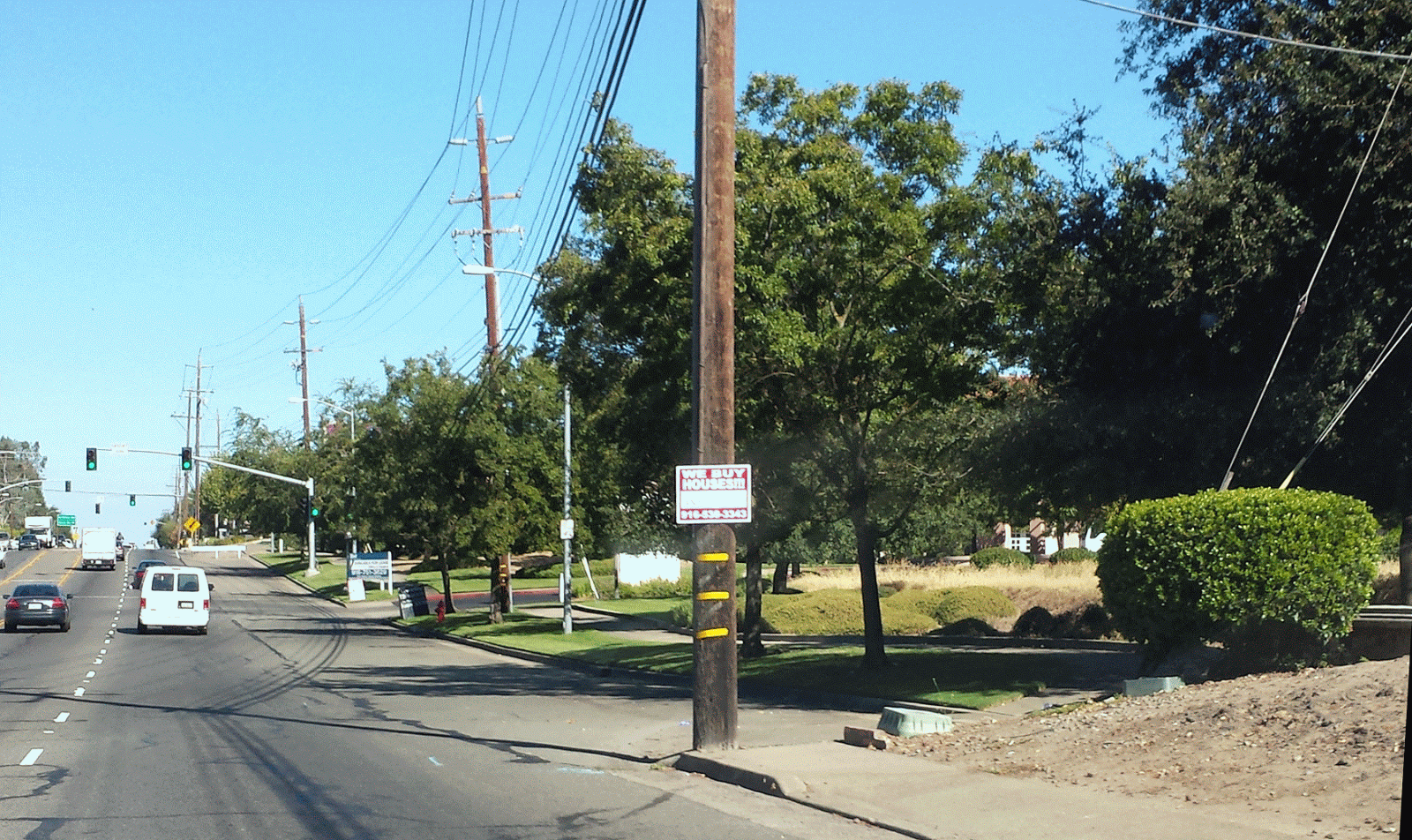
Crossing sprawl streets is dangerous for pedestrians, too. The little tertiary street in front of my (sprawl) house is 40 feet wide. That's two 12 foot travel lanes and two eight foot parking lanes. The 12 foot travel lanes are as wide as freeway lanes, and unsurprisingly constitute an invitation to speed that is so difficult to resist that the County's standards for these streets require them to bend every 1,000 lineal feet. Otherwise speeding cars would mow down the neighborhood kids. This is one of the origins of the spaghetti streets that make sprawl difficult to navigate.

To give you a sense of how disproportionately wide these little neighborhood streets are, one of the biggest, busiest shopping streets in London (Oxford Circus) has only 40 feet of pavement for autos and buses (not counting the medians). Flanking Oxford Circus are several multi-story "malls," and the street itself is busy with four lanes of those double-decked buses and autos. The takeaway: sprawl streets include a lot of unnecessary asphalt. Narrower travel lanes would not only be cheaper to build, they would be safer, slowing down the speeding cars.

The subtler effects of sprawl derive from how it degrades the public realm. Traditional communities had public squares, or parks that were in important locations where you could encounter a critical experience: being a member of a larger society. Sprawl equivalents to the public realm are private malls, where the very walls shout "Buy me!" (Gosh, I wonder why our kids are so materialistic!), and parks that occupy unimportant land--often floodplain. The chance to actually experience being a member of society, strolling among the neighbors, diminishes as sprawl spreads. Is it any wonder that the public realm is a mystery to large portions of our population?

Even the treatment of those unable to drive is less-than-optimum in sprawl. In sprawl, viable, unsubsidized transit is impossible. Typically, not enough people live near the stops to provide riders, and even when enough people do live near the stops, the street design makes walking to those stops either undignified or downright impossible.

Note the lack of sidewalks connecting
this "bus stop" to nearby residences.

Interrupted sidewalks and other barriers to access--all land use decisions--make transit something that must be subsidized. It's designed to fail.

Take a look at the picture: That sign sticking in a hill on the side of Greenback at Kenneth is an actual bus stop. No sidewalk offers pedestrians access. Just to get to the stop, you must walk on the shoulder of a street with cars traveling freeway speeds (Greenback) to reach a bus that comes roughly every three hours.


About a half a block away you’ll see this:
Sidewalks, potential destinations (health club, doctors' offices), even a turnout...but no bus stop.
Why not move the sign (at least), and perhaps install a bench? Answer: Because Sacramento transit is designed to fail--and working as designed. Even if you manage to get on a bus, the destination is often just as unpleasant. The accommodation for pedestrians are often primitive, at best. Even if your destination is the Mall, you must often walk over an ocean of hot asphalt before you reach a store.

In sprawl, those too young to drive do not even have a chance to demonstrate their own value to their family by going to the corner store. Single use sprawl separates residences from shopping by a car trip, typically, so youngsters need a ride to get that loaf of bread. Yes, sprawl is anti-feminist, turning moms into their kids' chauffeur. Those elders fortunate enough to live past their ability to drive must leave their neighborhood--because if you can't drive you can't shop--and move into that nice warehouse...er, I mean elder-care facility, where their assets are drained paying for their care.

Sprawl mentality instills in public servants a belief that we must pursue self-delusional public policy, too. We have plenty of evidence that un-subsidized transit in sprawl is impossible, yet to preserve the illusion that public policy takes care of those unable to afford cars, Regional Transit persists in providing extremely frustrating, designed-to-fail heavily subsidized transit, which rolls around a bunch of empty buses on three hour intervals. Even the vaunted light rail to Folsom is adjacent to a parking structure that has a three-hour time limit, meaning commuters with eight-hour jobs cannot use this parking if they plan to use light rail to go to work. Another delusional policy proposal: park-'n-rides. The new library design for Orangevale at least considered a 500-space parking lot for commuters to park, then take a ride on the bus. The only problem is that this is a proposal for Hazel Blvd, a street that sees 50,000+ cars per day. So...whoop-de-doo! We get to cut congestion by one percent.

Congestion is another failure of sprawl. Naturally it's much worse when everyone has to drive everywhere, but the remedies proposed--particularly road widenings--remain in the neurotic denial category. Widening roads produces what's called "induced demand." When everyone knows the street is wider, they start changing their route to include that street, and the congestion returns to the same level as it was previously. Unfortunately the road contractors do not refund the millions spent widening the road.

The Southern California Association of Governments mathematically modeled every congestion remedy, up to and including double-decking the freeways. Only one congestion remedy provided significant relief, given the possibility of induced demand: mixed use.

Sprawl costs us our health too. Even as little as a 10-minute daily walk leads to a significant reduction in late-life health problems. Sprawl builds that walk out of daily life, so we're afflicted with an epidemic of the diseases of chronic inactivity: obesity, heart and artery disease, type 2 diabetes, etc.

The insanity of sprawl land use afflicts us in many ways. It lengthens commutes, continuing our dependence on fossil fuels, making necessary our belligerent presence in the Middle East. It impairs the public realm, separating and alienating populations from each other. It impairs our health, and our families find children a burden rather than a help when they cannot drive.

It's bad.

Take another look at these costs:
  • Fires threaten edge cities
  • Doubled maintenance costs
  • Double vehicle miles traveled
  • Divide (and conquer) the population by income
  • Requires autos - a regressive "tax"
  • Discourage walking
     - Socially disenfranchise the elderly and young
     - Contribute to ill health, removing walking from daily life
  • Degrade the public realm and the experience of being a member of society.
  • Transit is, and will always be, lame.
  • Discourage youth from contributing to their families
  • Encourage dysfunctional public service (delusional transit plans, park-'n'-rides)
  • Increase Congestion
  • Encourages meddling in the oil rich portions of the planet (the Middle East).
  • Markets pay premiums for the alternative.
So it's really bad. How much worse much it get before we do something different?


Sunday, July 15, 2018

Religious Tendencies

Jesus' "Great Commandments" go like this:
"Thou shalt love the Lord thy God with all thy heart, and with all thy soul, and with all thy mind. This is the first and great commandment. And the second is like unto it, Thou shalt love thy neighbor as thyself." He continued: "On these two commandments hang all the law and the prophets."


These are not just great commandments, though, they are also "Great Observations." After all, you are unlikely to love your neighbor if you hate yourself. Similarly, you know that thing you love wholeheartedly? That's your "God." Even further, I'd suggest humans have a built in devotional tendency, and are religious whether they want to be or not.

Historically, people fought wars about which God is the correct one, and their (of necessity irrational) allegiance to whichever God their nation or tribe adopted often inspired soldiers to heroic acts. But even today, people can do amazing things in their service to ... oh, the Oakland Raiders. Sure, that's not the church-recognized God, but it has that quality of devotion the Great Observations require.

To a dictionary, religion is a "body of dogma"...but real religions have changeable dogma (an oxymoron? a doggymoron?). Typically priests preserve traditions, but prophets question and sometimes overturn or transform that preserved dogma in ways the priesthood abhors. After all, the priests were rooting for the Romans to crucify Jesus.

This is devotional tendency is true even in science-olatry. Those who worship science as the genuine way to access the truth first of all ignore the endorsement of experiment in traditional religions. Buddhists often hear disclaimers that the final authority is experience, not some pronouncement from a monk. Jesus himself told his disciples that they would know his true followers "by their fruits." In other words, see how their actions turn out. Sounds like an endorsement of experiment to me.

But secondly, science-olaters ignore how susceptible science is to the human tendency to cling to tradition or dogma, even though experiment proves it wrong. Max Planck's quanta (of "quantum mechanics") was one such case. Planck discovered energy came in discrete packets, and was, at the atomic level, not continuous. Nevertheless, the Newtonian physicists of Planck's time would not change their minds, even though quanta explain several things Newtonian physics cannot. Said Planck: "The truth never triumphs, its opponents simply die out. Science advances one funeral at a time."

As Planck predicted, quantum mechanics ultimately triumphed, but not before lots of scientists disputed it. Several science-for-pay scandals in pharmaceuticals and climate science continue to plague us today, so declaring some conclusion as the result of "science" is no guarantee of purity or truthfulness. I'd suggest the envy of the simplicity of Newtonian physics motivates lots of simple-minded pseudo-science, too. These types of advanced superstition remain a current concern.

The great world religious all have some equivalent of the of the golden rule (that second "Great Commandment"), and all have some disclaimer that experience trumps religious declaration. The first of the ten commandments forbidding idolatry says to stop worshiping symbols, and start worshiping and respecting reality, at least in some sense.

In any case, George Carlin's critique of religion aside, one of the side effects of rejecting religiosity is that people sensibly reject religious abuse, but throw the baby out with the bath water, rejecting wholesale the wisdom, the history and traditions of religions. They are certainly not perfect, but if the recent past is any indication, neither is the anti-religious secular science-olatry or the advanced superstitions which declare some Newtonian truth.


One other religious principle that remains perennial, declares how people get saved. Is salvation earned (salvation by works) or a gift (salvation by grace)? Orthodox religions throughout the world assert it is the latter, so we can't claim we deserve where we landed, but an all-too-human sense of how life is supposed to be leads men to embrace the former.

Lots of New Testament parables go over this ground: the prodigal son gets something far beyond his just deserts. The parable of the workmen who get the same pay whether they worked eight hours or one says something similar.

But, in truth, we cannot claim to have earned our current circumstances. We didn't earn the right to be born where we were rather than, say, Somalia. We didn't earn the right to mental or physical health, such as we have, even though our sense of advanced superstition leads us to punish the mentally ill as though they have done something to deserve their disease. How else can we account for the insane amount of incarceration in the U.S?

We can't lord our superior wisdom or dental work over our inferiors because we earned the right with our correct actions or better judgment. In fact, we can't even claim we earned the knowledge of the difference between right and wrong.

It may let air out of some people's self-esteem, but I have it on divine authority. We are blessed with many gifts. Even the curses we have to manage can turn out to be blessings.

So...Is "The Donald" really that bad, after all?...😉


How Political Fights are Distractions

(c) by Mark Dempsey

 Both Sasha Abramsky's recent Bee column decrying the treatment of immigrant children and the  comments from the political right in response aren't so much lying as changing the subject. Currently, 40% of America's population does not have $400 in savings to deal with an emergency. Medical bankruptcy threatens sick people. Poverty, joblessness, and their knock-on effects in crime, incarceration, homelessness and even starvation and opioid overdose are much bigger problems than Abramsky's worry about "thugs" in power and the intrusive government those opposing him decry. Separating immigrants from their children, right or wrong, is small potatoes in comparison. But whenever possible, the officious, [ahem!] I mean "official" commentariat and their sanctioned opponents prefer straining at a gnat while swallowing a camel.

America's net worth declined by 40% in the wake of Lehman's bankruptcy in 2007. Meanwhile, although Clinton's signature on financial deregulation enabled this, the same banksters whose Ponzi capitalism crashed the economy are not in jail. They're at large and doing pretty much what they did before. Letting them off with cost-of-doing-business fines was one of Barack Obama's big crimes.

Not his biggest crime, though; after all, he didn't prosecute the war crimes of Bush/Cheney, either... and yes, it's still a war crime to torture. Obama didn't prosecute the torturers, he promoted them and prosecuted the whistle blowers.

Boss Tweed's saying "I don't care who people vote for as long as I can pick the candidates" seems to apply here.

Meanwhile, from the political right, critics of government believe they can simply ignore systemic problems and attribute all genuine progress to individual effort only. What's a systemic problem? If you throw 95 bones out your back door, then let 100 dogs retrieve them, no matter how responsible, skilled and law-abiding those dogs are, five are not going to get a bone. We're short of jobs. No matter how well-trained and responsible are job seekers, both wages and labor participation are not going to rise until that shortage declines.

Another systemic problem: those "illegal aliens" (actually "undocumented workers"). The U.S. has been attacking its neighbors south of its borders literally for centuries. Between 1798 and 1994, the U.S. was responsible for 41 changes of government in the Caribbean, Central and South America. Then-Secretary of State Hillary Clinton even persuaded the Obama administration to tolerate a military coup in Honduras. Their democratically-elected government was going to raise the Honduran minimum wage from 60¢ an hour (the nerve of those people!)...so the generals had to take over, obviously. Meanwhile, 30,000 unaccompanied Honduran minors came north to avoid the ensuing chaos.

The U.S. attacks economically, too. Conspiring with Newt Gingrich, Clinton signed NAFTA, and real wages in Mexico declined 34%. One has to return to the Great Depression to find a wage drop like that in the U.S. and that prompted no great migration...oh wait! the Okies!

One might guess that shipping a lot of subsidized Iowa corn to Mexico would adversely effect  Mexican subsistence corn farmers. Sure, corn is only arguably the most important food crop in the world, and those Mexican corn farmers were keeping the diversity of the corn genome alive, but they weren't making any money for Monsanto, darn them! So ... let them come north to mow our lawns and paint our houses.

The right-wing critique of government also doesn't mention the advantages of big, enlightened sponsors of research, either. For example: 75% of pharmaceutical innovation comes from government-sponsored research. Most of the iPhone components that matter (transistors, microprocessors, lithium-ion battery, touch screens, the internet, GPS, etc.) are the product of government-sponsored research (see the graphic here).

 Government is the way we handle systemic problems; individuals cannot do that.

I do regret U.S. aggression, but, like racism, religious prejudice and xenophobia, the undocumented are a distraction.  Calling each side of the political aisle names ("thugs" "liars") is also a distraction.These distractions divide and conquer the population so that ignoring systemic problems can remain respectable, and ignoring the crimes of one's own party can continue. The debate between pro- and anti-immigrant factions are distractions, and distractions win as long as we don't get some candidates Boss Tweed didn't pick.

Conventional and Unconventional Economics

(c) by Mark Dempsey 1. The Conventional Economics Narrative   The conventional story says national debt is a (growing) problem. The bigger i...