Friday, March 15, 2019

A Way-Too-Early Handicapping of the 2020 Presidential Race


by Thomas Neuburger

There are two groups of candidates in the Democratic candidate field. The first group contains people like Bernie Sanders. The second group contains all other candidates whom corporate Democratic power brokers will find acceptable. 

That makes handicapping this field pretty easy, at least so far. Note that it's very early days still, so this is a way-too-early set of predictions. 

Characterizing the Pool of Voters

Before we begin, however, the pool of voters must also be grouped, since they have a role in the coming drama. The three main groups of voters are:
  1. Rebels against the pre-Trump status quo (2020 "change" voters).
  2. Those comfortable with the pre-Trump status quo ("Obama was just fine").
  3. Trump-and-Trump-only voters
There's a certain overlap between groups one and three, but group three rules out all who might vote for any non-Trump candidate. That is, group three isn't all Trump supporters, just his most rabid ones. There could be plenty of Trump voters in the first two groups. 

According to the latest Reuters/Ipsos poll, Trump's overall approval is at 39%. The percentage of Republicans, from the same poll, who think the country is on the wrong track is 29%, with 10% not sure. That is, only 60% of Republicans think the country is on the right track, though almost all of them would consider voting for Trump in 2020.


So let's take a guess at the percentage of "Trump and Trump only" voters in the electorate. The latest Gallup poll divides the electorate this way:


That is:
  • Independents: 42%
  • Democrats: 30%
  • Republicans: 26%
This means that perhaps 15% of the electorate (60% of 26%) is in group three, with the rest, or 85% of the electorate, in the other two groups. That's a lot of people who might vote for someone other than Trump.

Whom Will the Democratic Nominate in the General Election?

Let's go back to our grouping of Democratic candidates. A recent Morning Consult poll lists the leaders this way:


I would put Bernie Sanders and Elizabeth Warren (unless she spins herself out of this group by a terrible misstep) in the "like-Sanders" group — real threats to the status quo, at least on economic policy. Let's call these "actual change candidates," people who don't just preach change, but whom voters can count on to deliver it. 

I would put each of the others:
  • Joe Biden
  • Kamala Harris
  • Beto O'Rourke
  • Cory Booker
  • Amy Klobuchar (who has no chance at all)
  • Somebody Else
in the second category. Let's call them "status quo ante" or "next Obama" candidates — people who want to return to the pre-Trump years when they thought everything was just fine — or at least fine enough — in America. This group may preach "change," but it will clearly be change at the margins of a reasonably OK system. And they will signal that either advertently or inadvertently. 

To take the case of Amy Klobuchar, for example, she signaled that inadvertently just recently with her student loan proposals. 

For the following, let's assume that (a) Trump is the Republican nominee and (b) all Democratic candidates get all Democratic voters (according to the Gallup division) to vote for them. 

Case 1: If one of the Democratic "actual change" candidates — someone who espouses broad Sanders-like Democratic Socialist policies and is believed to be credible by the majority of Sanders most eager supporters — is nominated by the Democrats, that person could easily capture not just all of the Democratic voter pool, but a very large percentage of the independent voter pool and a good chunk of those 29% of Republicans who think the country is on the wrong path. 

If that person got the 30% who identify as Democratic, most of the "wrong track" independents, and just some of the 29% of dissatisfied Republicans (remember that much of Trump support came from change voters in a change year), that person could command perhaps 56% of the electorate, if not more:
  • 30% among self-identified Democrats
  • 22% or more among independents
  • 4% among "change" Republicans who think Trump is on the wrong track
That puts a Democratic Socialist in the White House. Remember, the total percentage of "wrong track" independents is 62%, or a full 26% of the electorate — assuming they all vote. 

Case 2: If one of the "status quo" candidates is nominated, however, things look different. A true status quo candidate will have to sell him- or herself to independent voters using a small set of appeals. These are:

1. "The Obama status quo is plenty good enough. Don't be scared by all this change-making."

2. "I'm really a change candidate, though my past belies that. I'm just not as change-y as those I like to call ' radicals'." 

3. "I have so much charm, you don't care what I think." 

About the latter appeal, Joe Biden himself espoused something like that in the 1970s (quoted here): “I don’t think the issues mean a great deal in terms of whether you win or lose,” Biden told Washingtonian back in 1974. “I think the issues are merely a vehicle to portray your intellectual capacity to the voters . . . a vehicle by which the voters will determine your honesty and candor.” 

By "honesty and candor" he meant "charm and charisma," since honesty he had none of, even back then. 

If he runs, Joe Biden will sell himself as keeper of the Obama status quo, plus folksy charm. Harris, Booker and Klobuchar (before she drops out) will each use the second appeal: "Despite my past, I'm change-y enough." O'Rourke's primary sell is eager charisma; none of his past looks remotely like change, despite the inexplicable addition to his campaign organization of some of the 2016 Sanders alums. 

Where Does That Put Them in the General Election?

Again, each will get the 30% of the electorate that identifies as Democratic. Very few staunch Party supporters will withhold their votes from any Democratic nominee in 2020. 

Because none of them is a credible change candidate in Republican eyes, very few Republican voters will switch sides if any of these candidates is the Democratic nominee. That puts 26% of the voters against them. 

How will independent voters split? According to Reuters/Ipsos, 21% of independents think the country is on the right track, with another 17% unsure. If Trump picks up all of the "right track" independents and a little more than half of the not-sures, his vote totals so far look like this:
  • 26% among self-identified Republicans
  • 9% among "right track" independents
  • 5% among "not sure" independents
With 40% of the electorate already in his pocket, Trump has to win just 17% of the "wrong track" independents to cross 50% of the electorate as a whole.  

Again, 62% of the independent voters in America think the country is on the wrong track. Will they vote for Trump, a status quo Democrat, or stay home? They didn't vote for Clinton in enough numbers to guarantee her a sure win. Will they stay home in sufficient numbers twice?

2020 Presidential Outcomes

It comes down to this. If the Democrats nominate a genuine change candidate, she or he will likely win comfortably. I could easily see a 55-45% popular vote split, with an even greater margin in the Electoral College. 

If the Democrats nominate a "status quo" or "change-y enough" candidate, on the other hand, the race could be tight, as it was in 2016. 

The key is the "wrong track" independents. Will they vote for Trump, vote just to vote against Trump, or stay home? Remember, shrinking the voting pool means shrinking the number of "wrong track" independents who actually vote; many of those lost votes will be lost by the Democrat. 

To show you what I mean, if all independents stayed home, the split between Democratic and Republican voters is just 4%. But 9-14% of independents are likely Trump voters. If only they vote, Trump has a 10% cushion among independents that the Democrats must make up. Can a status quo, change-y enough, or charisma-only candidate do inspire them to  vote? 

45% of all U.S. voters stayed home in 2016, a 20-year low. While all of them weren't independents, that's ironically the percentage of independent voters in 2018.

What Will Democrats Do?

What follows is even more speculative than the rest of this piece, but there's some history to back it up. 

1. Unless Sanders or a Sanders-like candidate has such a large lead that the race can't be stolen, the "status quo" (pro-corporate) leaders of the Democratic Party, with media help, will try to steal it. 

2. If the theft is so obvious that even NPR news watchers notice, it will drive down Democratic support among independents, who are largely a pro-change group if they see someone they like, and non-voters if they don't.

3. That won't matter to Party leaders. Assuming there hasn't been a palace coup that replaces them, they will run an even more strident version of the 2016 campaign: "Trump?! You want to leave Trump in office?!"

(This is where "Someone Else" comes in, by the way. If each of the other not-Sanders candidates stumbles, Someone Else will be put forward. There are some interesting names in this list.) 

4. If a non-Sanders-like candidate is nominated, the 2020 election will be a squeaker, as was 2016, with the incumbent (because this time there is one) likely winning. 

5. If the incumbent is Pence, the same applies.

Of the standard-issue Democrats, the most likely nominees at this point, and also the most vulnerable to attack in the eyes of independents and millennials, are Joe Biden (see here for a very long list of his sins) and Kamala Harris, the aggressive, anti-pot pot-smoking prosecutor.


Of course, something surprising could happen between here and there — this is a way-too-early handicapping of the race. And frankly, I hope something surprising does happen; for example, I would love to see the palace coup I mentioned above, though I'm not holding my breath. 

The wild card seems to be the amount of support the Sanders-like candidate gets. If that person's support is wildly off the charts, if she or he is ahead by miles, the refs can't steal the primary. Otherwise, it's going to be bumpy ride all the way into November.

Monday, March 4, 2019

Paul Krugman Asked Me About Modern Monetary Theory. Here Are 4 Answers.

Deficit levels, interest rates and the tradeoff between fiscal and monetary policy.
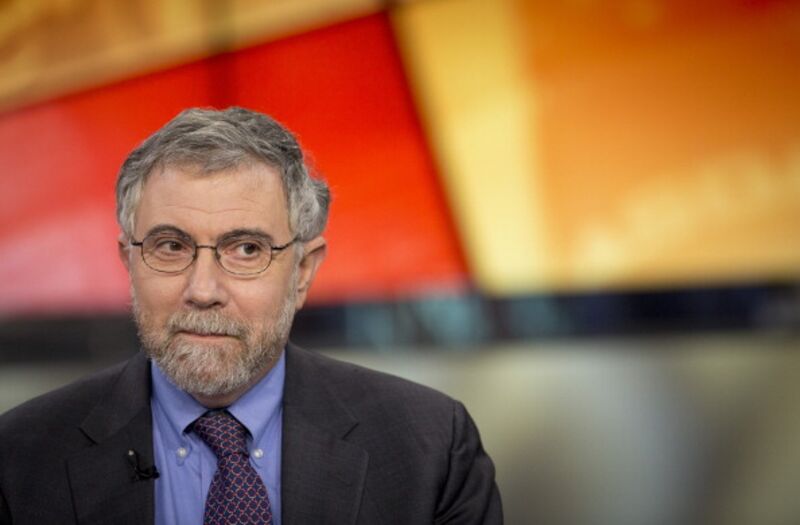
Paul Krugman during a Bloomberg Television interview in 2013.
There is a doctrine among mainstream economists holding that: (1) government deficits push interest rates higher and (2) rising interest rates crowd out private investment. The government can take more of the economy’s financial resources, but only at the expense of lost private investment. This means that running budget deficits has at least some downside.
Paul Krugman is a believer in this doctrine. I’m not, and he’s asked me to explain why. He is responding to a columnI wrote critiquing his view of modern monetary theory.
I’m going to respond directly to the questions he raised: 
Are MMTers claiming, as Kelton seems to, that there is only one deficit level consistent with full employment, that there is no ability to substitute monetary for fiscal policy? Are they claiming that expansionary fiscal policy actually reduces interest rates? Yes or no answers, please, with explanations of how you got these answers and why the straightforward framework I laid out above is wrong.
Quick responses first, followed by explanations behind my thinking.
#1: Is there only one right deficit level? Answer: No. The right deficit depends on private behavior, which changes. MMT would set public spending always to the level required to achieve full employment, and then accept whatever deficit may result.
#2: Is there no ability to substitute monetary for fiscal policy? Answer: Little to none. In a slump, cutting interest rates is weak tea against depressed expectations of profits. In a boom, raising interest rates does little to quell new activity, and higher rates could even support the expansion via the interest income channel.
#3: Does expansionary fiscal policy reduce interest rates? Answer: Yes. Pumping money into the economy increases bank reserves and reduces banks' bids for federal funds. Any banker will tell you this.
#4: Does MMT accept Krugman’s “straightforward framework”? No. We can come back to this at the end.
Is there only one right deficit level? No, because for one thing, MMT would establish a public option in the labor market — a federally funded job guarantee — thereby ensuring full employment across the business cycle. The deficit, then, would rise and fall with the cycle, as the job guarantee becomes a new stabilizer, automatically moving toward the “right size” in response to changes in the level of aggregate spending.
In the absence of a job guarantee, things get trickier. Leaving monetary (and exchange rate) policy aside, the government has to allow the deficit to go where it needs to go in order to accommodate the private sector’s net savings desires. If the private sector wants to spend less and save more, the public sector will need to accommodate that desire by running a bigger deficit or the economy will be pushed away from full employment. Krugman drew up the perfect schematic — based on the sector balance framework adopted by MMT — to explain all of this 10 years ago.
Is there no ability to substitute monetary for fiscal policy? Not much. Krugman sees MMT as saying that fiscal policy can always deliver the “right size” deficit to maintain full employment. He’s challenging that by asserting that you can have any size deficit and still have full employment because the central bank can always establish the “right size” interest rate to get you there. I disagree.
It is true that the Fed can pursue any rate policy it desires. It does not follow, however, that cutting interest rates will work to induce enough spending to maintain full employment. You can’t simply assume borrowers will always have the appetite for more private debt, even if you make it really cheap to borrow. Businesses borrow and invest when they’re swamped with customers (or expect to be). They don’t passively take on more debt simply because the central bank has dangled cheaper credit before them.
The evidence suggests that interest rates don’t matter much at all when it comes to private investment: J.P. Morgan (hereand here), the Reserve Bank of Australia (here), the Federal Reserve (here) and the Bank of England (here). It is even possible, as MMT has shown, that cutting rates could further slow the economy because lowering rates cuts government expenditures (interest payments), thereby exacerbating contractionary fiscal policy.
This is in fact what modern monetary theory suggested when the European Central Bank went to negative rates, which MMT sees as a contractionary tax. But MMT recognizes that raising rates could offset contractionary fiscal policy, though in a highly regressive manner as the interest paid by the government tends to go to those with the highest incomes.
Does expansionary fiscal policy reduce interest rates?Yes, unequivocally. You won’t see it in Krugman’s stylized graphic (below), but it does happen in the real world, where the interbank market exists.
Imagine the government is running a trillion-dollar deficit, sending out checks for military weapons, contracting to do massive infrastructure projects, and so on. All of those checks get deposited into financial institutions across the country. And each time a check is deposited, the bank gets a credit to its reserve account at the Fed.
When you pay your taxes, your bank loses reserves, but with a trillion-dollar deficit, there is a huge net infusion of reserves into the banking system. If the central bank takes no action to prevent it from happening, the overnight lending rate — the federal funds rate — will fall to a zero bid.
Why? Because all banks are flush with non-interest-bearing reserves, and everyone is scrambling to lend them to another bank. When everyone’s a seller and no one’s a buyer, the price goes to zero. To prevent this, the central bank steps in.
Before the collapse of Lehman in 2008, the Fed conducted open-market operations (selling bonds to mop up enough reserves to get the interest rate up). This was all coordinated with the Treasury Department on a daily basis, as I explained here.
Today, the Fed simply pays interest on reserves to establish a positive rate. That doesn’t change the fact that deficits, in and of themselves, put downward pressure on the short-term interest rate.
Yes, the Fed has a reaction function, and it can vote to raise rates in response to perceived inflationary pressures associated with deficit spending. But that is a different matter. That is fighting against the “natural” gravitation.
Is there some reason the straightforward framework Krugman laid out is wrong? Yes, as even its creator went on to acknowledge. MMT rejects the IS-LM framework that Krugman uses to demonstrate the conclusion that widening budget deficits put upward pressure on interest rates and crowd out private investment.
The model remains the workhorse for many mainstream Keynesians. MMT considers it fundamentally flawed. It is incompatible with much of Keynes’s “The General Theory of Employment, Interest and Money.” It was designed for a fixed-exchange rate regime, and it is not stock-flow consistent.
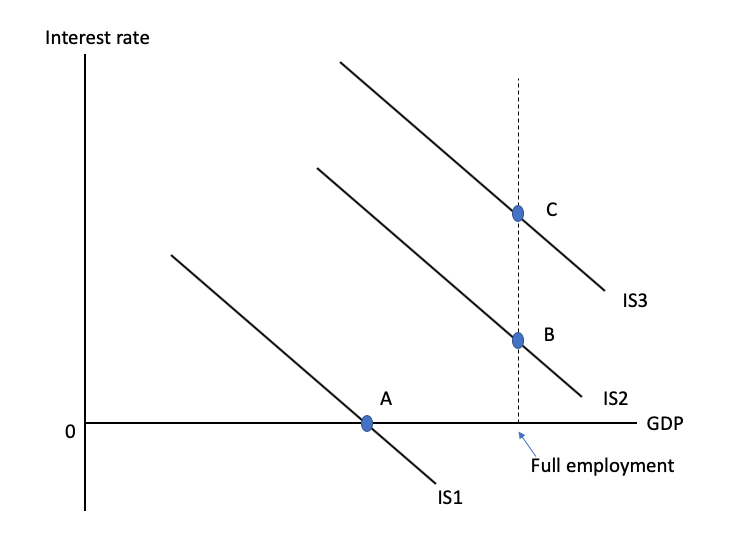
Here’s the framework Krugman presents as a challenge to MMT.
relates to Paul Krugman Asked Me About Modern Monetary Theory. Here Are 4 Answers.
Each of the IS curves (1-3) represents a different fiscal stance. This framework shows that the government can expand its deficit and move the economy from a depressed condition at point A to full employment by shifting IS1 to IS2. The economy is now at full employment, but with higher interest rates and lower private investment.
Keep this in mind: Higher deficits give rise to higher interest rates, which give rise to lower investment. The last bit is referred to as “crowding out.” This is the inherent tradeoff that MMT denies and Krugman defends.
And it’s easy for him to defend it because his model assumes a fixed money supply, which paves the way for the crowding-out effect!
Krugman’s framework treats investment as a simple function of the interest rate. Higher rates mean lower investment, and vice versa. Central banks can juice (or slow) the economy simply by lowering (or raising) interest rates. It’s Pavlovian in its simplicity: stimulus-response.
Keynes’s analysis was more nuanced. Investment decisions were forward-looking, heavily influenced by “animal spirits,” and overwhelmingly dependent on the state of profit expectations. When the profit outlook is sufficiently grim, no amount of rate cutting will entice businesses to borrow and invest in new plant and equipment (think Great Recession).
Conversely, when the outlook is exuberant, businesses may borrow and invest even more, despite the central bank’s desire to slow an expansion by raising interest rates (think savings and loan crisis). The downward-sloping IS curve does not allow for either of these possibilities. Yet both outcomes can, and do, occur.
One final point. Krugman says there is an inherent tradeoff between fiscal and monetary policy. I agree, but not with the tradeoff he describes. Deficits don’t automatically drive interest rates higher, and higher interest rates don’t automatically translate into lower private spending.
That tradeoff is disputed, and not just by MMTers. The tradeoff that matters is the one that Hyman Minsky and James K. Galbraith have highlighted. Monetary policy “works” by driving people into debt. Fiscal policy works by driving income into people’s pockets. As Galbraith put it:
There are two ways to get the increase in total spending that we call ‘economic growth.’ One way is for government to [deficit] spend. The other is for banks to lend. For ordinary people, public budget deficits, despite their bad reputation, are much better than private loans. Deficits put money in private pockets…This is called an increase in ‘net financial wealth’… In contrast, when a bank makes a loan, the cash is not owned free and clear.
That’s the tradeoff that interests me. Should we lean more heavily on (monetary) policy that works by leveraging the private sector’s balance sheet or on (fiscal) policy that works by strengthening it?
So, there you have it. Two no’s, a not really and a yes in response to Krugman’s questions. (Un)fortunately, this will be the last response from me, since my editors have asked me to continue any further discussion offline. I thank Paul for engaging me and am more than happy to do this.

Sunday, March 3, 2019

An MMT response on what causes inflation (Financial Times)

 
This week in testimony to the Senate Banking Committee, Jay Powell, Chairman of the Federal Reserve, offered a verdict on modern monetary theory. "The idea that deficits don't matter for countries that can borrow in their own currency I think is just wrong," he said. It was a victory for the movement, of sorts: modern monetary theory is now unavoidable. It now must be addressed in a committee hearing of the US Senate.
It's an idea being contested right now on finance and economics Twitter, which sounds like a silly thing to say but is not, because the people who read and write econ Twitter are the people who explain economics in newspaper articles and academic papers for the rest of the world.
Which is how yesterday we got an emai from three MMTers: Scott Fullwiler, Professor of Economics at the University of Missouri, Kansas City; Rohan Grey, a Doctoral Fellow at Cornell Law School; and Nathan Tankus, Research Director of the Modern Money Network. They wanted a chance to respond to several recent articles, our piece on how the US financed the second world war among them. Here, in their own words:
For two decades we and our like-minded colleagues have been putting forward the idea that a monetarily sovereign country like the United States with debts denominated in its own currency and a floating exchange rate cannot “go broke”. We have been writing about this and all the myriad implications this has for macroeconomics under what has come to be known as Modern Monetary Theory.
Excitingly, last month representative Alexandria Ocasio-Cortez brought attention to our views when she said that MMT should be “part of the conversation". This set the economics and finance media ablaze with renewed commentary. In a major step forward, the broad consensus of these pieces in a series of outlets has been to agree with my colleagues and I that the only limit on government spending is inflation. The acceptance of this crucial tenet of MMT is very welcome and new. It was not too many years ago that throughout the economics press it was commonplace to present MMT as a wild new theory and speak in worried uncertain terms about the possibility that bond markets would refuse to buy US treasury securities, causing a debt crisis. We are thrilled to move past this stage in the public macroeconomic debate.
Unfortunately, while the press has been willing to agree with this major proposition, it has not been willing to follow its implications. Josh Barro writing in New York Magazine particularly articulates what seems to be the emerging response to MMT in the press:
If the government prints and spends money when the economy is at or near full employment, MMT counsels (correctly) that this will lead to inflation, and prescribes deficit-reducing tax increases to reduce aggregate demand and thereby control inflation. See how we have ended up back where we started? Whether you take a Keynesian view or an MMT view, if the government spends more, it’s likely going to need to tax more, sooner or later. [...] Whatever the Federal Reserve’s demerits, the idea of depending on Congress to pass surplus-generating tax increases in order to keep the economy stable and prevent runaway inflation gives me hives.
Contrary to Barro’s assertions, we have not “ended up back where we started." MMT’s approach to budgeting and designing a macroeconomic policy framework for a Green New Deal with price stability is radically different from current Congressional practice and there are no other modern proposals like it.
First, when we suggest that a budget constraint be replaced by an inflation constraint, we are not suggesting that all inflation is caused by excess demand. Indeed, from our view, excess demand is rarely the cause of inflation. Whether it's businesses raising profit margins or passing on costs, or it’s Wall Street speculating on commodities or houses, there are a range of sources of inflation that aren’t caused by the general state of demand and aren’t best regulated by aggregate demand policies.
Thus, if inflation is rising because large corporations have decided to use their pricing power to increase profit margins at the expense of the public, reducing demand may not be the most appropriate tool. The recent controversies over rising housing rents and drug prices demonstrate that we need alternative tools in place to manage the power of big business and ensure their pricing policies are consistent with public purpose. The experience of the last decade inadvertently reflects the potential strength of alternative inflation-fighting tools, as one of the reasons inflation has remained below target for the past ten years is legislated cuts to medicare and medicaid payments.
Because of the pricing power of big companies, whichever administrative agency or agencies is responsible for managing aggregate demand should not be responsible for overall inflation on its own. It should either share joint responsibility for keeping inflation on target with other agencies responsible for regulating business pricing power or new price indices should be constructed that exclude concentrated markets where prices are clearly acyclical.
Second, we do not believe that any and all inflation that does result from excessive demand can and should be addressed by higher taxes. This is a distortion of our view, as years of publications can attest. When MMT says that a major role of taxes is to help offset demand rather than generate revenue, we are recognising that taxes are a critical part of a whole suite of potential demand offsets, which also includes things like tightening financial and credit regulations to reduce bank lending, market finance, speculation and fraud.
Assessing the potential inflationary effect of new spending proposals also requires seriously assessing how underutilised our existing resources are. This requires detailed, expert analysis from a range of industry analysts; not just statistical regressions on aggregate economic data by macroeconomists.
At the same time, we must also confront the fact that the fossil fuel, real estate, defense, and financial industries are too large, too dirty, and eat up too much of our national resources. They must be shrunk one way, or another. Thus, another way to offset excessive demand pressure is to tighten environmental and other forms of regulation, which would disemploy people and resources in those industries, and free them up to be redeployed in green production as part of the broader economic transformation of the Green New Deal. Our current political leaders tend to oppose such an approach on the grounds that demand is limited and jobs are a rare, scarce commodity, so each existing job must be preserved at all costs. MMT allows us to recognise that the government can commit to real full employment. We can instead focus on increasing the quality of jobs and ensuring our economy generates prosperity for everyone.
In addition, we must recognise that the Green New Deal is about creating new resources over the medium term, which will in turn expand green output to further accelerate the decarbonisation process. This is not our current approach. Instead the Congressional Budget Office continually defines potential capacity down from what it actually is, creating a vicious self-fullfiling cycle defined by low productivity and lost output. To address this failure, the Congressional Research Service (as well as other budget advisory organizations) will need to be enlarged to do the analysis necessary to find the right mix of inflation offsets that best move forward the task of decarbonizing our economy. There is no alternative if we are going to succeed at averting climate change.
Regardless of which policy tool is used in a particular context, demand management in general needs to lean much more heavily on the appearance of bottlenecks in specific industries instead of simply tracking changes in a general price index. The immediate signs of bottlenecks are large and sustained rises in unfilled orders for specific goods and services. Preventing shortages is after all what demand management is first and foremost about and price indices are misleading policy targets when they include factors that are insensitive to demand and would be counterproductive to manage with demand. The more actively we regulate big business for public purpose, the tighter the full employment we can achieve and the more resources we can devote to the Green New Deal while preserving price stability.
Third, when we do advocate using tax increases to address inflationary pressure, we are not suggesting that Congress attempt to raise taxes in real time after inflation has already emerged. Indeed, our approach is precisely intended to avoid a situation in which Congress merely spends without paying attention to inflation dynamics until it is too late. Thus, we argue varying tax rates and other inflation offsets should be included in the budgeting process from the outset. In our approach, an MMT-informed Congressional Budget Office would produce detailed reports of how specific spending or lending proposals would increase demand and which sectors and regions would be most affected, and would monitor inflationary pressures closely to determine the appropriate policy response based on specific conditions. This would be a radical improvement over the current CBO scoring process, which looks only at dollar values in aggregate, and treats all sources of revenue as equal. This crude approach can easily lead to mistaken conclusions, like that Elizabeth Warren’s wealth tax could adequately “pay for” large spending proposals, when in reality, such a tax would not be likely to reduce overall demand by very much in the areas that the new government spending would be directed towards (even if it was still desirable from an equity standpoint).
Beyond an improved Congressional budgetary process, there are well-established approaches to policymaking that can assist us in managing inflationary risks. For example, we have long recommended strengthening automatic fiscal stabilisers. Indeed, our principal policy recommendation is a Job Guarantee (which is part of a Green New Deal) which automatically creates more jobs as people need them, but does not continue to spend greater and greater amounts once the economy reaches full employment. Other ways we can strengthen automatic stabilisers include savings policiesand no longer indexing tax brackets or indexing them to an inflation target instead and introducing more tax brackets so that as incomes rise faster than the inflation target a higher percentage of income is progressively taxed. With these tools there is much less need to rely on day-to-day discretionary decision making like is currently the case with the Federal Reserve’s management of interest rates.
That said, we are not against one or more agencies being given additional tools to collectively manage demand on a discretionary basis. It is unclear where this myth came from but it doesn’t come from our extensive publication record- in academic journals or in the blogosphere. One of us long ago suggested in the Financial Times the goal of delegating responsibility for day-to-day demand management to an independent agency was a good one but that the Federal Reserve was the wrong agency. As we said then:
Whereas Bernanke only hinted at the need for a fiscal partner, former Fed Chairman Marriner Eccles openly advocated the use of fiscal policy as the most effective way to fight both unemployment and excessive inflation. In the depths of the Great Depression, Eccles pushed for a payroll tax cut, calling it ‘the most important single step that can be taken’ to stimulate consumer buying power. Years later, just prior to the near tripling of US war expenditures, Eccles urged lawmakers to raise the payroll tax in order to stave off an inflationary episode. Indeed, as his Special Assistant made clear in the following letter, Eccles considered adjustments in fiscal policy (in this case an increase in the payroll tax) to be ‘the most effective anti-inflationary means of reducing purchasing power.
Commenters are not wrong that some of these proposals and tools will be controversial. What is ignored by this criticism is the fact that our current approach of managing inflation on the backs of a very indebted and underemployed public is also controversial. Indeed, the Federal Reserve has historically been a conservative institution biased against full employment. To ensure the Green New Deal creates and maintains true full employment, we will need a new macroeconomic framework that brings in many currently excluded institutions and stakeholders, and abandons our reliance on interest rate adjustments as a primary tool for stabilising demand.
Modern monetary theory has a range of policy implications that bring us to an entirely different policy world, rather than back where we started. A Green New Deal must include some mixture of the policy instruments we’ve laid out if it successfully plans a new green full employment economy with price stability. Budgeting the traditional CBO way will focus attention on the wrong issues and fail to offset the inflationary potential of this necessary new spending. As we’ve said, there are a number of taxes -- especially on the rich -- which offset much less GND spending than their dollar amounts would imply. This does not mean that we shouldn’t tax the rich -- they are too rich. It just means Congress needs to look elsewhere if they’re going to fully offset the inflationary potential of this spending. We can afford a Green New Deal and we can accomplish it as well. We just need the right policy tools to make sure it's successful.

Friday, March 1, 2019

Deregulating Banks Fueled Speculation, Not Productive Investment

By Josh Ryan-Collins, PhD, Head of Research at University College London’s Institute for Innovation and Public Purpose. He was previously Senior Economist at the New Economics Foundation (NEF). Originally published at Evonomics 
In academic and policy circles there is deep mistrust of public sector involvement in credit allocation, much more than in the credit allocation decisions made by commercial banks. This mistrust continues, despite the financial crisis of 2007–08 demonstrating the huge dangers of a deregulated credit market. Whilst, post-crisis, financial regulators have begun to develop policies aimed at reducing lending in certain sectors, calls for proactively directing finance to support desirable sectors of the economy have largely been ignored.
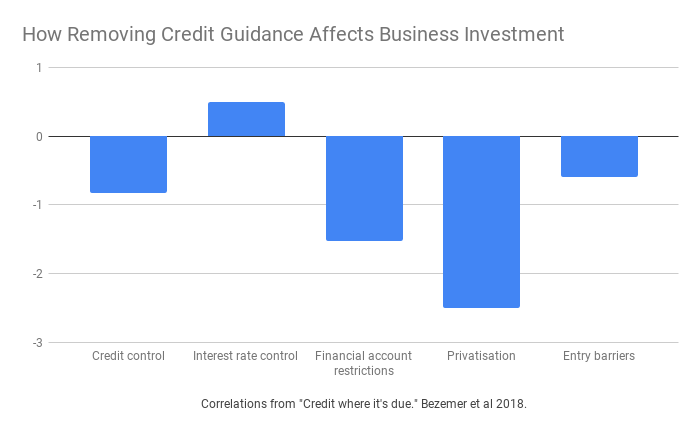
In a new UCL Institute for Innovation and Public Purpose (IIPP) working paper, co-authored with Dutch economists Dirk Bezemer and Lu Zhang and Frank van Lerven, we examine the theoretical, historical and empirical evidence around credit policy and its effects on the allocation of credit.
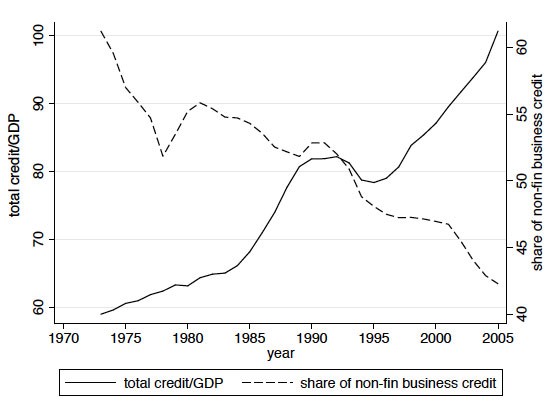
Our motivation, aside from the crisis, is the remarkable ‘debt shift’ in advanced economies over the past 40 years which has seen banks move away from their primary textbook role of lending to non-financial firms to support productive investment. Whilst total bank credit has roughly doubled relative to GDP since the early 1970s in advanced economies, the share of credit supporting firms has actually fallen, from 60% to 40%. The vast expansion in lending has been mainly to support households to buy houses and, to a lesser extent, consumer goods and the purchase of financial assets.
Total credit and business credit share in advanced economies, 1973–2005. Data is averaged across 17 advanced economies.
Mortgage and other asset-market lending typically does not generate income streams sufficient to finance the growth of debt. Instead, the empirical evidence suggests that after a certain point relative to GDP, increases in mortgage debt typically slows growth and increase financial instability as asset prices rise faster than incomes.
These new empirical findings support a much older body of theory that argues that credit markets, left to their own devices, will not optimise the allocation of resources. Instead, following Joseph Schumpeter’s, Keynes’ and Hyman Minsky’s arguments, they will tend to shift financial resources away from real-sector investment and innovation and towards asset markets and speculation; away from equitable income growth and towards capital gains that polarises wealth and income; and away from a robust, stable growth path and towards fragile boom-busts cycles with frequent crises.
This means, we argue, there is a strong case for regulation, including via instruments that guide credit. In fact, from the end of World War II up to the 1980s, most advanced economy central banks and finance ministries routinely used forms of credit guidance as the norm, rather than the exception. These include instruments that effected both the demand for credit for specific sectors (e.g. Loan-to-Value ratios or subsidies) and the supply of credit (e.g. credit ceilings or quotas and interest rate limits).
In Europe, favoured sectors typically included exports, farming and manufacturing, while repressed sectors were imports, the service sector, and household mortgages and consumption. Indeed, commercial banks in many advanced economies were effectively restricted from entering the residential mortgage market up until the 1980s. Public institutions — state investment banks and related bodies — were also created to specifically steer credit towards desired sectors.
The financial liberalisation and deregulation of the 1980s saw the gradual removal of credit guidance and credit control policies which were seen to distort the efficient allocation of capital. This was a key element of the ‘Washington Consensus’ pushed by the World Bank and the IMF to developing countries. Many State Investment Banks were also privatised.
Our empirical investigation of the relationship between credit policy and credit allocation examines two time periods with different samples. Firstly, for the 1973 to 2005 period, for advanced economies, we find that the liberalisation of credit markets and removal of credit guidance is significantly associated with a lower share of lending to non-financial firms, supporting the Schumpeter-Keynes-Minsky hypothesis.
In a second sample sample, for the 2000 to 2013 period, we use a wider sample of countries, including emerging markets. In this period, there has been somewhat of a shift by financial regulators back towards the use of credit controls, following the emerging market economy crises’ of the late 1990s and early 2000s and, in advanced economies, following the global financial crisis of 2007–08. However, for this period we do not find a significant relationship between the introduction of these ‘macro-prudential’ policies and the share of lending to non-financial firms.
We hypothesise this may be related to post-2000 interventions being primarily focused purely on financial stability concerns rather than economic growth and the need to steer credit towards productive sectors of the economy. We conclude that both types of credit policy may be needed.
The debate about the pros and cons of credit guidance is not a closed case and the empirical evidence presented in our paper raises as many questions as it answers. More detailed empirical and qualitative research, examining examples where credit guidance policy has been both successful and less so, is required going forward.
However, given the huge challenges facing modern economies, not least the need to rapidly transition to low-carbon economies, financial policy-makers should be encouraged to experiment with credit guidance policies to support sustainable and inclusive growth, while also maintaining a focus on financial stability issues. To do so, greater collaboration between central banks and ministries of finance and industrial policy will likely be necessary.

Sacramento County Jail Goes Off The Rails

© by Mark Dempsey “I don’t care who people vote for as long as I can pick the candidates.” - William “Boss” Tweed. In perhaps the least surp...