Saturday, October 5, 2019

Monday, September 30, 2019
Archimedes anticipates calculus...by nearly two millenia
The following comes from The Archimedes Codex, a book about the discovery of an ancient manuscript from Archimedes--the guy whose "Eureka!" moment heralded the discovery of specific gravity.
The book itself reads like the real-life adventures of Indiana Jones, but it also recounts Archimedes' proof of how one calculates the area of a parabolic segment (the yellow that includes triangle ABC below) as a proportion of the triangle it encloses. The added lines are part of the proof.

Among other his other enterprises, Archimedes was the architect of the defenses of Syracuse, a rival to Rome who sided with Carthage. When the Romans finished off the Carthaginians, they came after Syracuse, a Greek colony off the "toe" of Italy's "boot." At first Archimedes' defenses were too much for them, but eventually, some Syracusan defenders got drunk, the Romans got in, and that was the end of Archimedes. A cautionary tale.
What’s remarkable about this proof is that Archimedes uses infinity -- something both outside the province of Greek mathematics, prefiguring calculus. Since Archimedes lived around 270 BC, it was quite the leap.
One more astonishing thing about this proof is that he uses no numbers. In fact, he had nothing like Arabic (actually Indian) numerals.
A few comments about the drawing:
The line CZ is a tangent to the parabola (sorry, primitive drawing tools make it appear otherwise).
K is the mid-point of AZ
B is the mid-point of DE
Triangle AKC is half the area of AZC
B is the mid-point of KC
Triangle ABC is half AKC
The above, together, means that triangle AZC is four times the area of ABC.
Since this is a parabola, any line drawn parallel to the axis of the parabola (BD), say MX repeats the proportion of the perpendicular. So MX is to OX as AC is to AX, or MX:OX::AC:AX.
More comments:
Extending line CB cuts MX at point N, and cuts ZA at point K. The segment KT is the same as KC. In other words, K is the mid-point of CT.
Archimedes then duplicated the random line segment OX in SH, suspending it at the mid point, T.
So, as MX is to OX, so AC to AX
Also as AC is to AX, so KC to KN
Combined: MX is to OX as KC to KN, and since K is a midpoint, MX is to OX as TK is to KN.
And since they are identical, whatever is true for OX is true for SH: MX is to SH as TK is to KN.
Imagine, then that MX and SH are on a balance, with its fulcrum at K. Both lines weigh something in proportion to their lengths, and are on that balance at their centers of gravity (the idea center of gravity was Archimedes’ discovery -- a prerequisite for all subsequent physics.... How else would we be able to calculate planetary orbits?). The idea of treating lines as physically weighty was another of Archimedes’ innovations.
Remember: MX:SH::TK:KN, so the ratio of weight between MX and SH is the ratio of their lengths. The ratio of lines to balance such weights on a fulcrum is the inverse ratio to their weights, so MX and SH will always balance with K as their fulcrum on line TN.
So the random line, MX, always balances its smaller section OX around the fulcrum K when that smaller segment is transposed so its center becomes point T. The ratios will change, but they will remain proportional.
In other words, each parallel inside the triangle AZC balances its respective section from the parabolic segment ABC (positioned at T) around fulcrum K.
Therefore, all parallel lines (an infinite number) inside AZC balance all sections of the parabolic segment at K.
In other words, the triangle AZC, as a whole, balances the parabolic segment ABC, as a whole, at fulcrum K, when suspended at its center of gravity, T.
Where is the center of gravity for triangle AZC? It’s one-third of the median line KC. Since 1/3 of KC is also one third of KT, the parabolic segment is three times as far from the fulcrum as is the triangle. Therefore, the triangle must be three times the weight of the parabolic segment, and the area of the triangle (AZC) must be three times the area of the parabolic segment.
Since ABC is 1/4 the size of AZC, the parabolic segment ABC is 4/3 the triangle ABC.
In other words: the area of the parabolic segment is four-thirds the area of the triangle it encloses.
The book itself reads like the real-life adventures of Indiana Jones, but it also recounts Archimedes' proof of how one calculates the area of a parabolic segment (the yellow that includes triangle ABC below) as a proportion of the triangle it encloses. The added lines are part of the proof.
Among other his other enterprises, Archimedes was the architect of the defenses of Syracuse, a rival to Rome who sided with Carthage. When the Romans finished off the Carthaginians, they came after Syracuse, a Greek colony off the "toe" of Italy's "boot." At first Archimedes' defenses were too much for them, but eventually, some Syracusan defenders got drunk, the Romans got in, and that was the end of Archimedes. A cautionary tale.
What’s remarkable about this proof is that Archimedes uses infinity -- something both outside the province of Greek mathematics, prefiguring calculus. Since Archimedes lived around 270 BC, it was quite the leap.
One more astonishing thing about this proof is that he uses no numbers. In fact, he had nothing like Arabic (actually Indian) numerals.
A few comments about the drawing:
The line CZ is a tangent to the parabola (sorry, primitive drawing tools make it appear otherwise).
K is the mid-point of AZ
B is the mid-point of DE
Triangle AKC is half the area of AZC
B is the mid-point of KC
Triangle ABC is half AKC
The above, together, means that triangle AZC is four times the area of ABC.
Since this is a parabola, any line drawn parallel to the axis of the parabola (BD), say MX repeats the proportion of the perpendicular. So MX is to OX as AC is to AX, or MX:OX::AC:AX.
More comments:
Extending line CB cuts MX at point N, and cuts ZA at point K. The segment KT is the same as KC. In other words, K is the mid-point of CT.
Archimedes then duplicated the random line segment OX in SH, suspending it at the mid point, T.
So, as MX is to OX, so AC to AX
Also as AC is to AX, so KC to KN
Combined: MX is to OX as KC to KN, and since K is a midpoint, MX is to OX as TK is to KN.
And since they are identical, whatever is true for OX is true for SH: MX is to SH as TK is to KN.
Imagine, then that MX and SH are on a balance, with its fulcrum at K. Both lines weigh something in proportion to their lengths, and are on that balance at their centers of gravity (the idea center of gravity was Archimedes’ discovery -- a prerequisite for all subsequent physics.... How else would we be able to calculate planetary orbits?). The idea of treating lines as physically weighty was another of Archimedes’ innovations.
Remember: MX:SH::TK:KN, so the ratio of weight between MX and SH is the ratio of their lengths. The ratio of lines to balance such weights on a fulcrum is the inverse ratio to their weights, so MX and SH will always balance with K as their fulcrum on line TN.
So the random line, MX, always balances its smaller section OX around the fulcrum K when that smaller segment is transposed so its center becomes point T. The ratios will change, but they will remain proportional.
In other words, each parallel inside the triangle AZC balances its respective section from the parabolic segment ABC (positioned at T) around fulcrum K.
Therefore, all parallel lines (an infinite number) inside AZC balance all sections of the parabolic segment at K.
In other words, the triangle AZC, as a whole, balances the parabolic segment ABC, as a whole, at fulcrum K, when suspended at its center of gravity, T.
Where is the center of gravity for triangle AZC? It’s one-third of the median line KC. Since 1/3 of KC is also one third of KT, the parabolic segment is three times as far from the fulcrum as is the triangle. Therefore, the triangle must be three times the weight of the parabolic segment, and the area of the triangle (AZC) must be three times the area of the parabolic segment.
Since ABC is 1/4 the size of AZC, the parabolic segment ABC is 4/3 the triangle ABC.
In other words: the area of the parabolic segment is four-thirds the area of the triangle it encloses.
Sunday, September 29, 2019
The Impeachment Distraction
Somehow initiating an illegal war in the Middle East didn't provoke impeachment discussions. Neither did breaking the Geneva Accords to torture prisoners. Nor did the Obama administration's refusal to prosecute such crimes. Obama not only didn't prosecute, he promoted the torturers and prosecuted the whistle blowers. Nope, one has to threaten one of the oligarchy's own with investigation...now that's an impeachable offense!
Pundit Caitlin Johnstone declares she won't write about impeachment because it's a "boring" distraction. I almost agree.
However, I have read some interesting stuff about it. One article from Chris Hedges about impeachment is here. Here's Hedges' opening statment:
Impeaching Donald Trump would do nothing to halt the deep decay that has beset the American republic. It would not magically restore democratic institutions. It would not return us to the rule of law. It would not curb the predatory appetites of the big banks, the war industry and corporations. It would not get corporate money out of politics or end our system of legalized bribery.
And here's another from Rachel Brown taking a look at what happened in Latin America when such procedures removed a sitting ruler. Hint: deposing a crooked president is not a panacea. The entire crooked infrastructure that supported him needs to occur before significant change can take root.
Incidentally, the South Koreans sentenced their crooked president to 24 years in prison!
Saturday, September 28, 2019
A Stronger America Needs ‘Strong Towns’ First
A Stronger America Needs ‘Strong Towns’ First


Strong Towns: A Bottom-Up Revolution to Rebuild American Prosperity, Charles Marohn, Wiley, 256 pages
[In the "hell freezes over] category this post from the American Conservative, authored by someone from a Koch-funded foundation, outlines the misuse of zoning I originally documented here (from 1993). Suburbia is a form of white man's Potlatch, an absurd display of wastefulness. The only signs I've seen of it relenting is the re-introduction of pedestrian life to older downtowns--which presents a gentrification / homelessness problem as it displaces original residents--and California's commitment to build anything new with "Complete Streets"--streets that give space to autos and something other than autos (pedestrians, bicycles, transit). Intelligent civic design is pedestrian-friendly, mixed-income, mixed use. Suburbia is the opposite.]
Charles Marohn saw the light on a road in Pequot Lakes, Minnesota. Before him were two paths, a highway through town or a bypass around it—which one shall we build, the city asked? Marohn, a planner and engineer, was startled by what he saw. Every road led to civic suicide, either losing money or surrendering to the state’s control. He began modeling dozens of other streets, including his own—none of them could be built from their own tax base, let alone repaired.
What followed for Marohn was “six years in the intellectual wilderness” whereupon the revelation came on the eve of the 2008 financial crisis: “the more our cities build, the poorer they become.” From this insight emerged a grassroots media network and now a book, Strong Towns: A Bottom-Up Revolution to Rebuild American Prosperity. It distills years of writing on how communities of all sizes can draw on the “spooky wisdom” of the past to become solvent and resilient.
Marohn wasn’t always a prophet or a revolutionary. As a municipal engineer in his hometown of Brainerd, Minnesota, he helped lay the roads, pipes, and wires to sustain the booming 1990s. “I built sprawl,” he once confessed. Every new mile was to be paid for by the next mile’s promised growth. Yet somehow their dollars always fell short of their debts.
What he began to see was an America living in a post-World War II experiment to pour trillions of dollars into new homes and highways for the middle class. Gone were the small steps of man; this was one giant leap for mankind. We drove this growth machine out from old downtowns to shiny new suburbs, and when they faded we fashioned new rings of neighborhoods. On and on we went, easy money rolling out new towns preserved by regulation in their finished, “perfect” state.
In one example, in 1949, the city of Lafayette, Louisiana, had five feet of underground pipe per person. By 2015, each resident claimed 50 feet of pipe, a growth of 1,000 percent. The number of fire hydrants per thousand residents grew by 2,140 percent over the same period. Yet median household income grew by just 160 percent from 1949, while personal savings fell and debt ballooned. Today, Lafayette has one dollar of taxable wealth for every two dollars spent in public investment.
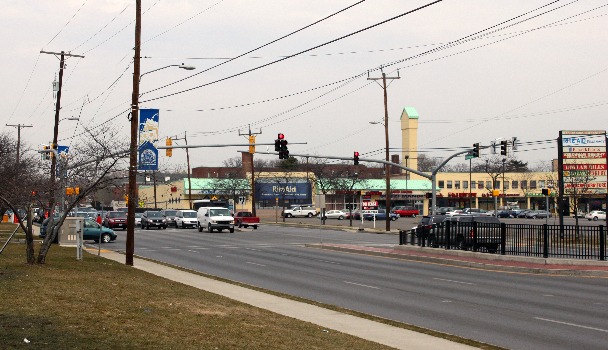
Typical strip mall at major intersection (Langley Park, Md.). (thisisbossi/Flickr)

A traditional downtown. (Michael Shake/Shutterstock)
This is why America’s experiment in sprawl has failed, in Marohn’s view. His judgement is not of markets, but math. “New growth provides local governments an opportunity to receive additional cash in the short term in exchange for taking on unpayable, long-term liabilities,” which in turn can only be paid for by yet more outward growth. City leaders are often so desperate to cover their “Municipal Ponzi Scheme” that they throw tax subsidies at “shiny and new” fast-food joints and strip malls whose value per acre is a fraction of what the “old and blighted” blocks boasted. And in the end, it’s the public that pays for private overreach.
So why haven’t more cities gone belly up? For one thing, state and federal government largesse has long helped paper over local financial shortfalls. And for another, infrastructure is accounted as an asset, not a liability. “With this approach, the more roads a city has, the more pipes in the ground, the more public buildings and pumps in its inventory, the richer that city is. It’s backward.”
America is, in short, becoming Detroit. Our decline will, like all bankruptcies, happen slowly and then all at once, in Marohn’s view. The signs are there, for those with eyes to see. Take any big city in America today and watch as growth becomes a zero-sum equation, with battles over the protected classes of renter and homeowner alike—as the NIMBYs cry “Not In My Backyard!” There is now a “malaise that creeps across society,” Marohn writes, and somewhere Jimmy Carter smiles.
There is something very American about these fears. Every generation since this country’s founding has worried that we are on an “unsustainable economic path” whose fiscal sins we will pay for, one way or another. The fact that Marohn is writing after the 2008 recession makes these fears all the more salient. This impression of Americana is aided by Marohn’s folksy writing style, sprinkled with homespun wisdom and timeless truths.
America has always been saved by its frontier, and when one closed another opened; first the West, then the industrial city, and now followed by the suburb and the gentrifying urban neighborhood. These American frontiers are closed now, and there is little chance of going back. But Strong Towns still answer to the past. What this democracy of the dead gifts us is a certain small-c conservative vision of society emergent from a complex order, an arrangement that we barely understand and therefore must respect. For the first time in our nation’s history, by this light, the frontier starts at our front porch.

StrongTowns.org
***
If, dear reader, you are looking for a grand solution or big idea from Charles Marohn, you will be sorely disappointed. The Strong Towns book is bereft of the hard data or models that we moderns delight in. You will not find out, for instance, how many cities are functionally insolvent and by how much. As this is a book built from the bottom-up—over years of observations poured into blog posts—it reads more as a series of insights strung together by an ethos, a belief. To tell towns what to do would be to deny them the bottom-up innovation they will need to minimize risks and maximize their strengths. “Building a prosperous America is a hyper-local undertaking,” and this is the heart of the Strong Towns approach.
Nevertheless, Charles Marohn gives readers rules of thumb to govern their towns. The greatest of these is profit: every community must operate in the black, with wealth exceeding liabilities and revenues surpassing expenses. Every dollar of public infrastructure liability must be backed by 20 to 40 dollars of private wealth. And the best way to determine if a new investment will sustain its infrastructure is measuring its projected value per acre. Even better, put infrastructure to the market test; if a public project costing a million dollars can easily recoup that sum (and more) through tolls, value capture, or some other levy on its actual users, all the better.
Marohn further calls for “triage” on infrastructure, starting with fixing up and maintaining the roads, sidewalks, pipes, and wires in high-value-added neighborhoods, which are invariably the older ones closer to the core. “We’re done adding new infrastructure,” he proclaims, though just how politically feasible such a proclamation will be remains an open question. Nevertheless, to the cycles of growth, stagnation, and decline afflicting America’s cities, Marohn would like to add another: renewal.
Yet too many neighborhoods are sealed in regulatory amber. Zoning codes do not allow places to naturally, incrementally evolve, let alone renew or reinvent themselves. So Marohn proposes a modest form of the pro-growth faction known as YIMBYism: for the next increment of development in a neighborhood to be allowed “by right, but no more.” That is, a single-family home should be able to add an accessory dwelling unit or convert to a duplex without any special approvals or conditions. Allowing such evolution in our regulatory code should be true for businesses too, whether it’s the brewery struggling to renovate an old warehouse or a food truck seeking to vend in a vacant lot.
Such reforms will be hard to achieve because the will of local governments to survive is greater than the desire for their own towns to endure. Which is why Marohn concludes with a simple plea for subsidiarity: “Instead of policies, how about talking to your neighbor?” Decisions should be devolved to the “smallest, lowest, or least-centralized level of decision-making” that can competently handle a decision. Of course, such subsidiarity runs against the liberal individualism that entrusts our communities and markets to lawyers and regulators; liberalism demotes our neighbors or family, enriching economic man whilst starving the social animal.
Strong Towns is then, perhaps unwittingly, written for a post-liberal moment questioning the atomism, materialism, short-termism, and civic infantilism that is the corrosive logic of our age. Every ideal of stability and tradition extolled by Marohn is a gift of our pre-modern or unchosen inheritances, as Patrick Deneen’s Why Liberalism Failed has written and Alexis de Tocqueville cautioned before him. Strong Towns also then risks catching the ill afflicting liberalism’s critics; that is, its specific cures are rarely cited or risk being worse than the liberal disease.
Which is why Charles Marohn concludes that redemption for America’s towns must ultimately well up from some vision of the common good, one that historically has only come from religious roots. As a professed Catholic, Marohn writes that while he would never “seek to structure my city to reinforce Catholic practices,” he sees how “it’s clear that as our religiosity fades, there is no cultural structure providing equivalent meaning and guidance for our lives.” Somehow then, we must still “bind us together as people” in the pursuit not of consumption but of virtue. It is the “burden” of every strong town, Marohn believes, and “it’s also our path to salvation.”
No prophet is welcomed in his hometown. But if Marohn’s message of financial strength and resilience resonates in this time and place, it is because we feel something is deeply amiss in the American experiment, and that a solution is to be found somewhere at home. Strong Towns is a conservative vision for community that has not been tried and found wanting, but found difficult and left untried. It’s time we tried.
Michael Hendrix is director of state and local policy at the Manhattan Institute. This New Urbanism series is supported by the Richard H. Driehaus Foundation.
Sunday, September 22, 2019
Boeing's Managerial "Revolution" illustrates the conflict between industry and business...
There are many things I like about this article. It illustrates that problems arise not from evil, malicious people, but the ideologies in which they have been trained to think. It gives details of how Republican leaders in Congress at the very least bent the truth if not outright lied to prevent inquiry into what actually went wrong. It shows that labor unions were the only actors in this whole story that acted from a sense of promoting the public good — which is an implicit repudiation of conservatives’ and neoliberals’ demonizing of organized labor. It explicitly contrasts engineers with financially mindede managers. It explicitly attacks Jack Welch, the former CEO of General Electric, and shows why the public acclaim he has been given is entirely misplaced. Most of all, it is a perfect example of Thorstein Veblen’s analysis of the conflict between industry and business.
….Nearly two decades before Boeing’s MCAS system crashed two of the plane-maker’s brand-new 737 MAX jets, Stan Sorscher knew his company’s increasingly toxic mode of operating would create a disaster of some kind. A long and proud “safety culture” was rapidly being replaced, he argued, with “a culture of financial bullshit, a culture of groupthink.”
Sorscher, a physicist who’d worked at Boeing more than two decades and had led negotiations there for the engineers’ union, had become obsessed with management culture. He said he didn’t previously imagine Boeing’s brave new managerial caste creating a problem as dumb and glaringly obvious as MCAS (or the Maneuvering Characteristics Augmentation System, as a handful of software wizards had dubbed it). Mostly he worried about shriveling market share driving sales and head count into the ground, the things that keep post-industrial American labor leaders up at night. On some level, though, he saw it all coming; he even demonstrated how the costs of a grounded plane would dwarf the short-term savings achieved from the latest outsourcing binge in one of his reports that no one read back in 2002.*Sorscher had spent the early aughts campaigning to preserve the company’s estimable engineering legacy. He had mountains of evidence to support his position, mostly acquired via Boeing’s 1997 acquisition of McDonnell Douglas, a dysfunctional firm with a dilapidated aircraft plant in Long Beach and a CEO who liked to use what he called the “Hollywood model” for dealing with engineers: Hire them for a few months when project deadlines are nigh, fire them when you need to make numbers. In 2000, Boeing’s engineers staged a 40-day strike over the McDonnell deal’s fallout; while they won major material concessions from management, they lost the culture war. They also inherited a notoriously dysfunctional product line from the corner-cutting market gurus at McDonnell.
…. much of the software on the MAX had been engineered by recent grads of Indian software-coding academies making as little as $9 an hour, part of Boeing management’s endless war on the unions that once represented more than half its employees. Down in South Carolina, a nonunion Boeing assembly line that opened in 2011 had for years churned out scores of whistle-blower complaints and wrongful termination lawsuits packed with scenes wherein quality-control documents were regularly forged, employees who enforced standards were sabotaged, and planes were routinely delivered to airlines with loose screws, scratched windows, and random debris everywhere. The MCAS crash was just the latest installment in a broader pattern so thoroughly ingrained in the business news cycle that the muckraking finance blog Naked Capitalism titled its first post about MCAS “Boeing, Crapification and the Lion Air Crash.”Here, a generation after Boeing’s initial lurch into financialization, was the entirely predictable outcome of the byzantine process by which investment capital becomes completely abstracted from basic protocols of production and oversight: a flight-correction system that was essentially jerry-built to crash a plane. “If you’re looking for an example of late stage capitalism or whatever you want to call it,” said longtime aerospace consultant Richard Aboulafia, “it’s a pretty good one.”
….
There was one unmistakable harbinger of what was to come at Boeing in the saga of the GE90—an all-new, ultra-efficient engine inspired by a NASA project that General Electric’s pioneering chief of aviation Brian Rowe developed exclusively for the new plane. Market watchers referred to the development of jet engines, which make up 20 percent of an airplane’s purchase price, as GE’s “crown jewel,” because the margins were high once the company had eaten the ten-figure cost of developing and testing one. But in 1993, GE’s notorious downsizing CEO Jack Welch—by then well on his way to becoming the most grotesquely lionized character in American business—abruptly fired Rowe, along with several thousand other aviation engineers. The results were predictable: The engines failed their tests, often in spectacular fashion, replete with smoke and flames, over and over and over again. Things deteriorated to the point that the FAA sent Boeing a “letter of discontinuance” directing the company to cease flight tests until GE got its act together. A shrunken staff of engineers, working overtime to implement decisions by colleagues who had long since been laid off, finally got the engines approved more than a year past their scheduled delivery dates, and malfunctions continued to plague the engines for years thereafter.Less than two years later, a layoff-happy Welch protégé named Harry Stonecipher, McDonnell Douglas’s former CEO, grabbed the reins at Boeing, and the same dysfunction took hold in Seattle. …
The McDonnell Douglas engineers had seen it all before: In the name of RONA, Stonecipher’s team had driven the last nail in the coffin of McDonnell’s flailing commercial jet business by trying to outsource everything but design, final assembly, and flight testing and sales of the MD-11. In 2001, one McDonnell engineer wrote a scathing critique of the metric and its inevitable result, “Out-sourced Profits,” that went viral on Boeing’s intranet server. But Wall Street analysts dismissed the paper as a “rant,” and so the whole process was fated to begin anew under Stonecipher’s watch at Boeing. …
The McDonnell Douglas engineers had seen it all before: In the name of RONA, Stonecipher’s team had driven the last nail in the coffin of McDonnell’s flailing commercial jet business by trying to outsource everything but design, final assembly, and flight testing and sales of the MD-11. In 2001, one McDonnell engineer wrote a scathing critique of the metric and its inevitable result, “Out-sourced Profits,” that went viral on Boeing’s intranet server. But Wall Street analysts dismissed the paper as a “rant,” and so the whole process was fated to begin anew under Stonecipher’s watch at Boeing.
Boeing might represent the greatest indictment of 21st-century capitalism
A link from the article above
Packed in the 737 fiasco are all the economic problems we face: crony capitalism, regulatory capture, offshoring…
And it's not just Boeing... See At $28 billion so far, the farm rescue is more than twice as expensive as the 2009 bailout of Detroit’s Big Three Two automakers, which cost taxpayers $12 billion.
Saturday, September 14, 2019
Modern Money Theory (MMT) Class
I've been teaching a class (Heterodox Economics - Modern Money Theory) at CSUS' Senior education program (Renaissance) with the usual mixed reaction. Something so contrary to the current economics narrative provokes tremendous skepticism.
I'm posting this so students can comment...
For those wanting more economics, and a mention of MMT, see Mark Blythe's Brief History of How We Got Here video here:
Notice he says the Republicans have been using MMT for some time, just not telling anyone about it....something I've written about before (here).
Tuesday, September 10, 2019
Warren's (really Sanders') Wealth Tax Attacked
Predictably, the Koch-funded think tanks are not happy with Elizabeth Warren's recently announced plan to tax wealth. Bernie Sanders proposed this in 2014...so "He who must not be mentioned" (no, not Voldemort, Sanders) got there first. Meanwhile, here is one editorial pooh-poohing Warren's idea from Tracy C. Miller of the Mercatus institute.
My response:
Let's take Ms. Miller's points one at a time:
1. Miller says: "in reality [Warren's wealth tax] will not raise enough revenue to pay for much."
Taxes do not provision the Federal government. That government is a sovereign, fiat money creator (with a floating exchange rate). It makes all the (non-counterfeit) dollars, and is the only fiscally unconstrained player in the economy.
Where would people get the dollars to pay taxes if government didn't spend them out into the economy first? Government spending is therefore not dependent on tax revenue. Taxes make the money valuable; they do not provision government.
So...It's not "tax & spend"...it can't be, logically. It's "Spend first, then get some dollars back in taxes." What do we call the dollar financial assets left in the economy untaxed? #1: Citizens' savings. #2: National 'Debt'. #1 and #2 refer to something that is exactly the same, just as your bank account is identically your asset and the bank's debt. It's just a different point of view. This is not exotic economics; it's double-entry bookkeeping.
Don't take my word for that declaration about the real use of taxes. Here's a 1946 paper from the chairman of the NY Fed called "Taxes for Revenue are Obsolete"
2. "According to Pew Research, in 2014, people with incomes above $250,000 per year paid 51.6% of all individual U.S. income taxes. The top 0.1% of income earners pay 31.1% of their income in federal taxes. Those in the bottom 50% pay considerably less than 10 percent, and many pay no federal taxes at all."
Since taxes don't provision government income tax proceeds really don't matter. Nevertheless, such statements as the above ignore the fact that (regressive) payroll taxes exceed income taxes for incomes below $50K or so.
So...Mitt Romney did pay 14% in 2011...less than many poorer people. Warren Buffett famously declared his secretary paid higher taxes than he did.
Saying the fix isn't in for the wealthy is simply specious.
This kind of propaganda agrees with Reagan's attempt to revive the economy by cutting the top marginal tax brackets by 50% while (between him and his successor) increasing payroll taxes eightfold. So 50% tax cut for the rich, but 800% tax increase for the poor. Gee, I wonder why income inequality plagues us now!
Incidentally, the Reagan budget deficit exceeded the sum of all previous deficits combined, and he did get an economic revival--called "Morning in America" by the Wall St. Journal. Actually it was an average business cycle recovery. For really big shifts in GDP growth rates, you have to look at the New Deal and that big public works project we call World War II.

Incidentally, for World War II, the government commandeered 50% of the economy. For the Green New Deal, it would require only 5%. How would we pay for it? The same way we produced trillions for wars in the Middle East and bank bailouts.
3. "In a market economy, we earn wealth as a reward for producing something consumers value. Steve Jobs accumulated $8 billion for developing products like iPhones that millions wanted and were willing to pay for."
Here are a few of the inventions Jobs (an adopted Syrian immigrant) used for his "products"... all of which were discovered with government-funded research (the funding agency appears in parentheses):
So Steve Jobs was a clever fellow, but the basic research he used came from government, not the private sector. In fact 75% of pharmaceutical innovation comes from government-funded research. (See Mariana Mazzucato's TED talk about government as innovator for more)
So this Mercatus propaganda really relies on the ignorance of the public, distorts just about everything it touches...and we wonder why we're in a mess now.
My response:
Let's take Ms. Miller's points one at a time:
1. Miller says: "in reality [Warren's wealth tax] will not raise enough revenue to pay for much."
Taxes do not provision the Federal government. That government is a sovereign, fiat money creator (with a floating exchange rate). It makes all the (non-counterfeit) dollars, and is the only fiscally unconstrained player in the economy.
Where would people get the dollars to pay taxes if government didn't spend them out into the economy first? Government spending is therefore not dependent on tax revenue. Taxes make the money valuable; they do not provision government.
So...It's not "tax & spend"...it can't be, logically. It's "Spend first, then get some dollars back in taxes." What do we call the dollar financial assets left in the economy untaxed? #1: Citizens' savings. #2: National 'Debt'. #1 and #2 refer to something that is exactly the same, just as your bank account is identically your asset and the bank's debt. It's just a different point of view. This is not exotic economics; it's double-entry bookkeeping.
Don't take my word for that declaration about the real use of taxes. Here's a 1946 paper from the chairman of the NY Fed called "Taxes for Revenue are Obsolete"
2. "According to Pew Research, in 2014, people with incomes above $250,000 per year paid 51.6% of all individual U.S. income taxes. The top 0.1% of income earners pay 31.1% of their income in federal taxes. Those in the bottom 50% pay considerably less than 10 percent, and many pay no federal taxes at all."
Since taxes don't provision government income tax proceeds really don't matter. Nevertheless, such statements as the above ignore the fact that (regressive) payroll taxes exceed income taxes for incomes below $50K or so.
So...Mitt Romney did pay 14% in 2011...less than many poorer people. Warren Buffett famously declared his secretary paid higher taxes than he did.
Saying the fix isn't in for the wealthy is simply specious.
This kind of propaganda agrees with Reagan's attempt to revive the economy by cutting the top marginal tax brackets by 50% while (between him and his successor) increasing payroll taxes eightfold. So 50% tax cut for the rich, but 800% tax increase for the poor. Gee, I wonder why income inequality plagues us now!
Incidentally, the Reagan budget deficit exceeded the sum of all previous deficits combined, and he did get an economic revival--called "Morning in America" by the Wall St. Journal. Actually it was an average business cycle recovery. For really big shifts in GDP growth rates, you have to look at the New Deal and that big public works project we call World War II.
Incidentally, for World War II, the government commandeered 50% of the economy. For the Green New Deal, it would require only 5%. How would we pay for it? The same way we produced trillions for wars in the Middle East and bank bailouts.
3. "In a market economy, we earn wealth as a reward for producing something consumers value. Steve Jobs accumulated $8 billion for developing products like iPhones that millions wanted and were willing to pay for."
Here are a few of the inventions Jobs (an adopted Syrian immigrant) used for his "products"... all of which were discovered with government-funded research (the funding agency appears in parentheses):
- Signal Compression (Army Research Office)
- Liquid Crystal Display (NIH, DoD)
- HTTP/HTML (CERN)
- Cellular technology (U.S. Military)
- Integrated Circults / Microprocessors (DARPA)
- The Internet (DARPA)
- Global Positioning Satellites (DoD)
- Touch Screens (DoE, CIA/NSF, DoD)
- Micro-hard drives (for iPods ... DoE, DARPA)
- Lithium-ion batteries (DoE)
So Steve Jobs was a clever fellow, but the basic research he used came from government, not the private sector. In fact 75% of pharmaceutical innovation comes from government-funded research. (See Mariana Mazzucato's TED talk about government as innovator for more)
So this Mercatus propaganda really relies on the ignorance of the public, distorts just about everything it touches...and we wonder why we're in a mess now.
Gosh! What could have caused that!
Subscribe to:
Posts (Atom)
-
(c) by Mark Dempsey 1. The Conventional Economics Narrative The conventional story says national debt is a (growing) problem. The bigger i...
-
The conventional wisdom is that excessive government debt, and large government deficits, are the roots of all economic evil. When you see...
-
RE: The DSA agenda may cost $200$. Who pays for it? 10/2/26 p. B-10 The Bee's opinion writer (Ingrid Jacques) joins the paid chorus of p...
