Thursday, December 14, 2023

Diet Facts

(c) by Mark Dempsey

Here are a few facts about dieting that are not widely known. I seldom write about diet since it is so personal, and often more controversial than politics or other soap operas. But here you go...

A pound of fat has 3500 calories. This means if you eat 50 extra calories daily for a year--and don't change your activity level--you will gain more than five pounds (50 x 365 / 3500 = 5.2 lbs). Do this year after year, and pretty soon we're talking some serious weight gain, not easily erased overnight.

If you adopt a low-calorie, low-carbohydrate diet, without doing exercise, you can lose weight--just as you can lose weight if you get chemotherapy--but there's a downside. If you lose seven pounds this way, only two pounds lost will be fat, the other five are lean body weight. The lean body weight is what burns calories, so this type of dieting eventually predisposes people to get fatter, despite the weight loss. What such dieters lose is muscle.

Incidentally, if you do have chemotherapy, you will get ketosis. Dr. McDougall calls Keto diets the "Make yourself sick" diets.

Normal, healthy males typically measure roughly 15% body mass as fat; females are 22% fat. Because of the phenomenon in the previous paragraph, anorexics are actually very fat--as much as 40% of their body weight is fat. They may look skinny, but the fat is marbled through their muscles, so they're skinny but weak.

Not eating extra calories is important--so portion control and not over-stuffing or binge-eating is helpful if you want to lose weight. However, diet expert Covert Bailey says diets that are just low-calorie, without exercise, program your body for famine, so more of what you eat goes to fat--unless you ramp up your metabolism with exercise. He says that in his experience, most of the famous low-calorie diets are helpful, but only if you want to gain weight. Meanwhile, Oprah confesses she started using diet pills.

The bottom line: exercise is essential for any permanent weight loss. Exercise doesn't burn many calories, but it does start to re-program your metabolism so that more of what you eat goes to feed muscle mass rather than being stored as fat. Exercise also helps you avoid depression and think more clearly.*

Glycemic Index

Glycemic index measures how fast food consumed appears in blood as glucose--the fuel for most muscle and brain processes. Faster is not better, though. Refined sugar--a candy bar, for one example--would have a high glycemic index. When your blood sugar (glucose) spikes, it also makes for an increased level of insulin, a chemical which often lingers after the spike in blood sugar. When insulin has consumed all of the candy bar, and is still in your blood, you typically feel hungry, and often hungry enough eat another candy bar...which spikes the blood sugar. When your muscles don't burn that glucose, your body stores it as fat.

Eran Segal makes an important qualifier for generalized glycemic indexes. In his study, he found that how fast people metabolize different foods varies, as you might expect. After all, it's an evolutionary advantage to  have a variety of different kinds of digestion, so humans can adapt to different environments.

So differences in genetics, and that microbiome--the bacteria in your gut--can have enormous impacts. Segal reports that some people can eat ice cream, and their glucose spikes upward, while others experience no such spike because their digestion doesn't assimilate it rapidly.

Fibrous foods, for example apples, can have a low glycemic index not because they lack sugar, but because digestion has to get past all that fiber to get to the sugar.

While it may be true that there is no one, ideal diet for humans, as Segal suggests, my money is on the fibrous foods, and avoiding the highly processed foods (white bread, refined sugar, etc.) to keep that glycemic index low. 

Either way, vegetables and fruit have a tremendous caloric advantage over meat and dairy. 

A hundred calories of meat can fit in the palm of your hand. A hundred calories of spinach, watermelon or strawberries fills a fair sized container. 

I've heard many people complain that cereal (refined grain) leaves them hungry after a short time. This is typical for refined, low-fiber food. A serving of unsweetened oatmeal typically has an lower glycemic index than bacon, eggs and toast, so it will "stick to your ribs." It has plenty of fiber, so it digests slowly, releasing glucose into your bloodstream gradually, unlike the refined food. I've seldom met anyone who complains that the bulky, low-glycemic index food doesn't satisfy their hunger especially if it's heavy on beans and rice. Vegetarian Indian food, or Mexican food is extremely filling, and keeps that hunger away for a while.

However, hunger pangs are not always to be avoided. If you want to lose weight, hunger pangs may appear as your body consumes fat. No need to give in to that impulse to snack at midnight...if losing weight is on your agenda.

And speaking of calories, tea has none, but look at the following:

12 oz Coke: 140 calories
12 oz (regular) beer: 153 calories
12 oz (higher alcohol, craft beer: 170 - 350 calories

Iced tea, even with two teaspoons of sugar only has 32 calories.

I hope this is useful when you make dietary decisions, especially during the holiday.

===

Disclaimer: I'm not a dietician or MD. The advice above is not strictly anecdotal, but a lot of it comes from a variety of sources, including my own experience. I've been (mostly) vegan for more than 30 years now. Eating that diet is not particularly hard to do, even when dining in restaurants, as long as one can adapt. I'm not a perfectionist about this. For example, I won't ask the Chinese restaurant to eliminate egg from their fried rice (it's such a small amount, anyway) and I'll eat pastries without being concerned if they aren't entirely vegan. I'll even eat an egg or sausage from time to time, and a slice of turkey at Thanksgiving. But I'd estimate 95% of the calories I consume are neither meat, nor egg, nor dairy, nor refined food (sugar, oil). 

When I had hernia surgery, the Kaiser surgical team took a look at my mostly naked body and told me I was an inspiration [blushes]. They may have just been trying to encourage me before they anaesthetized me, but I'm pretty sure they were sincere. The bottom line: This diet has served me well.

*The facts about dieting and weight loss above rely largely on a lecture by a nurse/dietician who measured my body fat content the old fashioned way--weighing in air, then in water. Many modern scales do this the digital way, with sensors, but this lecture predated the availability of such scales.

As the Eran Segal video shows, your mileage may vary. Still...when it comes to ice cream vs. fruit or veg...I'd stick with the latter.

Wednesday, December 13, 2023

Homelessness Are Us, at Home and Abroad

In the United States homelessness is a choice made by public officials. It cannot be whisked away
-
The elimination of public housing programs, beginning with the second Nixon administration in the early 1970s. New public housing was no longer built, and some existing public housing project were demolished.
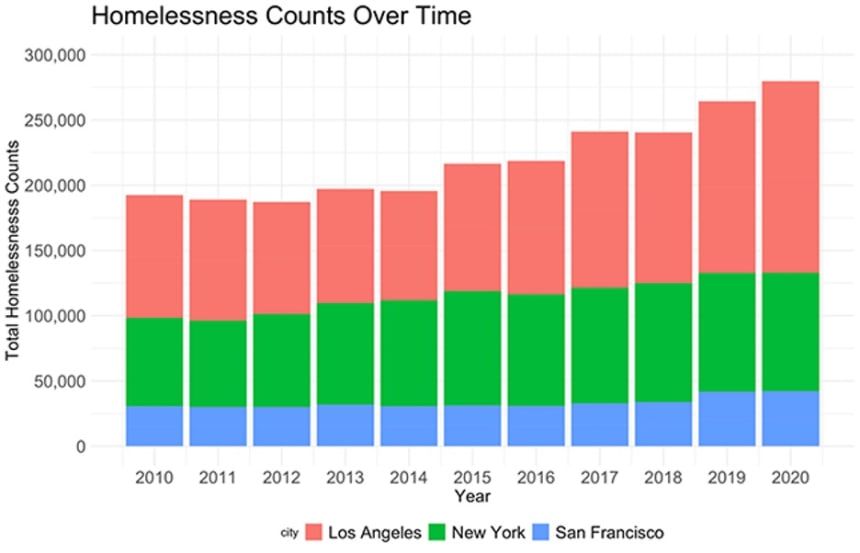
homeless over time
  • The State Legislation dissolved California’s 400 local redevelopment agencies in 2011. They, like the Community Redevelopment Agency in Los Angeles, were required to spend 20 percent of the budgets on public housing. The elimination of these subsidies was a major blow to the construction of new non-market low-income housing.
  • Wage stagnation while housing prices continued to rise, priced many people out of housing.
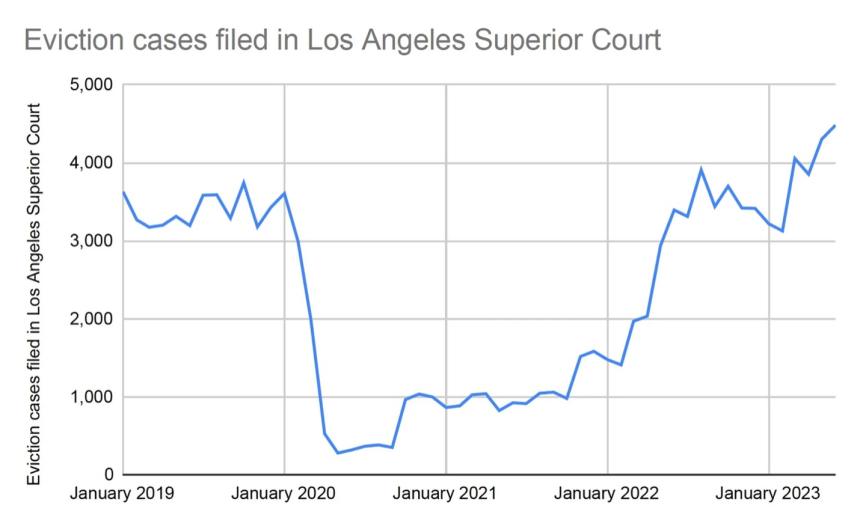
  • Mass evictions.

    eviction cases
  • Two forms of up-zoning have raised the market value of private parcels and existing housing, forcing some residents into homelessness. One form of upzoning was parcel level zone variances and zone changes, granted by the LA’s City Planning Commission and City Council 90 percent of the time. The second form of up-zoning was through City Council ordinances often attached to Community Plan updates.

For those who want evidence for these underlying causes of homelessness, the best study is: Toward a New Understanding: The California Statewide Study of People Experiencing Homelessness.

In the United States homelessness is a choice made by public officials. It cannot be whisked away by ignoring the causes listed above.

Planning Watch – Abroad: My previous columns focused on local planning and housing policies, explaining how they increased the numbers of unhoused, rent-gouged, and overcrowded people. But I have not written about US foreign policy. After all, the same elected officials whose housing programs produced so much homelessness and dead homeless people, also support U.S. foreign wars that lead to similar outcomes, homelessness and death.

This was clear in many Henry Kissinger obituaries. For example, according to Yale historian Greg Grandin, in Kissinger’s Shadow, between 1969 to 1976 Kissinger was responsible for the deaths of 3 to 4 million people, as well as the systematic destruction of infrastructure, buildings, and housing.

Cambodia. As Richard Nixon’s Secretary of State, in 1969 Kissinger was responsible for a secret war that dropped 540,000 tons of bombs to destroy Cambodia’s insurgents. This resulted in 300,000 deaths and the destruction of one-fifth of the country, including people’s houses.

East Timor. Under President Gerald Ford, Kissinger encouraged Indonesia to invade East Timor. Done in secret, the US proxy war resulted in enormous destruction, including 200,000 deaths.

Chile: Under President Nixon, Kissinger turned to the CIA to violently overthrow and murder Chili’s elected leader, Salvador Allende. The US instigated coup results in the death, torture, and imprisonment of 40,000 Chileans.

Argentina: In 1976 Kissinger orchestrated the overthrow of Argentinian President Isabel Peron by Argentinian General Jorge Rafael Videla. The Videla regime’s “dirty war” resulted in the death of between 10,000 to 30,000 opponents, many dropped into the ocean from helicopters.

Bangladesh: In 1976, Kissinger and Nixon backed the Pakistani invasion of West Pakistan (now Bangladesh). The resulting genocide murdered 300,000 to 500,000 Bengalis.

Vietnam: On behalf of Richard Nixon, in 1968 Kissinger was able to stall the Paris Peace Talks initiated by President Lyndon Johnson. Since the new Nixon administration was unable to re-start the stalled peace talks, they pursued mass bombing of North Vietnam to terrorize the country’s government into submission. In total, the war resulted in 3,800,000 deaths and the destruction of much of the country.

Indonesia: A decade before Kissinger was Secretary of State, in 1965-66 the U.S. government supported the Indonesian government and their proxies in the anti-communist and anti-Chinese genocidal murder of 500,000 to 2,000,000 people.

Iraq: Under the Clinton administration (1993-2001), US bombing of Iraq’s no-fly zones killed 500,000 people and destroyed public and private infrastructure. Beginning in 2003, the second Iraq War resulted in the 300,000 more Iraqi deaths.

Gaza: This leads us to the current Israeli war on Gaza. Despite the enormous propaganda blitz, we know that the US government has provided enormous military aid to Israel, stationed two US Navy aircraft carrier strike groups near Israel, given diplomatic cover to Israel at the UN Security Council, and shared intelligence with the IDF.

As for the results, there is no information on the number of Hamas fighters killed or captured by Israel, but there is data on non-combatants killed by Israel. Furthermore, Israel has blocked the entry of food, water, fuel, and medicine into Gaza for the past nine weeks. As of December Reuters reports the Israeli military has killed 15,899 people in Gaza, 70 percent of whom are women or children under the age of 18. Al Jazeera English gave an updated Dec. 5 total of 1.9 of 2.3 million people displaced, 16,248 overall deaths, including 4,885 women, 7,112 children, 79 media workers and journalists, 130 UN staffers, and 150 health workers.

Regarding housing, according to the Scientific American, as of December 1, 2023, 1.7 of Gaza’s 2.3 million people have been displaced because Israel destroyed or damaged their homes. Israel also destroyed much of Gaza’s infrastructure, including half of all buildings.

While the US military is not directly involved in the Israeli attacks on Gaza, it has actively supported Israel with weapons, intelligence, and diplomacy, similar to previous US proxy wars in Argentina, Chile, Indonesia, and East Timor.

Even though the mainstream media does not connect the dots between US domestic and foreign policy, common themes of death and destruction of homes and infrastructure link the two. Even though these domestic and foreign policies have enormous bipartisan support in Congress and the White House, most of the public disagree. .They want an immediate Gaza cease-fire.


Dick Platkin

Dick Platkin is a former Los Angeles city planner and veteran Planners Network member who reports on local planning issues for City Watch LA, which published an earlier version of this article. Please send any comments or corrections to rhplatkin@gmail.com.

Sunday, December 10, 2023

Pentagon Stupidity Is a Design Choice

From MATT STOLLER  DEC 9, 2023

Welcome to BIG, a newsletter on the politics of monopoly power. If you’d like to sign up to receive issues over email, you can do so here.
 

In the National Defense Authorization Act, Congress just empowered the Pentagon to learn who owns the defense contractors that supply it. This is good for national defense and bad for private equity.

Today’s piece is short. It’s about two useful provisions that Congress quietly slipped into a major defense bill. These new legal requirements will force private equity firms to tell the Pentagon whether they are mucking around with weapons makers.

These provisions are especially important at a moment when the U.S. is supplying, or failing to supply, three areas of possible conflict - Israel, Ukraine, and Taiwan.


Seeing Like a Pentagon


Using metaphor of blindness to sight is common throughout human history, because everyone understands what it means to open your eyes. It suggests not just a change in the ability to sense light, but a step change in how we think. “I was blind but now I see” is in the bible, a metaphor for seeing a spiritual truth, being able to reckon with the profundities of reality. In “Seeing like a State,” James C. Scott conveys a similar notion for bureaucracies. How a state collects information, aka sees, is a highly political question, because you can’t govern what you can’t see.

In August, I wrote up an important shift among antitrust enforcers, in a piece titled “Government Stupidity Is a Design Choice.” In it, I described how the Federal Trade Commission and Antitrust Division, prompted by Congress, tweaked a form, called the Hart Scott Rodino form, that companies must fill out when they want to engage in any corporate acquisition worth over $100 million.

Dealmakers will now have to answer basic questions, such as “Why are you merging?” “Who is on your board of directors?” “How does your industry work?” “Who is lending money for the buy-out?” They will have to give information upfront about subsidiaries, their product lines, defense contracts, their power in labor markets, and previous acquisitions, which is particularly important when a firm is rolling up a lot of smaller entities. If China is financing the bid, or a giant private equity firm, they will now have to tell the government.

The old form required none of this. The government got virtually no useful information from it, meaning that every day a government lawyer would receive a bunch of notifications that two random companies are merging, and he’d have to start with virtually no information, and then with a few hours of research decide which were worth investigating. No matter how smart you are, no one can learn a lot about, say, the paint industry, the mail sorting software industry, the pool cleaning industry, and the semiconductor design industry in one day starting from zero. So a lot of unlawful mergers just went through, because the government was blind.

The old form was the equivalent of being told to do an X-Ray and being given cardboard X-Ray glasses from the 1950s. The new form is an actual X-Ray machine.

While the new form hasn’t gone into effect yet, it will be very effective. How do I know? Well the big D.C. and New York corporate law firms that advise all large companies, private equity funds, foreign governments, and large institutions were absolutely furious about the shift. (Here are, for instance, angry notes to clients from Wilmer Hale. Steptoe. Kirkland and Ellis. Dechert. Wilson Sonsini. Sullivan and Cromwell. Covington & Burling. Etc.)

But while corporate lawyers might be mad about this change among antitrust enforcers, now they’ll have to deal with another part of the government getting that same X-Ray machine. The Pentagon.


Sprawl - Today's Bee Letter

12/10/23 re: “Sacramento has an ugly addiction to sprawl” p.D13

The Bee correctly decries Sacramento's addiction to sprawl. Sprawl is not just a polluting mess, it’s an unhealthy, regressive “tax”–every driving age adult must own a car to shop or get to work. Seniors who can’t drive and children are, in effect, second-class citizens.

As someone who protested this for literally decades both in a Community Planning Advisory Committee and as a private citizen, government’s tone-deaf response has been beyond frustrating. My best guess is that land speculators (i.e. "developers") are firmly in command, and their proxies in government have difficulty understanding that alternatives exist since their paycheck is conditioned on them not understanding. The late Grantland Johnson once said that it's widely acknowledged that, in all of California, the Sacramento region is the most in the hip pocket of development interests. That's not a contest anyone would want to win.

Meanwhile, the region has 20 years of unbuilt infill.

Money incentives' effectiveness pales in comparison to social pressure

From Mike Norman Economics:

"The study’s findings were striking in their similarity to [Soloman] Asch’s original results. In the non-incentivized group, the average error rate in the line judgment task was 33%, closely mirroring Asch’s findings. However, in the incentivized group, the error rate dropped to 25%. This suggests that while financial rewards can reduce the impact of group pressure, they do not eliminate it. [emphasis added]

“When we started the study, we could not imagine to be able to replicate the original findings as close as it turned out,” Franzen and Mader told PsyPost. “We thought Asch’s findings were overstated. We also believed that providing incentives for correct answers would wipe out the conformity effect. Both did not happen. The replication turned out to be very close to the original results and providing monetary incentives did not eliminate the effect of social pressure.”

The conclusion is also of interest to contrarianism.

Regarding what people should take away from the findings, the researchers remarked: “Here we like to cite Mark Twain, ‘Whenever you find yourself on the side of the majority, it is time to pause and reflect.'”

----

My observation of local political clubs aligns perfectly with the above. Such clubs are far more interested in social cohesion, rubbing their hands together as they huddle around some political bonfire ("Isn't Trump awful!" "Aren't those Democrats corrupt!") than in discussing public policy alternatives that might extinguish the fires.

It's essentially "My tribe is better than other tribes" ... which degenerates into a game called "Ain't it awful." It's the essence of inside-the-box thinking...or not thinking at all.

This is a shame not only because it means the public remains uninformed--they are too busy huddling with their homies--but because political inertia, not sensible thinking, rules the land. These are nice people, but, as Abe Lincoln said, good intentions are a second-rate virtue.

The insistence on adhering to one's own (and typically one's parents' own) ideology is a quasi-religious phenomenon. Persecuting heretics is part of that particular tendency. 

----

A little bit of the consequences of tribal loyalty rather than clear thinking driving public policy:

1. Sacramento County just voted to postpone any climate mitigation actions for 15 years. (Meanwhile, a tree fell on my house, thanks to a powerful windstorm in early 2023...it was bad enough that my homeowners' policy was canceled. But hey, that global warming is a hoax.)

2. Sacramento County just paused it, but they previously voted to spend $1 billion to enlarge the jail. 

3. The Federal reserve says 40% of the US population can't handle a $400 emergency without selling something or borrowing.  Around 60% of wage earners live paycheck-to-paycheck. An estimated 65% of seniors only have Medicare and Social Security to fund their retirement. Congress is moving to consider reducing those social safety nets, though, and can get away with that because the tribes are at odds.


Friday, December 8, 2023

The wisdom of Lord Salisbury

No lesson seems to be so deeply inculcated by the experience of life as that you never should trust experts. If you believe the doctors, nothing is wholesome: if you believe the theologians, nothing is innocent: if you believe the soldiers, nothing is safe. They all require to have their strong wine diluted by a very large admixture of insipid common sense.
 

letter to Lord Lytton, 15 June 1877; in Lady Gwendolen Cecil Life of Robert, Marquis of Salisbury (1921–32) vol. 2

A reminder the seemingly impossible remains possible


Sacramento County Jail Goes Off The Rails

© by Mark Dempsey “I don’t care who people vote for as long as I can pick the candidates.” - William “Boss” Tweed. In perhaps the least surp...