Saturday, April 28, 2018

The Federal Job Guarantee is not just "Better" than Universal Basic income, it's the only Reasonable. The UBI is Sinister.


April 26, 2018 aliteralmind Environment

ABOVE: From this tweet

Written by Jeff Epstein, Editor-in-Chief of Citizens’ Media TV. This article was inspired by the tweet at the bottom of this article, and the discussion in this Facebook thread, and in particular, the comments of Steve Grumbine.

FJG > UBI


No. That’s not right. The Federal Job Guarantee is not just better than Universal Basic Income, it’s the only good option. The UBI is a Trojan Horse for the reduction and elimination of wages and safety net programs for the powerless. UBI is sinister.

Universal Basic Income:

UBI adds money to the economy without increasing production or output. This is how you cause inflation: The creation of money without consideration of the real resources available to you. (Sure, everyone can have a pony, but not tomorrow!)
If the government is now paying your salary, even if you are performing poorly, even if you are not working:

This incentivizes private industry to further reduce wages, which logically extends to the reduction – or elimination – of minimum wage laws.

Then what’s the point of social safety net programs such as welfare, food stamps, subsidized housing, Medicaid, Social Security, etc.? These programs would necessarily be eliminated.
Then what’s the point of fighting so hard for free healthcare and free tuition and lower prescription drug costs and so on? Now people can, at least somewhat, at least temporarily, afford the private industry alternatives. The fights for these progressive programs would just…end.
Now, all of the sudden, everyone can afford shit. All at the same time. Competing with everyone for the same stuff, with no increase in productive capacity. UBI is therefore, by its very definition, inflationary. This governmental salary, this “negative tax” for those at the bottom, is instantly devalued. At best, income and wealth inequality is not reduced.

Would this increase or decrease the incentive to get or keep a job? At least at first…

Here’s the true sinister plot behind UBI: Picture a future and less-friendly Congress, after all these safety nets have been reduced or eliminated. They come in and eliminate or dramatically reduce the UBI program because “these deadbeats want everything for free?!” Our nation is instantly plunged into a private corporation slave-wage hellscape. No wage or workplace protections, no safety net programs at all.

UBI risks putting the United States into a much much worse position than it already is today…. Well, that is, if you care about the powerless.

The Federal Job Guarantee: 


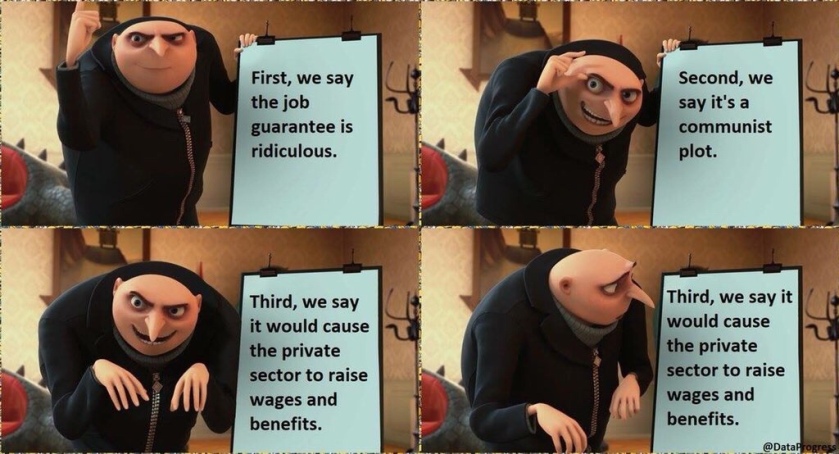
FJG adds money to the economy by increasing productivity and output. This is how you avoid, or greatly reduce the severity of, inflation. It forces private industry and the military to up their game, in order to be competitive with the FJG: better than bare-minimum living wage, benefits, and working conditions. It takes away the excuse of “I’m not hiring you… You’ve been unemployed. Ewww.”

If a future, less-friendly Congress were to come in and eliminate or reduce the FJG program, then those FJG job people would indeed once again be unemployed. But everyone else would still have those better jobs with better wages, benefits, and working conditions. Yes, without the “public option” FJG to compete with private industry, these things will start to degrade. But we would revert back to a position still substantially better than we are today.
Two final points: busywork and robots

If the FJG creates “busywork” pointless jobs, it is not a problem of the FJG itself, but rather a reflection of poor implementation of the FJG at the local level. There are basically an infinite number of genuinely useful things to be done at the local level, throughout the country.

The fear of automation is nonsense. We should embrace automation. Robots can cook our cheeseburgers, wash our cars, and accept and dispense cash better and faster than humans. But robots cannot take care of our children or seniors, they cannot entertain us, create works of art, write our books, or be our primary care physicians or psychologists. Leave the more physically taxing and repetitive drudgery work to the robots. Leave the infinite number of more satisfying and productive jobs for us humans.

[First appeared in Citizens' Media TV: 100% funded by readers. Please support independent journalism. Help pay for Citizens’ Media TV.]

Thursday, April 26, 2018

Cal Thomas tires of telling the kids to stay off his lawn

Today, the Sacramento Bee published a column from Cal Thomas in its electronic edition entitled "Crazy Bernie is at it again." The gist of the column is that Bernie Sanders' recent proposal that the government guarantee jobs for the unemployed is politically naive, unworkable, unaffordable, and just plain wrong. The link is to a right-wing website where the column originated, and the column itself claims several things:

1. George McGovern ran against Nixon on a "similar" platform. No, no he didn't. McGovern was the "get the heck out of Vietnam" candidate, while our last liberal president, candidate Richard Nixon, claimed he had a secret plan to end the war. His secret plan: continue and expand (illegally) the bombing that failed LBJ.

Seldom mentioned in this campaign are Nixon's dirty tricks: specifically persuading his future Secretary of State, Henry Kissinger, to sabotage LBJ's peace talks with the Vietnamese. In fairness, he could certainly have learned a dirty trick or two from LBJ...but two wrongs still don't make a right, and Cal Thomas looks like he's lying just to keep in practice.

2. Says Cal: LBJ's "war on poverty" promised something like a job guarantee and failed miserably. Not really, although there were plenty of job training programs in that "war."

So was that program a failure? See for yourself:

Datei:US poverty rate timeline.gif
(From Wikipedia) The program began in 1969, and has mixed results at best.

The really effective anti-poverty program appears to be the New Deal and the decades of government-sponsored programs that followed it. The New Deal  did include something like a job guarantee (the WPA). Naturally, Reagan's cutbacks coincide with the return to higher poverty rates. See American Amnesia: How the War on Government Led Us to Forget What Made America Prosper for the full story.


3. It's unaffordable! Eeek! We're running out of money!

Gee, I wonder who makes the money, and who made $16 - $29 trillion to bail out the financial sector in 2007-8? (The figures are from the Federal Reserve's own audit.) This doesn't pass the sniff test.

On the other hand, Mr. Thomas' response has been anticipated. Polish economist Michal Kalecki wrote a paper ("The Political Aspects of Full Employment") about the job guarantee in 1943. He expected resistance because such a guarantee would mean an end to "labor discipline." That means the peons would no longer have to suffer the indignities of poverty, homelessness and even starvation if they turned down a crappy job.

Basically, though, government is willing to buy agricultural commodities, even financial instruments ("Quantitative Easing"), so why would it not buy surplus labor? No reason.

See also Warren Mosler's talk about government's role in full employment.

Wednesday, April 25, 2018

The Affordable Housing Conundrum

The following describes some European remedies for problems with rental (i.e. affordable) housing.

It does not mention the effect of the U.S. 1986 tax law–a Reagan-era income tax revision. That law eliminated a tax break for apartment owning limited partnerships, and literally bankrupted those apartment-building partnerships by retroactively removing a tax break budgeted to be part of their income and profits.

The tax break allowed limited partners to take passive losses (e.g. depreciation) even though they weren’t liable for the losses of a project. As I say, all apartment-building limited partnership failed. The fortunate ones deeded the apartments to the banks rather than go through the pain of foreclosure. The rate of rental building also declined after this, sabotaging transit-friendly projects that require density to provide enough riders for transit. In Sacramento, Laguna West could not build apartments since construction financing was not available for them.

This change occurred in the era of the S&L crisis that prefigured the sub-prime/derivatives meltdown. All those bankrupt apartments didn’t help the S&Ls either.

The socialists will tell you giving tax breaks to the wealthy is a second-rate housing solution since those taking them remove some money from the apartment’s income, whereas simple government ownership of affordable housing means 100% of the money spent / earned builds apartments. Nevertheless, the subsidy eliminated by the Reagan administration’s tax law revision was devastating.

Section 8 (rental subsidies) is another solution that works when it’s implemented. Since its inception, it’s been underfunded so there’s a large queue of poor people waiting for those Section 8 vouchers. Recent administrations have cut funding further, too. Section 8 is also something ex-felons can’t get, so the pressure on the incarcerated doesn’t let up just because they’re turned loose.

The bottom line, at least to me, is that Americans believe that poverty is really morally reprehensible. The poor deserve their poverty, and must be punished. This is perverse fallout from that “Protestant ethic."

Five changes that could make make housing better for generation rent

April 23, 2018

Research by the Resolution Foundation has confirmed what many young people already sensed; that for them, the private rented sector in Britain is less a stepping stone, and more of a trap. The research predicts that up to a third of millennials will live in private rented housing from the day they’re born, until the day they die.

Many aspire to own their own home, pay off the mortgage and have an asset against which they can leverage the support they may need in their old age, or pass on to their children. But this traditional dream is becoming increasingly distant, as more of the UK’s housing stock is owned by organisations or landlords with multiple properties.
What went wrong?

Home ownership is increasingly the preserve of those with wealth, or older people who bought at a time when housing was cheaper. Some of the wealthy don’t just own their own home, but also others, which they collect the rent on to buy more properties.

While owner occupation, as a proportion of market share, has not changed dramatically, very recently (it has been around 62% for a couple of years) the private rented sector has grown at the expense of the social housing sector.

Social housing – that’s homes owned by local councils or housing associations, rented out at significantly less than the market rate – has become rarer. And there’s more so-called “affordable” housing – usually a set proportion of up to 80% of the market rate – which in many cases just isn’t affordable for those on lower incomes.

In continental Europe – especially countries such as Sweden – there is a different approach. The level of owner occupation is much lower, while the private rented sector is better quality, more affordable and more secure for renters.
What could work?

There are plenty of policies which could improve the situation for “generation rent”:


Cap rents in the private rented sector and regulate landlords, so that properties must meet quality standards; this is the case in countries such as Sweden, but the differences between markets means comparisons are nuanced and complex.


Reform tenancy law and enforce better protection for tenants against “rogue” landlords. There are stories about landlords undertaking “revenge” evictions against tenants who have complained. There are examples of poor or no repairs, hazardous and unhealthy conditionsto live in, but the legal redress for tenants is slow, costly and limited.


Invest government money to build more social housing, and keep it in public ownership for those who can’t access the private market. At the moment, “personal subsidies” do not provide long-term assets of bricks and mortar, but instead go into into welfare payments which, through rental payments, can ultimately boost profits for private landlords.


Disrupt the flow of public housing into private hands by halting the Right to Buy, which allows eligible social housing tenants to buy their home with a discount of up to £108,000 (£80,900 outside London). The Local Government Association refers to a “firesale” of social housing, with over 55,000 homes sold under RTB in the last six years.


Put more housing into the hands of communities by establishing co-operatives and community land trusts (CLTs), which have the power to decouple housing cost from market value, and link rent cost to earnings, with the uplift in value retained by the community co-operative – not wealthy private individuals. There are over 200 examples of small scale urban and rural schemes in England - such as East London CLT – learning from embedded projects, such as Champlain Housing Trust in Vermont, US. The relaunched Community Housing Fund will go some way to boosting activity here.
Why things won’t change tomorrow


The UK can’t just set out tomorrow and become Sweden by placing more stringent regulations on rent levels, tenancy security and quality of housing. The UK’s political and economic systems are materially different, and this manifests in the flavour of its housing markets.

In his 1995 book, Jim Kemeny highlighted how, in England, the housing private market is protected from competition through the suppression of social renting. Neo-liberal policies which promoted private commercial interests over social ones were the bedrock of this paradox, and this remains the case now more than ever.

Pendulum politics, resulting from our democratic process, means short-termism is the only political game in town. Reforming the housing market, fixing the private rented sector and building more genuinely affordable housing need a longer term approach.

Then there are voter dynamics to consider: for example, Right To Buy appeals to people already in the social housing sector who wish to own. The policy is often leveraged as a political at election time. But it benefits the few, rather than the many, and it disproportionately disadvantages young people who are in the private rented sector and cannot benefit from Right To Buy.

Older people, those who own their own homes, or wish to buy their council or housing association home, are more likely to engage with the current democratic system and vote. Until more and more young people use their ballot card, their voices will be marginalised.

There are too many vested interests in the political system to maintain the status quo. The people who can change the system – British MPs – have too much to lose. Just over 120 MPs – that’s almost one in five - declared on the register of interests that they rent out one or more homes or private properties. There is too much at stake for them to seek more regulation and fewer profits – turkeys won’t vote for Christmas.
Author

 
Jo Richardson

Professor of Housing and Social Research, De Montfort University
De Montfort University provides funding as a member of The Conversation UK.

Jo Richardson does not work for, consult, own shares in or receive funding from any company or organization that would benefit from this article, and has disclosed no relevant affiliations beyond their academic appointment.

Wednesday, April 18, 2018

Framing the Progressive Platform


Posted on April 16, 2018 by J.D. Alt |

This essay was first posted at www.realprogressivesusa.com

I keep reading the big challenge Democrats face in the 2018/2020 elections is that they have moved too far left, proposing a platform that includes “free” universal health care, “free” college tuition, “free” pre-school day-care—and a national infrastructure building and repair program paid for, not by the states, but by the federal government (i.e. “free infrastructure”). Progressives seem to genuinely wonder why mainstream Americans would object to these proposals. Why would American voters be put off by proposals they’d obviously gain so much real—and in many cases personal—benefit from?

The answer lies in three objections which flow together to become an undercurrent mantra of the American psyche:
  1. When the government pays somebody to provide a service, it is the government who gets to decide who that provider is, and the quality of the service provided. Americans, in general, do not like that idea: they call it “socialism.” Americans prefer the idea that the individual citizen pays for his or her own services and, therefore, gets to choose who provides those services—presumably based on the value and convenience the provider offers.
  2. To pay somebody to provide a service, the government must collect taxes. The more services the government decides to provide, the more taxes it must collect. Alternatively, the government can borrow dollars to pay for the services it provides—but ultimately it will have to collect more taxes, again, to repay what it has borrowed. Americans do not like to pay taxes—and they do not like the idea of their government being “in debt.”
  3. Many of the services progressives want the government to provide can, in fact, be provided at lower costs—and with better results—if they are structured with the same profit-motive that organizes and incentivizes the Market Economy. The need to constrain the federal government’s taxing and borrowing means, by logic, that “costs” for government-provided services must be reduced—and it is a demonstrated fact that costs are reduced by the creative competition of a Market Economy seeking to maximize profits. It is also a demonstrated fact that where the government provides services “for free” (“socialism”) there is no incentive or dynamic for controlling costs, maximizing efficiency, or creating value. The “socialist” model encourages reliance on the government, unmotivated idleness on the part of citizens, one-size-fits-all products and services, and a massive bureaucratic state that is unresponsive to customer needs and obstructive to creative innovation. A profit-motivated structure, in contrast, encourages self-reliance, freedom-of-choice, creative entrepreneurship, and merit-based rewards that keep people busy and constructively motivated.
These are not idle objections. Progressive Democrats ignore or brush them aside at their peril. I would go further and say the only viable HOPE for the progressive agenda is not just to consider these objections, but to embrace them—to specifically frame progressive goals in terms of both the fears and aspirations the objections express. In other words, the Democrats must begin speaking not only to the needs of mainstream America, but to its underlying psyche as well.

Here are a few ideas for reframing the message:

Paying Americans to CARE for Americans: How our fiat-money system works.

Health-care is never “free.” It “costs” real time and effort on the part of doctors, nurses, technicians and administrators to keep American’s healthy. The “government” is not going to provide these services—American health professionals are going to provide them. Paying these care-givers to give the time and effort to heal and nurture disabled, sick and injured Americans is one of the primary purposes of our modern fiat-money system. This monetary system—which has been willfully misunderstood, but operational now for over half a century—pays Americans first, then collects taxes second.

Paying Americans to TEACH Americans: How our fiat-money system works.

Education is never “free.” It “costs” real time and effort on the part of teachers, administrators, (and students). The “government” is not going to provide these services—American education professionals are going to provide them. Paying Americans to spend the time and make that effort to educate and train our future workers, managers, and creative entrepreneurs is one of the primary purposes of our modern fiat-money system. This monetary system—which has been willfully misunderstood, but operational now for over half a century—pays Americans first, then collects taxes second.

Paying Americans to CARE for CHILDREN: How our fiat-money system works.

Pre-school day-care is never “free.” It “costs” real time and effort on the part of early-childhood care-givers and teachers. The “government” is not going to provide these services—American child-care professionals are going to provide them. Paying Americans to spend the time and make the effort to ensure that working parents have a safe and nurturing place for their children is one of the primary purposes of our modern fiat-money system. This monetary system—which has been willfully misunderstood, but operational now for over half a century—pays Americans first, then collects taxes second.

Paying American business to REBUILD AMERICA: How our fiat-money system works.

We know we must repair, rebuild, and modernize America’s infrastructure. There is no choice. The “government” is not going to get this done—American design and construction professionals are going to accomplish it. Paying America’s engineers, architects, fabricators and builders to repair and modernize our bridges, roadways, damns, water and sewer systems, airports and seaports, rail and urban-transit systems—paying Americans to spend the time and apply their skills and creativity to rebuild and re-envision all these systems is one of the primary purposes of our modern fiat-money system. This monetary system—which has been willfully misunderstood, but operational now for over half a century—pays Americans first, then collects taxes second.

When we use our sovereign fiat-money system to pay Americans to provide health-care, education, and child-care services to American families, those families choose who provides them the service. They choose their doctor. They choose their college or technical school. They choose their child-care center. The providers of these services must compete for the “business” of American families.

When we use our sovereign fiat-money system to pay American engineers, architects, and builders to design and construct our modernized infrastructure, it is regional, state, and local communities who decide what should be built—and what should not be built. We have a traditional democratic process that can make those decisions: The Referendum. An “infrastructure referendum” is not a referendum on whether we should tax ourselves to accomplish a needed or desired collective goal—it is a referendum on whether a particular goal is something we want to pay ourselves—as a democratic society—to accomplish.

Because our modern fiat-money system pays us to accomplish collective goals first, then collects taxes afterwards, we can re-evaluate how much taxing the federal government needs to do to drain excess dollars from the economy (to manage inflation). This might well result in reducing the taxes Americans have to pay.

What is at play here is not just framing the progressive agenda in terms of the reality of modern fiat-money—but framing modern fiat-money in terms of the values and traditions embedded in the American psyche. This is the REAL challenge the progressive platform faces.

Tuesday, April 17, 2018

Today's Bee Letter responds to "Congress' and Trump's deficit binge paves way for the next one"

RE: 4/17/18 "Congress' and Trump's deficit binge paves way for the next one"
by Washington Post writers Damian Paletta and Erica Werner

Your story about the deficit misleads about National "Debt," conflating it with household debt. It's more like bank debt.

When you have a bank account, it's your asset, but the bank's debt. The common name for bank debt is "depositors' accounts." The common name for National "Debt" is "citizens' dollar assets." Reduce the "debt" and you'll impoverish the population. Historically, this leads to waves of asset forfeitures.

How often do you hear depositors clamoring for their bank to reduce its debt (i.e. their account balances)? The “Fiscally Responsible™” who want to impoverish the population by reducing their savings are not promoting thrift or virtue; they are promoting ignorance in the service to vulture capitalists who will pick up those foreclosed or forfeit assets on the cheap. Please stop this deception.

Tuesday, April 10, 2018

The Plutocrats' Toxic Narrative: Lies, Half Truths and Bigotry in Service to Big Money

My neighbor Jeff sent me a "sobering" editorial entitled Goodbye California from Hoover Institute  fellow, and military historian, Victor Davis Hanson. Hoover is a conservative think tank, funded by plutocrats like the Scaifes and Waltons among others.

Hanson repeatedly assures us he's not editorializing...and then proceeds to slant his presentation so dramatically that it amounts to distortion in the service of his point of view.

What's his point of view? Why the smart, handsome, productive rich are victims of poor people who are parasites, and California is going to hell in a handcart, propelled by it's regulations, liberal bias, Mexicans (Eeek!) and profligate welfare spending. The rich are victims, I tell you! Honest! Pay no attention to the man behind the curtain!

But I know some actual poor people, even some poor Mexicans. I didn't just bicycle past them, as Hanson says he did in his account. Here are a few excerpts from his essay with my comments:

Hanson begins with a gratuitous lie, appealing for sympathy from farmers, that "arbitrary cutoffs of federal irrigation water" have made farmers suffer. Of course we know that anything federal is bad, and must be condemned. But dude! Calfornia's been in a drought for years! Those cutoffs were not arbitrary! They were warranted by the circumstances! (For more about the campaign to convince people of the badness of government, see American Amnesia: How the War on Government Led Us to Forget What Made America Prosper by Hacker & Pierson)

In fact enough groundwater has been extracted to compensate for the lack of rain that other problems like subsidence have emerged. See Overpumping Central Valley Groundwater causes crisis, experts say, for just one example.

But darn those arbitrary federal bureaucrats! (Not editorializing, just FYI.)

Hanson also observes that lots of manufacturing has gone overseas. Darn those regulating California bureaucrats! He fails to mention that the offshoring of manufacturing has been a corporate priority for decades (since Reagan, at least) as a way to disempower unions. One of the outsourcing pioneers, Jack Welch (CEO of GE), sent GE's customer service call centers to India.

Welch got cheap, third world labor and multi-million-dollar bonuses in return, while unemployment in the U.S. got a boost. GE and several other large corporations (AT&T, IBM, etc.) also looted the defined-benefit pensions that 70% of American workers once enjoyed. (see Ellen Schultz's Retirement Heist for the gory details)

Just so you know, defined benefit pensions are roughly twice as remunerative as the defined-contribution pensions (IRA, 401Ks) that those of us lucky enough to have savings now have. Some public sector employees still have defined benefit plans...but Hanson and his allies are working to end that...In fact, they're working to ensure Americans don't have what we used to call a "good job." The ultimate destination: debt peonage for the population, with a few plutocrats collecting rent. We're pretty much there now...


Hanson is right about rural California looking like some third world country. Regulations are not strictly enforced. Why not? Hanson's answer speculates: "..are we all terrified by the national debt and uncertain future?"

That rhetorical question is where Hanson shows his true colors. With it, he promotes panic about running out of money (Eeek! National Debt!) while deriding the poor condition of infrastructure.

But America's recent austerity is strictly optional. The U.S. has made money without limit to bail out banks and prosecute wars. Why not improve the infrastructure? Well, for one thing, once enough people complain, you can privatize it, and turn the economy into a series of toll booths for roads, schools, healthcare, etc. It keeps the dept peons in debt.

And us peons had better take whatever crappy job is on offer, or we'll suffer the indignities of poverty, homelessness and even starvation. Ending the social safety net is the whip in the hand of our plutocratic masters.

To clarify: national "debt" is nothing like household debt. It's like bank debt. If you have a bank account, that's your asset. But to the bank, it's a liability (i.e. a debt). When you write a check, you're assigning a portion of the bank's debt to the payee. Currency is simply checks made out to "cash" in fixed amounts. The U.S. Central Bank (The Federal Reserve, or "The Fed") carries currency on its books as a liability, too.

The common name for all the dollar financial assets in circulation--that is the savings of the population--is "National 'Debt,'" just as one common name for bank debt is "my bank account." Reduce that "debt" with austerity, and you starve the poor, degrade infrastructure, and diminish the population's savings, turning a once free people into debt peons. We know the history.

So...how often do you hear of depositors going down to the bank, complaining about the size of the bank's debt (i.e. their accounts)? "You're going to have to reduce your debt to us with higher fees or lower interest paid on savings," say the depositors....NOT!

This assumes you do not bank at the Bank of Crazy. For even more about this, see Warren Mosler's video here.

Back to Hanson: "...coastal elites [are so bad they]...have no interest in the epidemic dumping of trash...throughout California's rural hinterland." Sheesh! What a whiner!

Just FYI, I used to live in a relatively poor rural community (Rio Linda) where illegal dumping was epidemic. To solve this problem, the Sacramento County Supervisors added 50¢ to local garbage bills and the County now does big item garbage pickups on demand every 18 months, so no one pays the dump fee if they use this service. This eliminates most illegal dumping.

I don't know whether the neighborhood Hanson observed adopted this tactic, but I doubt it. Notice that government, even that nasty, unresponsive County bureaucracy, was the solution to this problem, too.

Hanson, still not editorializing, you understand, says "...regulations...have driven residents out of the state, at the rate of 2,000 to 3,000 a week." I call bullshit. California's population has increased without letup in recent years. Inflows of people exceed outflows. Don't take my word, check for yourself. That link shows more than 200,000 inhabitants are in California than last year.

Hanson, again not editorializing, honest!...uses the phrase "the nearly 47% of U.S. non tax payers"... That means 47% of the population doesn't pay income tax--accurate, but deceptive. Not mentioned: doubly regressive payroll taxes which exceed income tax for lower incomes and is about the same amount as income tax at $50K/year income. Also not mentioned: "Jawb Creators" like Mitt Romney and Warren Buffett paying lower tax ratest than their secretaries.

Yep, the wealthy have this huge burden of unproductive parasites that they nobly carry on their backs! Darn those parasitic poor people (who deserve their poverty, darn them!).

Also omitted: The Reagan administration roughly halved the top marginal income tax rates paid by the wealthy, while Reagan and his successor increased payroll taxes eightfold. Gee, I wonder why the middle class got so impoverished! Did they deserve it because they thought government could help them rather than helping themselves? Were they unproductive?

Here's a look at who has received the economic benefits of increased economic productivity:
So...productivity gains could increase real incomes...if they were shared. The plutocrats skimmed off the real income gains.

Here's a graph of who has received the benefit of income growth in the expansions following economic downturns:


The bottom 90% of the income distribution has seen an increase in its real income of a whopping $59 a year since 1972.   Meanwhile, healthcare, education and housing have all increased in price, so borrowing by the bottom 90% increased to keep pace.

If that $59 real income increase were an inch on a bar graph, the bar indicating the income increase to the top 10% would be 141 feet tall, the bar for the top 0.1% would be five miles tall. (Source: investigative reporter David Cay Johnston)

The bottom 90% of incomes have been basically shut out of any economic growth for nearly a half century, while the top 10% reaped all the benefits. Why, with all that extra money, they can hire shills like Hanson who paint them as the victims! Can anyone say "Chutzpah"?

Hanson--he's really not editorializing, I tell you!--notes poor people are using food stamps despite their visible wealth (cars, "electrical appurtenances"). He doesn't mention that since Bill Clinton and Newt Gingrich conspired to "end welfare as we know it," welfare has diminished considerably. In fact, before that "end," 76% of those needing public assistance got it. After: 26%.

That "end" meant a half million people lost food stamps. They aren't too easy to get now--like I say I know actual poor people--so Hanson is just another despicable rich guy claiming that the relatively tiny expense of welfare is somehow a social burden. He also ignores that loans and leases make autos available even to the poor and that cars and relatively inexpensive cell phones are necessities. After all, we've built our cities so every significant trip must be in an auto--no transit please! it just encourages the poor!--and who can find work without a phone?

The annual Federal budget was roughly $4 trillion in 2017, but for the really big money, take a look at the bank bailouts. According to the Federal Reserve's own audit, it gave Wall Street $16 - $29 trillion in credit in the eight months following Lehman's bankruptcy in 2007--proof, if of nothing else, that there never is a shortage of dollars when the really important people want them. Social safety net programs like welfare and food stamps are a rounding error in comparison to the bank bailouts and wars.

Why for just $9 trillion, the Fed could have paid off everyone's mortgage rather than bail out the banks. Apparently it was more important to save the banks, though. The Fed still has $4 trillion in "Quantitative Easing" assets on its books to prop up the stock market.

Hanson continues: "I do not editorialize [honest!], but I note these vast transformations over the last 20 years that are the paradoxical wages of unchecked illegal immigration from Mexico"

Unbelievable! He blames this on the Mexicans! Sure, we gave the banks trillions, and the Iraq war trillions more ($3 - $7 trillion, says Nobel laureate economist Joe Stiglitz), but it's the Mexicans, I tell you! Madre de dios!

Just so you're clear about what Hanson is doing: he's race-baiting to direct public attention away from the genuine malefactors. Crooked banksters, not Mexicans crashed the economy. As with all racist arguments, the object is to divide and conquer the public.

Those darn Hispanics in the woodpile are sabotaging everything, I tell you! They're taking our jobs and devouring our grandchildren, right? Well...maybe it's really the Jews, or the Muslims, or maybe those other people...over there! (Pay no attention to the plutocrat picking your pocket)

The Hispanics--those bad hombres--are typically refugees. Ask any of them whether they would rather be back in their country. They'll tell you exile was not their preference, every time.

With the Monroe Doctrine, the U.S. declared that South and Central America were no longer European colonies; they were American colonies, and we've been treating them that way ever since. Between 1798 and 1994, the U.S. was responsible for 41 changes of government south of its borders. These changes were certainly not always peaceful, often done through proxy wars, or economic or political sanctions. Bush 43 had the military kidnap the elected leader of Haiti and then drop him off in Central Africa. You just can't make these things up.

A recent example of the U.S.' economic persecution of Mexico is NAFTA. That treaty was such a great idea that within a few months of its passage the capital flight it permitted meant the U.S. had to bail out Mexican banks, many of them branches of big U.S. banks, with $50 billion. Naturally the Mexican government guaranteed the loan, and paid it back.

As for the direct effects of NAFTA itself, one might guess that shipping a bunch of subsidized Iowa corn down south would put Mexican subsistence farmers out of business, sending them north as economic refugees. And sure, corn is only arguably the world's most important food crop, and those little Mexican farmers kept the diversity of the corn genome alive, but they weren't making any money for Monsanto, darn it!

So...in the wake of NAFTA, Mexican real incomes declined 34% (source: Ravi Batra's Greenspan's Fraud). One has to go back to the Great Depression to find a decline like that in the U.S. economy. And that prompted no great migration...Oh wait! The Okies!

The U.S. has been attacking our Southern neighbors, militarily, economically and politically literally for centuries. And we're going to blame them for our economic troubles because they send their refugees north to do the crappy jobs no gringo will take! Wow! Chutzpah squared!

Ronald Reagan once asked the President of Mexico to endorse his proxy war in Nicaragua--remember Iran/Contra?--because the Nicaraguans were a threat to the U.S. Just FYI, Haiti and Nicaragua are the two poorest nations in the hemisphere.

The Mexican President replied that he would be glad to go along with his good friend Ronnie if there were any way he could do so without being laughed out of office.

Unfortunately, guys like Hanson are all too common, and all too plausible (I've encountered them before).

Too few people are laughing at their ridiculous arguments, too. They're well funded--the right-wing billionaire Kochs  spent $889 million in the 2016 election cycle promoting this stuff--and as deceptive as any of those ads from big tobacco discounting cigarettes caused cancer. Hey, nine out of ten doctors agree Camels are good for you, right?

So I don't blame Jeff or anyone else who is fooled. But you've read this. Can you honestly say you still believe Hanson's toxic, racist propaganda?....

(A version of this appears on LAProgressive.com)
Tuesday, April 3, 2018

Supervisor Frost (or her proxy) Responds: She's just being sensible! Really! Wait! Come back!

"Anonymous" comments about a previous posting:
I also read Supervisor Frost's article [in her newsletter] regarding rent control. As such, I have two questions for you:
  1. In her article she provided a source that there are virtually zero nationally recognized economists that agree with your position. Why do you think that is?
  2. You indicated that you believe her argument is "right-wing". If that is the case, why has California (arguably the most liberal state in America) not even allowed rent control bills to get passed by a single committee?

Answers:
1. Why don't economists bless rent control? Who cares? Orthodox economics is a form of advanced superstition, like 19th century medicine. Then, Doctors believed bleeding patients would cure them. Similarly, orthodox economists, from "righty" Mankiw to "lefty" Krugman, did not predict the Great Recession, arguably the biggest economic event in nearly a century.

Lest you think I'm just some crackpot, opining about the bankruptcy of an entire "science," here's what Nobel Laureate economist Joe Stiglitz said about economics: "When the recession began there were many wise words about having learnt the lessons of both the Great Depression and Japan’s long malaise. Now we know we didn’t learn a thing."

Steve Keen, who did predict the Great Recession, and won the Revere prize for doing so, also wrote Debunking Economics: The Naked Emperor Dethroned  which describes the dismal scholarship and awful record of predictions by economists published in the mainstream press--inaccuracies surprisingly similar to the economics that preceded the Great Recession too, as Joe Stiglitz says.

So the high priests of economics don't think much of rent control. So what?

Meanwhile, economists aside, where's Ms. Frost's proposal for a better solution, for example restoring inclusionary zoning? What about a living minimum wage? Or a Job Guarantee? What about taxing the unearned increment (the premium paid land speculators), and using the money to fund affordable housing?

Where does she propose any solution besides economically crushing renters as rents rise?

This is a real problem, too. See this Business Journal article for how dramatic that rise has been. Sacramento's rents are rising far faster than wages or even general inflation.

Rent control may be a second-rate solution, soothsayers and economists may even agree, but what's the alternative that actually works, even a little bit? Why is all we hear from Frost: "Suppress anything the little people do to control their destiny! Off with their heads!" Okay, now I exaggerate. She didn't say that; she implied it.

And no, relying on that quasi-religious faith that the magical market will build more housing isn't and hasn't been working any more than deregulating Wall Street prevented Ponzi schemes, or orthodox economics predicted the Great Recession.

2. California is a “lefty” state, so why hasn't it passed rent control?

First, let's deal with the distortion: Right-wing politicians called Barack Obama, a man who governed to the right of Richard Nixon, a "Kenyan Socialist" to move the popular perception of  what's the center of public policy solutions rightward. Calling something "lefty"--even an Eisenhower Republican like Obama--that really isn't lefty has been a very successful technique that doesn’t lack funding, either. The Kochs spent $889 million promoting it in 2016. The entire political spectrum has inexorably moved rightward with those millions impelling that move, buying up the media, paying to primary any representatives who step out of line, and so on.

Calling California--a state that repeatedly elected Ronald Reagan--unambiguously "lefty" is at least an exaggeration. When it had the chance, California did not elect a genuine lefty (Upton Sinclair).

Real lefties exist, too, like Dennis Kucinich, and Bernie Sanders, and they would likely meet resistance, even in California. They would certainly find the media resistant to their message. Mainstream media virtually ignored Sanders' presidential run while it gave billions in free publicity to Trump.

Even the "liberal" Sacramento Bee--a paper with a multimillionaire CEO and a history of labor trouble--regularly publishes a Business section, but only publishes labor news in a single column every other week.

And just so we're clear about the distinction: right wing policies favor capital; left wing policies favor labor.

Supervisor Frost consistently favors plutocrats over working America. She talks as though she's the Fiscal Conservative™, but ignores genuine solutions to fiscal problems (I've sent her some, too).  Her solution for public policy problems appears to be either handing the plutocrats all the money, or austerity, certainly not figuring out how to provide concrete benefits for the population at large--stuff like stable rents, a living wage, free tuition, or working transit.

Her preferred solution--cutting public spending--austerity--disproportionately favors the wealthy, who aren't as dependent on public services, and can pick up any assets of the recently crushed poor that have been forfeit or foreclosed, perhaps because their rent became unaffordable, on the cheap. This subjects poor people to debt peonage--just what Mr. Potter wanted in It's A Wonderful Life.
Image result for mr. potter it's a wonderful life

If you don't think debt peonage is on the agenda of Ms. Frost's plutocratic masters now, see this (includes a graph of private indebtedness as a fraction of GDP). The economist who pays attention to this?...Steve Keen.

Another example: Federal funding for higher education is down 55% since 1972. Gosh, I wonder why our colleges keep raising tuition, and why our kids graduate as debt peons? Wasn't that "lefty" Hillary Clinton one of the Senate votes to make student loans immune from even bankruptcy relief?

People still believe Bill Clinton, the guy who deregulated Wall Street and ended welfare "as we know it," colluding with Newt Gingrich's Republican congress, is a "lefty." Before the "end" of welfare, 76% of those needing public assistance got it; after: 26%. It threw a half million people off of food stamps. But Clinton's a "lefty," doncha know!

So let's say rent control is a bad solution for even those bad, bad lefties in California. What's a good one that works without squeezing the economic life out of renters?

We're waiting, Sue.

Conventional and Unconventional Economics

(c) by Mark Dempsey 1. The Conventional Economics Narrative   The conventional story says national debt is a (growing) problem. The bigger i...