Tuesday, February 27, 2018

Sympathy for the Devil...What motivates the Kochs

For anyone unaware of the forces driving current public policy, the Kochs are funders of the sharp rightward turn in American politics. In the last presidential election, they spent an estimated $889 million. The linked article says that's as much as the major political parties spend; Jane Mayer's biography of the Kochs (Dark Money) says they spend three times the Republicans party's budget. In contrast, unions spent roughly $27 million, and "lefty" (actually, capitalist currency speculator) George Soros spent $17 million. Note: Hillary officially spent nearly twice what Trump did, but that comparison ignores outside money (like Kochs).

But what is behind the Koch's extraordinary commitment to what Thomas Franks calls "The Wrecking Crew"--the anti-government lobby?

Fred Koch, the father and founder of the Koch dynasty was a brilliant chemist who invented the methods used to manufacture useful products like gasoline and kerosine from crude oil. He patented these, and his company manufactured refineries worldwide, including ones for Hitler in Germany and Stalin in the Communist U.S.S.R. He apparently hated Stalinist Russia and loved the Germans. In fact he hired a German nanny to raise his sons. The nanny was so sympathetic to the Nazis that she eventually left the Koch's employ to return to the Third Reich when Hitler consolidated his power there.

...so the current Koch generation was literally raised by a Nazi.

One other root of this committment to anti-government philosophy: Despite Teddy Roosevelt's Trust busting, the Rockefellers largely monopolized oil production in the U.S. and began using Fred Koch's technology in their refineries too--but without paying him any royalties for his patents. Fred Koch sued for that royalty money....and lost! About a dozen years later, news surfaced that Rockefellers had bribed the judge in Koch's lawsuit. Koch re-sued and won. One can only imagine the amount of skepticism in the honesty of government this produced in Fred Koch.

Fred Koch went on to continue building his fortune, and his political empire. Among the organizations he founded and funded was the John Birch Society. You may remember them as an organization that accused Dwight D. Eisenhower of being a communist, or at least a communist dupe. Calling the Birchers right wing is an understatement.

Nevertheless, the Kochs currently oppose "collectivism" (anything done by the community on its own behalf) as the seed of corruption, and understandably, given the history. They fund enormous enterprises to press these beliefs in the popular press, and in the courts. The current Janus vs. AFSCME lawsuit against union dues collection in the Supreme Court was funded, partly, by their organizations.
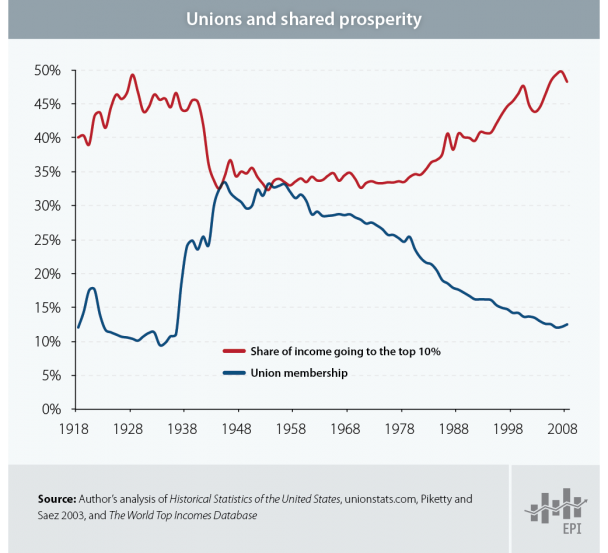


The attack on unions, partly funded by the Kochs, correlates with the rising income disparity in the U.S. economy (see the graph).

...anyway, that judicial corruption has certainly borne bitter fruit.

Friday, February 23, 2018

Money Technology, the Basics

Why advocate public banking? The way we allocate resources, rewards and punishments is with money. Money often trumps public process, political power and even laws as written. Banks, not votes, or even political influence, often decide public policy, plans, and particularly what actually gets built. (Caveat: those other things have influence, and may encourage / prevent actual improvements, but banks have a veto.)

If we're to have an enriched, sustainable public realm, the public needs to take charge of at least part of the money currently controlled by private banking, and one way to do that is with public banks. Currently, private profit directs public policy. If the public is to be in charge and empowered, public purpose needs to balance private profit.

By my lights, what’s posted below is critical path information. To keep the information in manageable hunks, here are the topics covered:

1. Money Technology
2. Public Banking
3. A Non-Issue: Inflation
4. The Real Enemy: Austerity

One final note. Most of this is based on the work of some heterodox economists often called Modern Money Theorists. Their advice is not necessarily partisan. Warren Mosler advised Bush 43, and Michael Hudson advised Dennis Kucinich. Unlike the orthodox economists--from “lefty” Krugman to “righty” Mankiw--these heterodox economists predicted the Great Recession. One of them--Steve Keen--won the Revere prize in economics for that prediction. The economics “Nobel” that Krugman got is issued by (private) Swedish banks, not the Nobel committee that issues the Peace prize. Why did orthodox economics miss one of the biggest bank crises in history? Answer: Because orthodox economics omits analysis of lending and banks. That means conventional economics cannot detect bank crises like the subprime/derivatives meltdown in 2007-8.

#1: Money Technology

“Only puny secrets need protection. Big discoveries are protected by public incredulity.” -  Marshall McCluhan

Although many people treat it like a commodity--a lump of gold, for one example--money is actually (and historically) a measurement, more like the score at the ballgame or the inches on a ruler. It’s a way to keep track of obligations. It evaluates debt; it is an IOU amount and marker.

If, rather than cash, you accept an IOU from a neighbor who is buying your lawn mower at your garage sale, then use the IOU to satisfy a debt with another neighbor, that IOU amounts to a “money thing.” It has both purchased goods and paid off debt. The IOU measures or tracks the obligation(s) throughout the process, and makes the transaction more precise. As economist Hyman Minsky used to say: “Everyone can make money; the problem is getting it accepted.”

Perhaps the most common money technology is checking accounts. When we have such an account it is our asset, but to the bank, it is a liability (an IOU or a debt). When you write a check, you’re assigning a portion of the bank’s liability to the payee. The assets and liabilities are exactly the same item; which one is which depends on one’s perspective (bank or depositor).

This is true for the currency in your wallet, too. Dollars are, in effect, checks made out to “cash” in fixed amounts, drawn on the Federal Reserve (AKA “the Fed,” the United States’ central bank). The Fed carries currency on its books as a liability just as your bank carries your checking account as its liability. Banks also have liabilities for interest-bearing savings accounts and the Fed has an equivalent to such accounts in T-bills and Treasury bonds.

The sum of all dollar financial assets in circulation in the economy therefore equals, to the penny, the national “debt” (a word written in quotes because it is so different from household debt). That statement is not exotic economics; it’s double-entry bookkeeping.

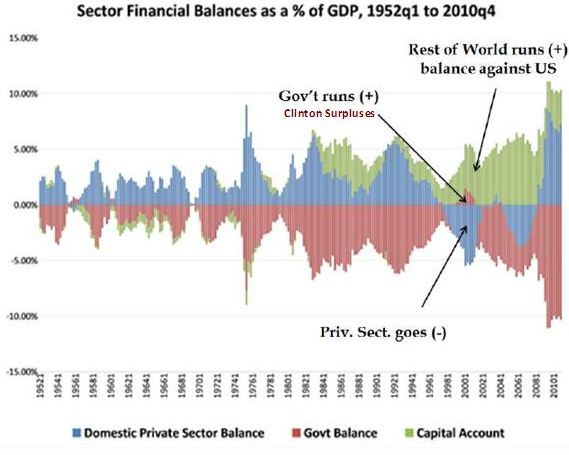
Here’s an illustration of sectoral balances over the years (liabilities are below the line, assets are above):

(This divides the private sector into Domestic and “Capital Account”--i.e. Foreign trade, too)

Clearly assets and liabilities mirror each other. This means, as mentioned above, national “debt” is completely unlike household debt; it’s like bank debt, or household asset.

Even so, the marketing of panic about national “debt” is widespread and well funded. We’re constantly told national “debt” is like household debt. For just one example, Obama compared the federal budget’s deficit to credit card debt.

But no one ever goes to their bank to demand it shrink the amounts in checking accounts, or to say that the bank’s debt is going to crush their grandchildren, and would the bank please diminish its own liability (i.e. the depositors’ assets in their accounts) by increasing its fees or decreasing the interest paid on savings accounts. That would be crazy.

Nevertheless, Pete Peterson and other billionaires are funding think tanks, “Fix the Debt” speaking tours and the like. Local congressman Ami Bera sponsored a Peterson-funded Concord Coalition “Budget Workshop” to poll participants about the best ways to decrease national “debt”--in other words to decrease the population’s assets we call “savings.”

What happens historically when the population plays the “Fiscal Responsibility™“ con game, and significantly reduces national “debt”? The last time this occurred was the Clinton surplus. The previous time such a reduction occurred was in 1929. Andrew Jackson actually paid the “debt” off in 1835. There are seven such major “debt” paydowns since 1776. What happens 100% of the time is that these fits of “Fiscal Responsibility™“ are followed by Great Depression-sized holes in the economy, the worst of which was the Panic of 1837.

The disastrous economic fallout from reducing the population’s assets makes some sense, too. Creditors don’t say “There are fewer dollars in circulation, so we’ll forgive this month’s mortgage payment.” No, they say “Pay your payment or we’ll take your house.” So diminishing the population’s savings in dollar financial assets crushes debtors, and leads to waves of asset forfeitures and foreclosures. Vulture capitalists like Pete Peterson profit mightily from such events, but most ordinary citizens don’t.

There are two other surprising corollaries to the observation that the money government spends and leaves in the economy (rather than retrieving it in taxes) is the population’s asset, not household debt:

Sovereign, fiat currencies (dollar, yen, pound, but not euro) do not provision the governments that issue them. They can’t. Where would taxpayers get the dollars with which to pay taxes if government didn’t spend them out into the economy first? The notion that currency creators must wait for tax revenues to fund programs is really just deflation and austerity promoted in service to vulture capitalists. “Pay as you go” is plausible for households (currency users), but not for governments who are currency creators. It’s practically a logical tautology to say you cannot pay taxes until you have the dollars spent by government, but you’ll hear “tax and spend,” rather than the more accurate “spend, then tax” whenever you listen to mainstream pundits.

While taxes don’t pay for (federal) government programs, they are necessary, however, to make the money valuable. The promised payoff implied by currency is that it will retire those inevitable future tax obligations. Taxes make the money valuable; they don’t provision the (federal) government. Currency is really just tax credits.

The Federal government makes the money and does not need yours. If you went to the Treasury building in Washington D.C. and paid your income taxes in cash, after marking your bill “paid,” Treasury would shred the dollars. They don’t need your money, and make as much as they need whenever policy makers ask for it. Witness the aftermath of Lehman’s bankruptcy when, according to its own audit, the Fed pushed $16 - $29 trillion out the door in 2007-8. (More accurately: they permitted that $16-$29 trillion to be overdrawn in the financial sector’s accounts at the Fed.)

No one ever says “Hey, we’re out of money” when it comes to a war or bank bailouts, public officials only say that for social and environmental programs.

For more information:

See Randall Wray’s piece about the status and history of U.S. Federal “debt” here.

For a comprehensive look at the clever way Italians are side-stepping their monetary non-sovereignty as part of the European Union, see an account of how they are paying people with tax credits. (Never underestimate an Italian!)

For even more details, try Warren Mosler’s Seven Deadly Innocent Frauds of Economic Policy, a 35-page pamphlet that’s available free online.

#2 Public Banking

“…banks make their profits by taking in deposits and lending the funds out at a higher rate of interest” said Paul Krugman in 2015, demonstrating that a Nobel prize-winning economist, doesn’t know what banks do.
So far, it’s clear that currency creators are fiscally unconstrained, despite the existence or entirely optional, self-inflicted limitations like the “debt” ceiling. It’s even reassuring to know currency creators can never be involuntarily insolvent, so worry about “going bankrupt” like Greece (which cannot make its own euros) is not an issue, ever for the U.S. But, like households (and Greece), local and state governments are currency users, not currency creators.

Fortunately, public banking provides solutions that can ease state and local governments’ fiscal constraints.

In general, banks create money too. Banks do this by extending credit with fractional reserve lending. One commonly cited estimate of the amount of bank-created money in the economy: 97% of the money in circulation.

Fractional reserve lending originated with medieval goldsmiths, who stored people’s gold and issued receipts. People storing gold discovered the receipts were more convenient to use as money, and began doing so. Goldsmiths also discovered people seldom retrieved their gold, so they could issue more receipts than they had gold--and in doing so invented “fractional reserve lending.” The downside of this practice: When everyone wants their gold at once, that’s called a “run on the bank.”

Note: Even private, commodity-backed currency like the goldsmiths’ receipts are IOUs. In this case it’s “IOU a lump of gold.”

Modern bankers create money by lending more than they have on deposit--in this case dollars, not gold, is what’s on deposit--but the principle is the same. Banks do not lend their dollar reserves.

By issuing a loan, banks create money, typically by opening a checking account for the borrower. From the bank’s point of view, the IOU (note) from the borrower describing what’s owed and how it will be repaid is the bank’s asset, while that checking account is the bank’s liability. Notice: no reserves appear in this bookkeeping.

So if buyers borrow to buy a house, they write the sellers a check on that new checking account created for the mortgage. If the seller banked at the same location as the borrower, the bank would simply shift numbers between the buyer’s account and the seller’s account. No deposited dollars would change hands. If the buyer and seller bank at different locations, then the Fed settles any imbalance, and makes sure all banks have the required amount of reserves. Banks can borrow reserves without limit from the Fed too, at less than one percent interest a year!

Banks are, and must be, heavily regulated. They must have a minimum amount of reserves and adhere to several other restrictions to have the license to make money this way, and to get Federal Deposit Insurance that prevents runs on the bank.

In any case, the saying is “Loans create deposits.” Notice also that the borrower’s asset (checking account) and liability (mortgage note) are equal, as are those things on the bank’s books--the borrower’s checking account is a bank liability while the mortgage note is a bank asset.

The difference made by a public bank is that public benefit, rather than profit, would determine the kinds of loans available. One local example occurred with the Transit-Oriented Development (TOD) Phil Angiledes attempted in Laguna West. To be successful in lowering environmental impacts, TODs require higher-density housing so enough patrons can walk to the transit stops or local commerce to make them viable. Working TODs can cut vehicle miles traveled roughly in half, compared to sprawl.

Oddly enough, no apartment or condo construction financing was available from private lenders when Laguna West builders tried to build high density housing. Could banks avoid loans that would impair their profitable auto loan (and auto inventory loan) business? Could private profit trump public benefit? And is the pope still Catholic?

...OK, in fairness, I’ve been told by a knowledgeable banker (Modern Money Theory founder Warren Mosler) that bankers generally are just not that sophisticated in their thinking. Some other cause probably made them hesitant to lend apartment money--perhaps the proximity of the many foreclosures on apartments in the Savings & Loan scandal.

Still, notice that the public process (Sacramento County’s planning), and even a politically-connected developer (Angiledes) didn’t determine what was built. Banks did. The iron law of architecture is no longer “Form follows function,” it’s “Form follows finance.”

Public opportunities with large up-front investments that ultimately save money include “Housing First” programs for the homeless, energy-saving retrofits and solar installations for public institutions, and suburban retrofits (housing in shopping centers to make them mixed use). Private banks do not currently make such loans.

California actually has a (public) Infrastructure Bank now, but as valuable as it is, its underwriting is so restrictive that it cannot make a loan to install solar panels based on the savings a public entity might enjoy (that might have changed, but in my conversation with the bank’s chief he voiced his frustration at his inability to fund such investments in energy saving projects, never mind Housing First for the homeless, which he said he certainly could not fund).

Restrictions to its underwriting also meant California’s Infrastructure bank could not finance either the Bay Bridge seismic rebuild or the Kings’ Stadium; (private) Goldman Sachs did that. The California Infrastructure Bank’s restrictive underwriting practice really has no other reason than “That’s how it is,” too. Well, that and the standard difficulties in making good loans.

So...public banking could actually make a difference and remove the “we’re out of money” excuse for (good) projects that could save public money. It could be an essential element in a more robust, sustainable public realm, serving the public, not just private profit.

One specific proposal ECOS might back: emulate the East Bay communities’ study of public banking. It’s proposed such a public bank could fund clean energy, too. Here’s a direct link to one organization promoting the East Bay idea. I’ll post more specifics about their process as I get information from them. So far, they’ve said they want to confine their study area to Alameda County.

Should SMUD create a public bank dedicated to financing renewables installations? After all, Ford and GM made most of their profit in many recent years from financing auto purchases, not from making the cars themselves. This way, SMUD could remain a guiding force in the community even if its power supplying days ended provided it financed the technology replacing its generating power.

#3 A Non-Issue: Inflation

A common objection to the previous descriptions of money technology is that “B...but if you just print money, you’ll get [gasp!][hyper-] inflation!”--never mind that creating money out of nothing is the norm now for any money in the economy.

Government money creation could theoretically create inflation since real goods and services are limited, while government’s ability to create money is not. Government could bid up prices, competing with the private sector for limited goods and services, and win every bid even if it meant prices rose. In other words, theoretically, government spending could cause inflation. It just never happens in reality.

First, notice that the bidding process is absolutely necessary for the inflation to occur. Simply creating a lot of money then squirreling it away (or paying off loans with it) does not bid, and does not cause inflation.

If Treasury were to mint a few trillion-dollar coins--something it can literally and legally do--then deposit them at the Fed, the government’s balance sheet could move from “deficit” to “surplus” without any impact on the economy because there would be no spending--demonstrating that the panic about the “debt” level is overblown. Spending occurs at the beginning of debts, when they are initiated, in any case. Loan payoffs are, in effect, “un-spending” since they remove money from circulation in extinguishing the IOU.

Similarly, no inflation resulted from the $16 - $29 trillion the Fed produced in 2007-8 to rescue the financial sector from its own frauds. Why? That money mostly paid off loans (actually it provided overdrafts for counterparties of creditors no longer willing to believe their debtors had sufficient assets to pay their obligations).

Another non-inflationary policy: a job guarantee. Without raising taxes, government could employ everyone currently unemployed who wanted a job, and since no one else is bidding for the unemployed, by definition, no inflation would ensue. The U.S. has already done something like this with FDR’s WPA which was part of the recovery from the Great Depression.

In any case, no historic episode of hyperinflation was ever caused by printing lots of money.

"Not a single one of … 56 cases [of hyperinflation documented by a recent Cato study of such episodes] were caused by a central bank that ran amok. In virtually every case, the inflation was not caused by too much money but too few goods." Farming collapsed in Zimbabwe, France annexed the industrial Ruhr depriving Weimar Germany of goods.

"Inflation is overwhelmingly driven by cost-push variables... Printing money just doesn't do it. If it did, Japan would have exploded decades ago, because they've been trying quantitative easing for nearly 20 years, and they can't move the needle on inflation. We've been trying it here in the U.S. for about five years, and Bernanke can't even hit his 2% target." - Stephanie Kelton October 2013 (She is Bernie Sanders’ former Senate budget committee economics advisor, and cites a Cato Institute study. Cato is a libertarian think tank, funded by the Koch brothers, so no tree huggers here.)

Late breaking news: Ms. Kelton gets a NY Times op-ed.

Just so we’re clear: Weimar Germany did print lots of money during its 1920’s hyperinflation, but that did not cause the hyperinflation, just as the $16 - $29 trillion the Fed issued in 2007-8 didn’t cause a surge of inflation. Printing money alone doesn’t cause inflation. Typically, such inflation originates with a shortage of goods, perhaps even essential commodities (e.g. oil in the ‘70s). That’s true of the hyperinflation episodes cited by Cato above. For a comprehensive look at the mechanics of inflation by heterodox economics, here’s a highly recommended article. A little technical, but really the complete story.

Notice that the mainstream media narrative about inflation makes the population expect more inflation than actually appears (Stephanie Kelton calls the programmed reaction “Pavlovian”... and I agree.):


In my experience, it’s probably hardest to persuade the public to accept that, while it can potentially limit the fiscally-unconstrained spending of a monetary sovereign, inflation has not been a problem initiated by “printing” money. The current narrative sold by mainstream media and the advanced form of superstition promoted by orthodox economics is difficult to dislodge. Manufacturing that narrative is therefore extremely important in maintaining the status quo. The Kochs spent nearly a billion dollars in the 2016 elections promoting just that story.

If you, dear reader, retain some skepticism about what I’ve said above, You might ask yourself where are the warnings about deflation? It’s far closer to what’s happened recently--see oil prices, and house prices in 2007. Financial assets have been spared deflation by the Fed’s purchases (“Quantitative Easing”) that prop up asset prices, and the Fed still has $4 trillion of private assets on its books. The Fed does announce it’s going to sell those assets (called “the taper,” and the markets’ response was called “the taper tantrum”), and raise interest rates, but so far hasn’t done this.

Deflation is far more harmful to the economy than inflation--which, to be fair, harms creditors and savers--since inflation allows debtors cannot pay their debts off with cheaper money. Deflation is what we call the Great Depression and phenomena like it.

Inflation remains a non-issue when we have plenty of unemployed people and factories. Labor participation remains low, and factories are currently at about 76% of capacity. That means there is a lot of room for expansion before shortages of goods, and the accompanying upward price pressures occur.

Thursday, February 22, 2018

#4 The Real Enemy: Austerity

Just as vultures profit from the demise of roadkill, so vulture capitalists profit by picking up foreclosed and forfeited assets cheaply. The difference is that, unlike birds, humans are willing to sabotage the population’s livelihoods for their own profit by spreading misinformation about the financial system and money technology itself. Among others, Pete Peterson’s efforts to “fix the debt” and his many foundations put that misinformation out, pretending “Fiscal Responsibility™,” but spreading misinformation.

Despite the obvious-in-retrospect difference between them, it takes very little effort for these deceivers to make the public believe that currency creators and currency users are the same because the public seldom experiences this distinction in the ordinary course of their economic lives. Even the idea that a bank’s liability is a household’s asset, or that national debt is the savings of the population does not appear often in mainstream economics, or the narratives promoted by media and pundits.

So...the idea that the Federal government, like a household, must “pay as it goes” is a commonplace, but the mixed economy that “Made America Great” is disappearing. Why? Government spending on research, the environment, and health and social services all decline as this false narrative gains traction. (For historical perspective about the mixed economy in recent times, see Hacker and Pierson’s American Amnesia: How the War on Government Led Us to Forget What Made America Prosper.)

Examples of how essential government is to social justice (courts, the NLRB), environmental preservation (parks, the EPA), health care (the CDC, vaccines and an estimated 75% of pharmaceutical innovation) or even technology (GPS, the internet, transistors, integrated circuits, touch screens, etc.) are difficult to ignore. Nevertheless, it’s common to hear that taxes are theft and government is useless, and far more corrupt and incompetent than the private sector. (But what about all those private scandals: Equifax, Enron, Adelphia, Silverado Savings & Loan, Credit Mobilier, etc?)

Unfortunately, even the promoters of government innovation like economist Marianne Mazzucato don’t always understand money technology. Mazzucato, for one, wants government to be reimbursed for its investments in research and development. Not a terrible idea, but certainly unnecessary. This misperception of government’s role in the economy leads even “lefties” like Dilma Rousseff in Brazil to adopt austerity, ultimately leading to their own demise (Rousseff is out of power).

Given the narrative that taxes are theft and government is a bunch of incompetents--heard even from government employees by this author--it’s not difficult to understand why austerity, cutting back taxes, and cutting back programs, has occurred. For just one example, federal spending on higher education has diminished 55% since 1972. I’ve heard from educators themselves that states have cut higher education funding even more than the federal government. As a consequence college tuition rose, and generations of students graduate to decades of debt peonage.

The current situation echoes the post-civil war “Gilded Age.” The Confederate South was particularly hard hit. Not only did Washington encourage deflation by withdrawing its fiat currency (“greenbacks”) from circulation, the South lost their biggest asset (slaves), all their banks failed, and Confederate currency was invalid. Lawrence Goodman’s The Populist Moment says that the state of Connecticut had as much currency as the entire Confederate South.

So...Southerners bought necessities on credit from the “furnishing man” (shortened later to “the man”) at interest rates that would be familiar to payday lenders now. As security, farmers had to pledge the “crop lien”--an obligation denominated in dollars that was still owed if prices fell, or crops failed. What happened as a result? Debt peonage supplanted slavery.

The U.S. can still become a nation of debt peons now, funneling all the economy’s surplus to the one percent (the creditors), privatizing what used to be free (roads, schools, ports, airports, etc.), making an entire economy navigable only through a series of tollbooths, while a small cohort of plutocrats gets to enjoy the fruits of the debt peons’ labor. (Actually, the plutocrats are miserable too. See The Spirit Level). There are indications we’ve already begun this process. See the Princeton study declaring the U.S. is no longer a democracy, it’s an oligarchy. The narrative answering those observations: all the wealthy earned their fortunes; no wealthy person stole their money, so pay no attention to the man behind the curtain.

Look for austerity locally as governments excuse their inability to fund essential programs--never mind how wasteful or subsidized are the current programs for plutocrats--like sports teams, and land speculation. Boards of Supervisors and City Councils will say “Our pension obligations are too big!” and begin to squeeze essential programs, and try to persuade pensioners to reduce COLAs, health insurance payments, etc. This is all clothed in “Fiscal Responsibility™,” but completely unnecessary, given the covert subsidies to land speculators, builders and finance that could more than fund what they plan to “bravely” cut.

Public banks could recycle infrastructure dollars locally--and nearly half of the cost of infrastructure is typically financing. Public banks also offer high yields as investments, and the bulk of California’s pension payments (for CalPERS, 62%) derive from investment earnings. Do public banks suggest an alternative to Wall Street’s lower-earning investment offerings?

Locally, Sacramento County Supervisor Sue Frost has repeatedly informed her constituents that they must be “brave” in anticipation of service cuts, because we’re running out of money (“Our reserves are low”). When I sent her several solutions to budget shortfalls, including the suggestion that the County use a public bank to fund money-saving solutions like a line of credit to deal with temporary revenue shortfalls, her response was...silence.

The public--you and I--and the environment will suffer if we continue down the path of austerity. Assuming humanity survives, you and I--and our children and grandchildren--will be at the service of the monied interests if we ignore what can solve our problems.

I say let’s have the money serve us rather than vice versa.

For more about austerity, see Mark Blyth’s Austerity: The History of a Dangerous Idea. Here are some excerpts:

[p.179] “There are … cases where austerity as policy reached its limits and either broke down or broke the society it was being imposed upon. The natural histories of these episodes demonstrate quite clearly that economies do not ‘self-heal’ once ‘the bust’ has run its course. Austerity was tried, and tried again--its application was not wanting--and it simply didn’t work. In fact, its repeated application made things worse, not better, and it was only when states stopped pursuing austerity that they began to recover.”

[p.196-7] “...repeated rounds of austerity policy, plus the ideological intransigence of the Social Democrats, helped to bring Hitler to power far more than any memory of inflation a decade earlier. … By 1933 the lesson should have been clear. You can’t run a gold standard [i.e. austerity policies] in a democracy. Eventually people will vote against it. They did so in Sweden and they did so in Germany. Austerity gave interwar Europe both social democracy and genocidal fascism.” [Blyth goes on to explain how Japan suffered similarly]

Blyth (4:17) explains Brexit and “Trumpism” as a consequence of austerity too. The short video is an explanation of why global “Trumpism” exists (from a European perspective) as clear and concise as can be.

Wednesday, February 21, 2018

Curitiba Stories

Curitiba, Brasil is one of the most amazing success stories of urban, environmentally-friendly policies. It's success is even more significant since it implemented these policies with third-world funding and a population with low income levels. These success stories began with the election of Jaime Lerner, and architect who was the nephew of the guy who was supposed to be elected. Lerner stood in for his uncle, and began surprising the conventional thinkers.

Lerner had some first world problems, but among his initial difficulties were cleaning up the dilapidated, third-world barrios near the city. These had streets too narrow for conventional trash collection. So what did he do? He sent trucks with bags of food. He would trade residents a bag of food for a bag of garbage. Presto! One health hazard gone, and the barrios were clean and more habitable!

Curitiba is a large city, with more than a million residents, so Brazil's central government sent it money to build a subway. Subways (heavy rail) are about ten times more expensive than light rail, which, in turn, is about ten times more expensive than buses. The problem with buses, however, is that you need to employ a driver for every 80 or so passengers, whereas the trains can simply add cars to accommodate larger loads.

Lerner collaborated with Volvo to produce multi-section buses, and designed the Bus Rapid Transit (BRT), or "Speedybus," stops to mimic train stations, and provide all the handicap access, rather than burden buses with special lifts and equipment. At one point, Volvo was going to suggest an automated docking system to align with the stations' doors, but a driver suggested painting a line in the road, and so they avoided even that expense.

Incidentally, the stops and fares are publically owned and controlled. The buses are funded by private companies.

So Curitiba was able to have 100 times the subway distance served by BRT, and has one of the most successful transit systems in the world. It's well used, and well-funded. In fact it makes money.

Part of making this work is that the land use reflects the Speedybus routes. Higher density housing is adjacent to the BRT stops. Feeder buses and vans serve nearby lower density housing.

One other land-use consideration: Curitiba has lots of floodplain. Rather than develop it, and maintain expensive levees, the city bought the floodplain, and now Curitiba is a world leader in park acreage per capita.

But Curitiba was too poor to mow and maintain this expanse as park with lawns. Enter the "municipal sheep," who trim the grass and provide wool that funds other programs. These other programs include mentorship programs. Those barrio residents now can intern with maintenance workers for the city.

Curitiba also had a harbor full of junk discarded during previous administrations. Lerner proposed paying the fisherman as much as they would get for fish for the junk they retrieved. His harbor was cleaned up at a fraction of the cost of a formal cleanup operation.

Lerner was so successful that other cities emulate his BRT and other solutions. Lerner himself successfully ran for governor of the Brasilian state, Parana. His innovations remain an inspiration for those of us in much wealthier countries, though.

Why isn't Brazil as productive as Switzerland?

  The problem with this argument is it rests entirely on the widely misunderstood concept of labor productivity. Many people, especially no...