[See also: Sprawl is not the best alternative]
Although newer developments may change this pattern, the vast majority of what California builds now is auto-centric sprawl--despite market premiums paid for the pedestrian-friendly mixed use of traditional neighborhoods. Since recent fires threaten sprawl, or edge-city housing throughout the state, it seems appropriate to remind people that fire danger is not the only cost of this development pattern, and that fire danger and several other problems will persist until we return to that traditional mixed-use, pedestrian-friendly development style rather than continuing to expand our suburbs at their edge.
More compact development is roughly half as expensive to maintain as sprawl, so sprawl costs local governments dollars they might need for other services, and just from a financial standpoint, sprawl degrades the public realm. Traditional development also means a reduction in vehicle miles traveled of roughly half what sprawl requires--something worth exploring in an era when CO2-producing commutes make global warming encourage those fires too.
The hallmark of sprawl itself is the mandatory automobile. Every driving age adult must own one, and every trip of any significance must be in a car. We build our cities for auto dealers, then. This requirement is also one of the most regressive "taxes," crushing the poor, and worsening the banana republic level of wealth inequality in U.S. society.
Besides separating different incomes into class mono-cultures--"No multi-unit buildings among the mansions, I tell you, harrumph!"--sprawl separates different uses--residences, commerce, offices, industry--connecting them only with auto-friendly streets. That is why the auto is not optional. It's the only connection between these uses.
Crossing sprawl streets is dangerous for pedestrians, too. The little tertiary street in front of my (sprawl) house is 40 feet wide. That's two 12 foot travel lanes and two eight foot parking lanes. The 12 foot travel lanes are as wide as freeway lanes, and unsurprisingly constitute an invitation to speed that is so difficult to resist that the County's standards for these streets require them to bend every 1,000 lineal feet. Otherwise speeding cars would mow down the neighborhood kids. This is one of the origins of the spaghetti streets that make sprawl difficult to navigate.
To give you a sense of how disproportionately wide these little neighborhood streets are, one of the biggest, busiest shopping streets in London (Oxford Circus) has only 40 feet of pavement for autos and buses (not counting the medians). Flanking Oxford Circus are several multi-story "malls," and the street itself is busy with four lanes of those double-decked buses and autos. The takeaway: sprawl streets include a lot of unnecessary asphalt. Narrower travel lanes would not only be cheaper to build, they would be safer, slowing down the speeding cars.
The subtler effects of sprawl derive from how it degrades the public realm. Traditional communities had public squares, or parks that were in important locations where you could encounter a critical experience: being a member of a larger society. Sprawl equivalents to the public realm are private malls, where the very walls shout "Buy me!" (Gosh, I wonder why our kids are so materialistic!), and parks that occupy unimportant land--often floodplain. The chance to actually experience being a member of society, strolling among the neighbors, diminishes as sprawl spreads. Is it any wonder that the public realm is a mystery to large portions of our population?
Even the treatment of those unable to drive is less-than-optimum in sprawl. In sprawl, viable, unsubsidized transit is impossible. Typically, not enough people live near the stops to provide riders, and even when enough people do live near the stops, the street design makes walking to those stops either undignified or downright impossible.
Interrupted sidewalks and other barriers to access--all land use decisions--make transit something that must be subsidized. It's designed to fail.
Take a look at the picture: That sign sticking in a hill on the side of Greenback at Kenneth is an actual bus stop. No sidewalk offers pedestrians access. Just to get to the stop, you must walk on the shoulder of a street with cars traveling freeway speeds (Greenback) to reach a bus that comes roughly every three hours.
About a half a block away you’ll see this:
Why not move the sign (at least), and
perhaps install a bench? Answer: Because Sacramento transit is designed
to fail--and working as designed. Even if you manage to get on a bus,
the destination is often just as unpleasant. The accommodation for
pedestrians are often primitive, at best. Even if your destination is the
Mall, you must often walk over an ocean of hot asphalt before you reach a
store.
In sprawl, those too young to drive do not even have a chance to demonstrate their own value to their family by going to the corner store. Single use sprawl separates residences from shopping by a car trip, typically, so youngsters need a ride to get that loaf of bread. Yes, sprawl is anti-feminist, turning moms into their kids' chauffeur. Those elders fortunate enough to live past their ability to drive must leave their neighborhood--because if you can't drive you can't shop--and move into that nice warehouse...er, I mean elder-care facility, where their assets are drained paying for their care.
Sprawl mentality instills in public servants a belief that we must pursue self-delusional public policy, too. We have plenty of evidence that un-subsidized transit in sprawl is impossible, yet to preserve the illusion that public policy takes care of those unable to afford cars, Regional Transit persists in providing extremely frustrating, designed-to-fail heavily subsidized transit, which rolls around a bunch of empty buses on three hour intervals. Even the vaunted light rail to Folsom is adjacent to a parking structure that has a three-hour time limit, meaning commuters with eight-hour jobs cannot use this parking if they plan to use light rail to go to work. Another delusional policy proposal: park-'n-rides. The new library design for Orangevale at least considered a 500-space parking lot for commuters to park, then take a ride on the bus. The only problem is that this is a proposal for Hazel Blvd, a street that sees 50,000+ cars per day. So...whoop-de-doo! We get to cut congestion by one percent.
Congestion is another failure of sprawl. Naturally it's much worse when everyone has to drive everywhere, but the remedies proposed--particularly road widenings--remain in the neurotic denial category. Widening roads produces what's called "induced demand." When everyone knows the street is wider, they start changing their route to include that street, and the congestion returns to the same level as it was previously. Unfortunately the road contractors do not refund the millions spent widening the road.
The Southern California Association of Governments mathematically modeled every congestion remedy, up to and including double-decking the freeways. Only one congestion remedy provided significant relief, given the possibility of induced demand: mixed use.
Sprawl costs us our health too. Even as little as a 10-minute daily walk leads to a significant reduction in late-life health problems. Sprawl builds that walk out of daily life, so we're afflicted with an epidemic of the diseases of chronic inactivity: obesity, heart and artery disease, type 2 diabetes, etc.
The insanity of sprawl land use afflicts us in many ways. It lengthens commutes, continuing our dependence on fossil fuels, making necessary our belligerent presence in the Middle East. It impairs the public realm, separating and alienating populations from each other. It impairs our health, and our families find children a burden rather than a help when they cannot drive.
It's bad.
Take another look at these costs:
Although newer developments may change this pattern, the vast majority of what California builds now is auto-centric sprawl--despite market premiums paid for the pedestrian-friendly mixed use of traditional neighborhoods. Since recent fires threaten sprawl, or edge-city housing throughout the state, it seems appropriate to remind people that fire danger is not the only cost of this development pattern, and that fire danger and several other problems will persist until we return to that traditional mixed-use, pedestrian-friendly development style rather than continuing to expand our suburbs at their edge.
More compact development is roughly half as expensive to maintain as sprawl, so sprawl costs local governments dollars they might need for other services, and just from a financial standpoint, sprawl degrades the public realm. Traditional development also means a reduction in vehicle miles traveled of roughly half what sprawl requires--something worth exploring in an era when CO2-producing commutes make global warming encourage those fires too.
The hallmark of sprawl itself is the mandatory automobile. Every driving age adult must own one, and every trip of any significance must be in a car. We build our cities for auto dealers, then. This requirement is also one of the most regressive "taxes," crushing the poor, and worsening the banana republic level of wealth inequality in U.S. society.
Besides separating different incomes into class mono-cultures--"No multi-unit buildings among the mansions, I tell you, harrumph!"--sprawl separates different uses--residences, commerce, offices, industry--connecting them only with auto-friendly streets. That is why the auto is not optional. It's the only connection between these uses.
Crossing sprawl streets is dangerous for pedestrians, too. The little tertiary street in front of my (sprawl) house is 40 feet wide. That's two 12 foot travel lanes and two eight foot parking lanes. The 12 foot travel lanes are as wide as freeway lanes, and unsurprisingly constitute an invitation to speed that is so difficult to resist that the County's standards for these streets require them to bend every 1,000 lineal feet. Otherwise speeding cars would mow down the neighborhood kids. This is one of the origins of the spaghetti streets that make sprawl difficult to navigate.
To give you a sense of how disproportionately wide these little neighborhood streets are, one of the biggest, busiest shopping streets in London (Oxford Circus) has only 40 feet of pavement for autos and buses (not counting the medians). Flanking Oxford Circus are several multi-story "malls," and the street itself is busy with four lanes of those double-decked buses and autos. The takeaway: sprawl streets include a lot of unnecessary asphalt. Narrower travel lanes would not only be cheaper to build, they would be safer, slowing down the speeding cars.
The subtler effects of sprawl derive from how it degrades the public realm. Traditional communities had public squares, or parks that were in important locations where you could encounter a critical experience: being a member of a larger society. Sprawl equivalents to the public realm are private malls, where the very walls shout "Buy me!" (Gosh, I wonder why our kids are so materialistic!), and parks that occupy unimportant land--often floodplain. The chance to actually experience being a member of society, strolling among the neighbors, diminishes as sprawl spreads. Is it any wonder that the public realm is a mystery to large portions of our population?
Even the treatment of those unable to drive is less-than-optimum in sprawl. In sprawl, viable, unsubsidized transit is impossible. Typically, not enough people live near the stops to provide riders, and even when enough people do live near the stops, the street design makes walking to those stops either undignified or downright impossible.
 |
| Note the lack of sidewalks connecting this "bus stop" to nearby residences. |
Interrupted sidewalks and other barriers to access--all land use decisions--make transit something that must be subsidized. It's designed to fail.
Take a look at the picture: That sign sticking in a hill on the side of Greenback at Kenneth is an actual bus stop. No sidewalk offers pedestrians access. Just to get to the stop, you must walk on the shoulder of a street with cars traveling freeway speeds (Greenback) to reach a bus that comes roughly every three hours.
About a half a block away you’ll see this:
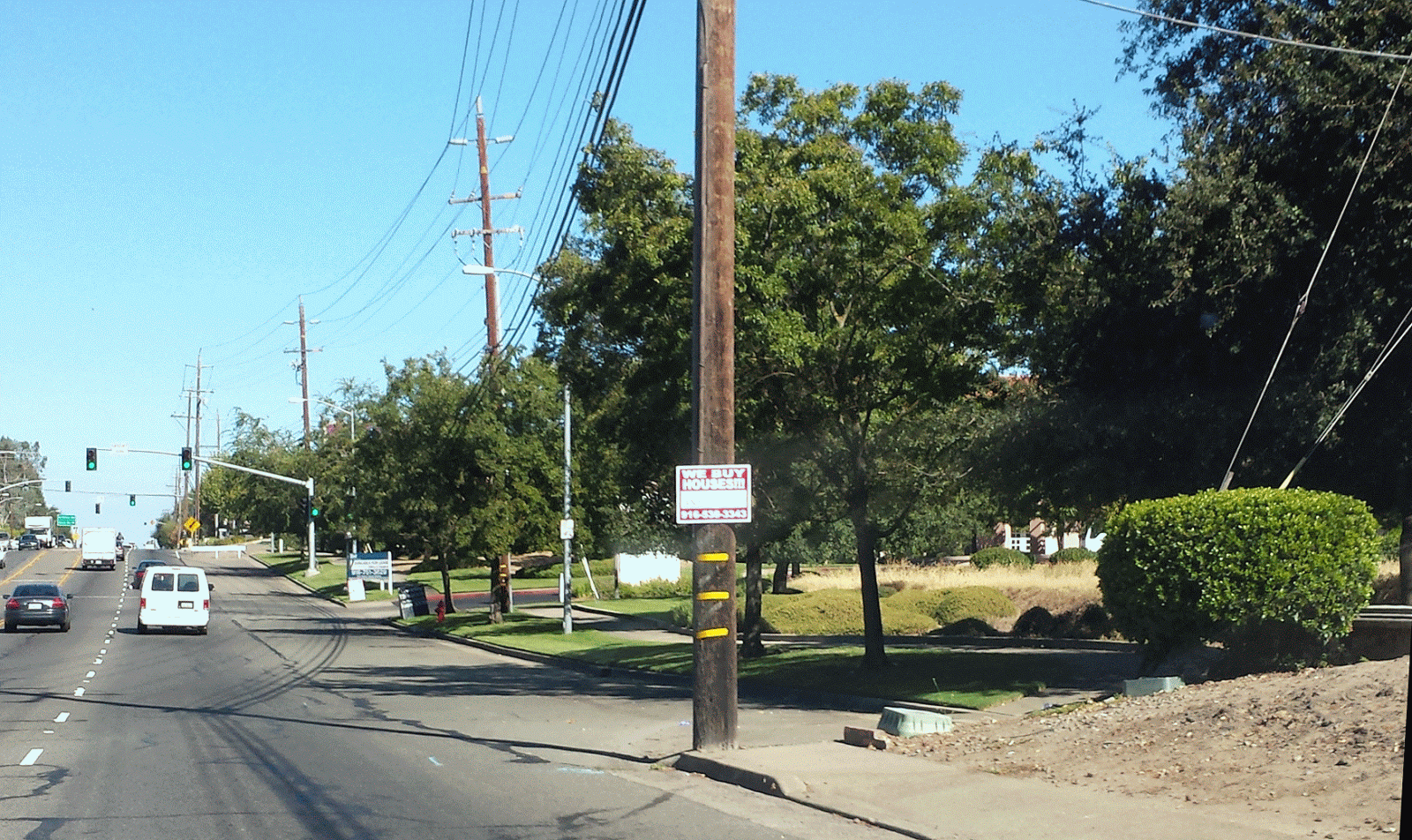 |
| Sidewalks, potential destinations (health club, doctors' offices), even a turnout...but no bus stop. |
In sprawl, those too young to drive do not even have a chance to demonstrate their own value to their family by going to the corner store. Single use sprawl separates residences from shopping by a car trip, typically, so youngsters need a ride to get that loaf of bread. Yes, sprawl is anti-feminist, turning moms into their kids' chauffeur. Those elders fortunate enough to live past their ability to drive must leave their neighborhood--because if you can't drive you can't shop--and move into that nice warehouse...er, I mean elder-care facility, where their assets are drained paying for their care.
Sprawl mentality instills in public servants a belief that we must pursue self-delusional public policy, too. We have plenty of evidence that un-subsidized transit in sprawl is impossible, yet to preserve the illusion that public policy takes care of those unable to afford cars, Regional Transit persists in providing extremely frustrating, designed-to-fail heavily subsidized transit, which rolls around a bunch of empty buses on three hour intervals. Even the vaunted light rail to Folsom is adjacent to a parking structure that has a three-hour time limit, meaning commuters with eight-hour jobs cannot use this parking if they plan to use light rail to go to work. Another delusional policy proposal: park-'n-rides. The new library design for Orangevale at least considered a 500-space parking lot for commuters to park, then take a ride on the bus. The only problem is that this is a proposal for Hazel Blvd, a street that sees 50,000+ cars per day. So...whoop-de-doo! We get to cut congestion by one percent.
Congestion is another failure of sprawl. Naturally it's much worse when everyone has to drive everywhere, but the remedies proposed--particularly road widenings--remain in the neurotic denial category. Widening roads produces what's called "induced demand." When everyone knows the street is wider, they start changing their route to include that street, and the congestion returns to the same level as it was previously. Unfortunately the road contractors do not refund the millions spent widening the road.
The Southern California Association of Governments mathematically modeled every congestion remedy, up to and including double-decking the freeways. Only one congestion remedy provided significant relief, given the possibility of induced demand: mixed use.
Sprawl costs us our health too. Even as little as a 10-minute daily walk leads to a significant reduction in late-life health problems. Sprawl builds that walk out of daily life, so we're afflicted with an epidemic of the diseases of chronic inactivity: obesity, heart and artery disease, type 2 diabetes, etc.
The insanity of sprawl land use afflicts us in many ways. It lengthens commutes, continuing our dependence on fossil fuels, making necessary our belligerent presence in the Middle East. It impairs the public realm, separating and alienating populations from each other. It impairs our health, and our families find children a burden rather than a help when they cannot drive.
It's bad.
Take another look at these costs:
- Fires threaten edge cities
- Doubled maintenance costs
- Double vehicle miles traveled
- Divide (and conquer) the population by income
- Requires autos - a regressive "tax"
- Discourage walking
- Socially disenfranchise the elderly and young
- Contribute to ill health, removing walking from daily life - Degrade the public realm and the experience of being a member of society.
- Transit is, and will always be, lame.
- Discourage youth from contributing to their families
- Encourage dysfunctional public service (delusional transit plans, park-'n'-rides)
- Increase Congestion
- Encourages meddling in the oil rich portions of the planet (the Middle East).
- Markets pay premiums for the alternative.

