Wednesday, February 27, 2019

Krugman vs Kelton on the fiscal-monetary tradeoff

26 February, 2019 at 16:01 | Posted in Economics | 
 
stefPaul Krugman is back again telling us that he doesn’t really want to spend time on arguing about MMT — and then goes on complaining that well-known MMTer Stephanie Kelton says things “obviously indefensible.” What has especially irritated the self-proclaimed ‘conventional’ Keynesian is that Kelton “seems to claim that expansionary fiscal policy … will lead to lower, not higher interest rates.”
Now, the logic behind Krugman’s “conventional Keynesian” loanable-funds-IS-LM-theory is that if the government is going to pursue an expansionary fiscal policy it will have to borrow money and thereby increase the demand for loanable funds which will — “other things equal” — lead to higher interest rates and less private investment.
The loanable funds theory is in many regards nothing but an approach where the ruling rate of interest in society is — pure and simple — conceived as nothing else than the price of loans or credits set by banks and determined by supply and demand in the same way as the price of cars and raincoats.
It is a beautiful fairy tale, but the problem is that banks are not barter institutions that transfer pre-existing loanable funds from depositors to borrowers. Why? Because, in the real world, there simply are no pre-existing loanable funds. Banks create new funds — credit — only if someone has previously got into debt! Banks are monetary institutions, not barter vehicles.
In the traditional loanable funds theory — as presented in Krugman’s own textbooks — the amount of loans and credit available for financing investment is constrained by how much saving is available. Saving is the supply of loanable funds, investment is the demand for loanable funds and assumed to be negatively related to the interest rate.
The loanable funds theory in the ‘New Keynesian’ approach means that the interest rate is endogenized by assuming that Central Banks can (try to) adjust it in response to an eventual output gap. This, of course, is essentially nothing but an assumption of Walras’ law being valid and applicable, and that a fortiori the attainment of equilibrium is secured by the Central Banks’ interest rate adjustments. From a Keynes-Minsky-MMT point of view, this can’t be considered anything else than a belief resting on nothing but sheer hope.
The traditional loanable funds theory is that it assumes that saving and investment can be treated as independent entities. This is seriously wrong:
gtThe classical theory of the rate of interest [the loanable funds theory] seems to suppose that, if the demand curve for capital shifts or if the curve relating the rate of interest to the amounts saved out of a given income shifts or if both these curves shift, the new rate of interest will be given by the point of intersection of the new positions of the two curves. But this is a nonsense theory. For the assumption that income is constant is inconsistent with the assumption that these two curves can shift independently of one another. If either of them shifts​, then, in general, income will change; with the result that the whole schematism based on the assumption of a given income breaks down … In truth, the classical theory has not been alive to the relevance of changes in the level of income or to the possibility of the level of income being actually a function of the rate of the investment.
Savers and investors have different liquidity preferences and face different choices — and their interactions usually only take place intermediated by financial institutions. This, importantly, also means that there is no ‘direct and immediate’ automatic interest mechanism at work in modern monetary economies. What happens at the microeconomic level is not always compatible with the macroeconomic outcome. The ‘atomistic fallacy’ has many faces — loanable funds is one of them.
We have to free ourselves from the loanable funds theory — and scholastic gibbering about ZLB — and start using good old Keynesian fiscal policies. Keynes — as did Lerner, Kaldor, Kalecki, and Robinson — showed that it was possible to promote economic growth with an “appropriate size of the budget deficit.” The stimulus a well-functioning fiscal policy aimed at full employment may have on investment and productivity does not necessarily have to be offset by higher interest rates.

Tuesday, February 26, 2019

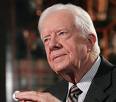
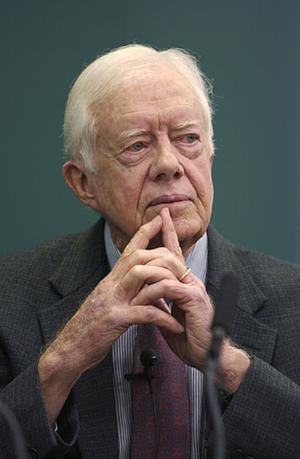
Former US President Carter: Venezuela’s Electoral System “Best in the World”

“As a matter of fact, of the 92 elections that we’ve monitored, I would say the election process in Venezuela is the best in the world.”
 445 
  31  5 
 
  487
First published in September 2012 prior to Venezuela’s October 2012 presidential elections, in which Chavez was reelected.

***

Former US President Jimmy Carter claimed Venezuela’s electoral system is “the best in the world” (agencies).
Mérida, 21st September 2012 (Venezuelanalysis.com) – Former US President Jimmy Carter has declared that Venezuela’s electoral system is the best in the world.
Speaking at an annual event last week in Atlanta for his Carter Centre foundation, the politician-turned philanthropist stated,
“As a matter of fact, of the 92 elections that we’ve monitored, I would say the election process in Venezuela is the best in the world.”
Venezuela has developed a fully automated touch-screen voting system, which now uses thumbprint recognition technology and prints off a receipt to confirm voters’ choices.
Real News 2012 Report on Venezuela’s electoral system

In the context of the Carter Centre’s work monitoring electoral processes around the globe, Carter also disclosed his opinion that in the US “we have one of the worst election processes in the world, and it’s almost entirely because of the excessive influx of money,” he said referring to lack of controls over private campaign donations.
The comments come with just three weeks before Venezuelans go to the polls on 7 October, in a historic presidential election in which socialist incumbent President Hugo Chavez is standing against right-wing challenger Henrique Capriles Radonski of the Roundtable of Democratic Unity (MUD) coalition.
Chavez welcomed Carter’s comments, stating yesterday that
“he [Carter] has spoken the truth because he has verified it. We say that the Venezuelan electoral system is one of the best in the world”.
Chavez also reported that he had had a forty minute conversation with the ex-Democrat president yesterday, and said that Carter, “as Fidel [Castro] says, is a man of honour”. The Carter Centre has recently confirmed it will not send an official delegation to accompany the presidential election, but may have officials observe the process on an individual basis.
Meanwhile, the Union of South American Nations (Unasur) electoral accompaniment delegation arrived yesterday in Venezuela.
The delegation’s head, former Argentinian vice-president Carlos Alvarez, mentioned that this was the Unasur’s first electoral observation mission, and that “for us it’s fundamental to consolidate our democracies, because it’s taken us a lot of struggle, effort and time to establish [democracy] in our countries”.
In press comments after meeting with officials from Venezuela’s National Electoral Council (CNE) Alvarez declared that based on his experience of electoral observation in South America, ”Venezuela has one of the most advanced electoral systems in the region and the continent, that grants a great deal of confidence and transparency”.
Meanwhile, secretary of the MUD, Ramón Guillermo Aveledo, accused the CNE yesterday of being “biased”, and said that it doesn’t adhere to the National Constitution nor electoral law. In an interview with opposition TV station Globovision, he clarified his opinion that “we [the MUD] trust the voting system” but that CNE officials “have a preference” for the government.
The CNE has issued warnings regarding both the MUD and Chavez’s Carabobo Command for infringements of campaign rules relating to electoral publicity and advertising space.
Pro-Chavez sources have speculated that the opposition is planning not to recognise the CNE results in the likely event of a Chavez victory on 7 October. In July, Chavez and Capriles signed an accord by which both agreed to recognise the result announced by the CNE.

How Much Will It Cost to Address Climate Change? Pennies Compared to the Alternative

By Thomas Neuburger. Originally published at DownWithTryanny!
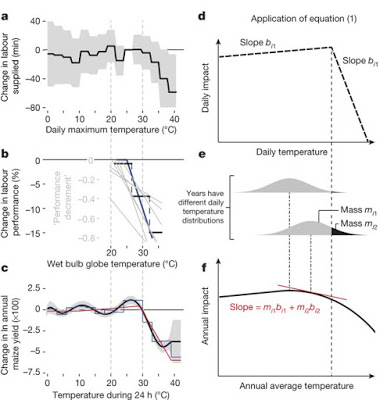
Economic growth and global warming, Figure 1 from a paper studying “Global non­linear effect of temperature on economic production” (link below). “Non-linear” in this case means “at what warming point do economies tend to ‘fall off a cliff'”? It’s not the same point for all economies, but the non-linearity is obvious. (For conversion in charts a, b, and c, 20°C = 68°F, and 30°C = 86°F. Click to enlarge.)

The cost of addressing climate change is much in the news these days, thanks to the Ocasio-Cortez Green New Deal (GND) proposal. Everyone seems to want to know how much it will cost. Too much, according to the editors at Forbes. “The Green New Deal Would Cost a Lot of Green,” they warn us, and the editors at Bloomberg want us to know that “The Green New Deal Is Unaffordable.”

These headlines tell you they measure cost in terms of lost profit, not lost wages, since no one at Forbes or Bloomberg wants to see wages rise. Nor do they consider lost lives.

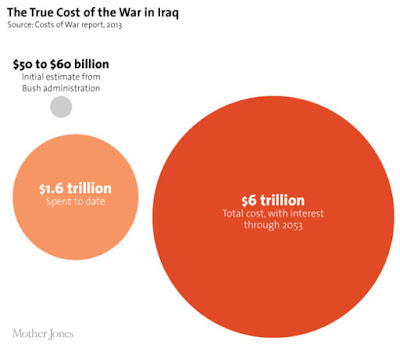
Green New Deal advocates assure us that indeed we can pay for it, partly because of increased productivity (it will put a lot of people to work, FDR-style) and partly because the economy can simply absorb the influx of new money without the need for high “pay for it” taxes, just as the economy is absorbing the multi-trillion cost of the Iraq War and President Trump’s tax cuts. When elites and the wealth they serve want something expensive, they get it, and no one bothers to make them “pay for it” later.


See this Huffington Post article, “We Can Pay For A Green New Deal,” by Stephanie Kelton, Andres Bernal and Greg Carlock for the gist of the “yes, it’s affordable” argument.

Both statements are true, of course. Any attempt to really mitigate climate change — make the damage less, as opposed to merely adapting to the crisis — will cost “a lot of green.” And yes, the economy can absorb the additional spending, allowing taxes to be used only as an economic cooling device (if and as needed), not as a prohibitory “pay for it” device.

Measuring the Wrong Variable

But few are focusing on the real measurable — not what it will cost economically to address the problem, but what it will cost economically to not address the problem. “Cost economically” here means exactly and only what the people at Forbes and Bloomberg think it means — How does economic activity slow when atmospheric temperature rises? How are profits and wealth affected? This analysis looks at no other factors affecting the economy, such as the cost of recovery from super-storms.

One of those who did address the economic cost of not dealing with climate change is Solomon Hsiang, professor of public policy at UC Berkeley and coauthor of a little-noticed 2015 paper, “Global non­linear effect of temperature on economic production.” A link to the Nature abstract is here; a link to the paper itself is here (pdf).

The abstract begins this way (notes are linked in the original):
"Growing evidence demonstrates that climatic conditions can have a profound impact on the functioning of modern human societies (1,2), but effects on economic activity appear inconsistent. Fundamental productive elements of modern economies, such as workers and crops, exhibit highly non-linear [jerky or stepwise] responses to local temperature even in wealthy countries (3,4). In contrast, aggregate macroeconomic productivity of entire wealthy countries [aggregate economic activity of whole nations] is reported not to respond to temperature (5), while poor countries respond only linearly (5,6). Resolving this conflict between micro [i.e. labor] and macro [nationwide] observations is critical to understanding the role of wealth in coupled human–natural systems (7,8) and to anticipating the global impact of climate change (9,10)."

The language of the abstract is a little confusing for a lay reader, so let me explain. In essence, the question they’re studying is this: Are macroeconomies (economies of whole nations) affected by atmospheric warming, contrary to what is reported? If so, are those effects linear (gradual and along a straight line) or non-linear (sudden and precipitous at certain thresholds)?

In other words, do national economies “drop off a cliff” at certain levels of increased atmospheric heating? The graph at the top, taken from the paper, shows the answer is yes.

The authors conclude (my emphasis):

We show that overall economic productivity is non-linear in temperature for all countries, with productivity peaking at an annual average temperature of 13 °C [56°F] and declining strongly at higher temperatures. The relationship is globally generalizable, unchanged since 1960, and apparent for agricultural and non-agricultural activity in both rich and poor countries.
Note that this is a study of the past, not the future. In other words, the study looked at real-world consequences of warming that has already occurred, not projected consequences using economic models only. Thus this forward-looking conclusion: “If future adaptation mimics past adaptation, unmitigated warming is expected to reshape the global economy by reducing average global incomes roughly 23% by 2100 and widening global income inequality, relative to scenarios without climate change.”
Widening global wealth inequality means that some nations will do better than others — at first. An article covering a subsequent talk by Dr. Hsiang put it this way:
That decrease in economic output will hit the poorest 60 percent of the population disproportionately hard, said Hsiang. In doing so, it will surely exacerbate inequality, as many rich regions of the world that have lower average annual temperatures, such as northern Europe, benefit from the changes. Hotter areas around the tropics, including large parts of south Asia and Africa, already tend to be poorer and will suffer.
A graph printed with the article indicates the eastern seaboard of the United States and northern Europe, among other places, will have improved economies (click through to see it).
But the conclusion that the East Coast and northern Europe will thrive economically is deceptive, since the study was limited to the economic effects of warming. What about the physical effects? For example, the population of the East Coast of the U.S. will at some point suffer numerous super-storms, sea level rise and the shoreline erosion that always accompanies it.
Put simply, at some point cities on both coasts will have to be moved inland as the land they sit on erodes into the ocean. How far inland? I wouldn’t want to be the planner that has to figure that out, since you only want to have to do it once.
The East Coast is home to about 120 million people. The total U.S. population is between 300–350 million people. More than a third of all U.S. citizens will be forced to relocate away from the Atlantic shore. What’s the cost of that?
As to northern Europe, if the thermohaline current (the Gulf Stream) is drastically altered by fresh water melt from Greenland, northern Europe — England, for example — will freeze like Canada in the winter, whose latitude it shares. Will England thrive economically in that scenario?
How Much Will It Cost Not to Mitigate Climate Change? $17 Trillion Per Year in Economic Loss Alone
So what’s the economic cost of not responding to global warming? According to the paper, the bottom line is this. Global GDP (called Global World Product, or GWP) was estimated between $70 and $80 trillion about five years ago. Thus, by this paper’s (highly conservative) estimates, the economic loss that results from willfully ignoring climate change will be roughly $17 trillion per year by 2100, a sum that doesn’t include the additional cost of wars, famines, droughts, plagues, epidemics, and “national emergencies” of various flavors and stripes.
Can we afford, economically, not to address climate change now? The answer, of course, is no.
Yet once more the pathological among us have us asking the wrong questions. All they want to know is, will their own wealth be affected? Will they still keep their billions? Will they die poorer than they are today?
The question we should be asking is, will the rest of us die poorer — and sooner — if our first priority is protecting the wealth of the wealthy?
The answer, of course, is yes.

Saturday, February 23, 2019

Instanbul, not Constantinople, treats pets well


And yes, music, too:


Thursday, February 14, 2019

Hillary's campaign was not NORMAL

Mark Gisleson
I’m sorry I lack the credentials to make this case more forcefully, but as a veteran of political campaigns from local to presidential, nothing about Hillary Clinton’s campaigns is NORMAL.
She doesn’t run campaigns that are organized like actual political campaigns. She instead establishes a cult of personality that is direct at odds with classic strategies for winning elections.
Her people use wedges to divide and shrink the electorate.
Instead of turning out the vote, they try to discourage people from voting.
Instead of reaching out to their base (whom they secretly despise) they focus on their enemies.
They seek to discredit their enemies even within their own party.
They burn bridges.
There is no way for grassroots to communicate upwards.
Dissent is not tolerated (even if it’s heard which is unlikely).
They are NEVER to blame. Anything that goes wrong is someone else’s fault.
When they lose, no lie is too egregious, no blameshifting too outrageous.
They do not fail, others fail them.
Campaigns fall apart after each election. Cults persist. The Clintonites are still fighting to cover up what happened in 2016. There’s nothing normal about that. So long as the party and the Clintonites are not held accountable, we will continue to struggle with bad choices at the ballot box.

(from nakedcapitalism.com's comments)

Wednesday, February 13, 2019

MMT Baffles Krugman

NY Times columnist economist Paul Krugman claims MMT misses some obvious economic problems. He says it really originated with Abba Lerner's Functional Finance, and writes about it here and here. MMT economist, Stephanie Kelton, responds here.

Here's what Krugman gets wrong:

"But you don’t have to be a deficit scold to suggest that progressives should be thinking about how to pay for their policies. ....some progressives appear to believe means that they don’t need to worry about how to pay for their initiatives." -- Krugman

...and he basically criticizes MMT for believing their spending wouldn't raise the specter of inflation, and higher Fed interest rates, effectively "crowding out" private investment, ignoring that shortages of goods and services are really what initiate inflation (e.g. oil in the U.S. in the '70s, or food in Zimbabwe).

1. Taxes manage demand, they do not provision the government.  If they really provisioned Federal programs, where would taxpayers get the dollars they use if government doesn't spend them out into the economy first?...

Then...uncontroversially, even taxes paying for Medicare for all would cost half what we pay private insurance now.

2. Krugman also cites "Okun's Law" about unemployment, but that law does not anticipate a job guarantee (JG). which the Green New Deal proposes. Short of a JG, the current labor surplus, and downward pressure on wages will continue to dominate the employment scene.

What remains stunning is Krugman's continuing embrace of his own DSGE/pseudo-Keynesianism. Hicks himself, the inventor of IS/LM--a calculation frequently cited by Krugman--withdrew his support of that tool because, he confessed, it was *not* Keynesian. Incidentally, the "E" in DSGE signifies an assumed equilibrium...not exactly what happened in 2007-8.

Krugman's neoclassical economics' advice not only did not anticipate the Great Recession--as MMT did--it has put us in the perilous position of blessing the rentiers as the "productive" members of society--exactly the opposite of classical economics!

What is astonishing is how far pundits like Krugman will go to avoid admitting their own mistakes. They're too busy picking the mote out of MMT's eye to deal with the beam in their own.

The "Interest Trap" is an illusion

 From this Ellen Brown piece :  As Thomas Edison observed in a New York Times interview in 1921: If our nation can issue a dollar bond, it ...