Friday, March 15, 2024

The effect of sanctions on Russia (Hint: no biggie)

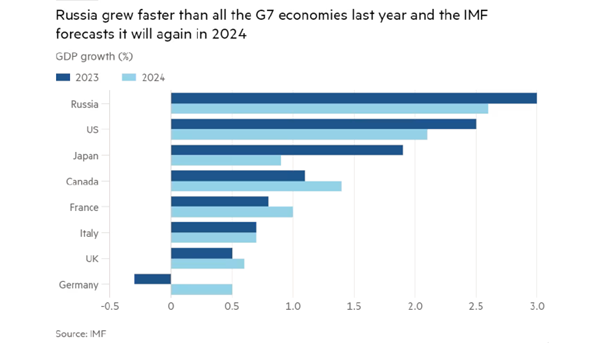
From Michael Roberts' blog. Contrary to Western predictions, Russia has weathered the sanctions imposed by the NATO allies without a significant downturn (see the graph below)

Excerpt:

Over the past two years of war, Russia has managed to steer through sanctions, while investing nearly a third of its budget in defence spending. It’s also been able to increase trade with China and sell its oil to new markets, in part by using a shadow fleet of tankers to skirt the price cap that Western countries had hoped would reduce the country’s war chest. Half of its oil and petroleum was exported to China in 2023. And it became China’s top oil supplier in 2023, according to Chinese customs data. Chinese imports into Russia have jumped more than 60% since the start of war, as the country has been able to supply Russia with a steady stream of goods including cars and electronic devices, filling the gap of lost Western goods imports. Trade between Russia and China hit $240 billion in 2023, an increase of over 64% since 2021, before the war.

Contrary to Western forecasts, Russian industry has grown due to war-related production, while demand for domestic manufactures has also increased due to a fall in imports because of sanctions. The automobile industry – which was hit hard initially, as Western and Japanese car manufacturers left Russia en-masse – has been recovering strongly month by month, as Chinese companies have stepped in.


....And the Russian economy remains fundamentally natural resource linked. It relies on extraction rather than manufacturing. Mining accounted for around 26% of gross industrial production in July 2023, and three industries – extraction of crude petroleum and natural gas, coke and refined petroleum products manufacturing and basic metals manufacturing – made up more than 40% of the total. “The regime is resilient because it sits on an oil rig,” says Elina Ribakova, a non-resident senior fellow at the Peterson Institute for International Economics. “The Russian economy now is like a gas station that has started producing tanks.”

War production is basically unproductive for capital accumulation over the long run. And Russia’s potential real GDP growth is probably no more than 1.5% a year as growth is restricted by an ageing and shrinking population and low investment and productivity rates. The profitability of Russian productive capital before the war was very low.

The Russian war economy is well placed to continue the war for several years ahead if necessary, but when the war is over, Putin may face a significant slump in production and employment.

....

Meanwhile, a contradiction from Foreign Policy: Claims That Sanctions Hurt Europe More Than Russia Are Wrong

Tuesday, March 5, 2024

Big news: Victoria Nuland resigns....And Synema elects not to run

 Ms. Nuland supervised the US-encouraged Ukraine coup that occurred in 2014, helped select the new Ukraine government (no messy democracy needed) and has cheerlead the war ever since. That she's resigning, and being replaced by the ambassador who was in place when the US withdrew from Afghanistan is a faint glimmer of hope for peace.

For more, see commentator Gilbert Doctorow's article: Victoria Nuland resigns: what can this mean for U.S. policy on Ukraine?

Also: Comment from Naked Capitalism... and Glenn Greenwald

Also: Kyrsten Synema elects to not run.

Sunday, March 3, 2024

We do not have a fractional reserve banking system. Banks create deposits out of thin air.

Answering the question "Does the U.S. have a fractional reserve banking system?"

From Quora::

No. The U.S., as well as pretty much every other country, uses what is better described as a credit creation system.

In a true fractional reserve system, banks collect and then lend out 'hard' currency, in the way we have all learned from the old story. It is easiest to think of hard currency as coins – the bank has 100 coins; it can lend out 90, and keeps 10 on hand in reserve. The next bank collects those 90 coins; they can lend out 81, and keep 9 in reserve, etc., etc., until you end up with the same 100 coins in existence, plus 900 in bank accounts. Bank lending is limited by the amount of hard currency in existence. By extension, cash withdrawals are limited as well.

The way banks actually operate is by creating credit on ledgers. Loans are “funded” 100% with credit; if you take out a $1000 loan with $200 in interest, your bank simply marks up your account by $1000, and holds your promissory note, nominally worth $1200, as their asset. M1 has just increased by $1000, and bank equity has (nominally) increased by $200. The loan, and the funding, are complete at this point. When you write a check that is deposited at a different bank, reserves (“hard” currency, liabilities of the central bank) are transferred from your bank’s reserve account to depositor’s bank’s reserve account, your account is marked down, and depositor’s account is marked up. This transaction is financially neutral for all parties.

This is where you will get an argument from fractional reserve people. Since the bank ends up transferring hard currency, isn’t this just a more complicated way to describe FR banking? Well, no. The bank didn’t need to collect reserves before making the loan; reserve requirements are calculated days after the loan was made. Also, the central bank will always supply enough reserves to banks, so hard currency isn’t a limiting factor. Finally, if you picture two banks, each creating identical loans that get deposited in the other bank, no reserves will be transferred, yet $2000 has still been created. Which is pretty much what happens on a large scale every day – the amount of loans created every day is far greater than the net amount of reserves that must be transferred in settlement at the end of the day. In our credit creation system, reserves are merely settlement funds. If you dissolved the central bank/settlement agent tomorrow, banks could still operate just fine settling up among themselves, using mostly bank-created credit to do so. If things got really unbalanced, they could then settle up using other assets. No “hard currency” required for loans or transactions. The central bank is now merely a useful tool for settlement, funding government spending, and backstopping banks in crisis.

This paper by Richard Werner explains the three theories of banking in good detail:

The Bank of England's paper on the subject, is a more technical read.


Charlie Munger criticizes conventional economic thinkers

As a partner of Warren Buffet, Munger has been a spectacular success, out-performing market averages often. He points out the following are flaws in typical economics (from talk nine in Poor Charlie's Almanack) and MBA thinking:

1. Fatal Unconnectedness, leading to man-with-a-hammer syndrome, often causing overweighting what can be counted.

2. Failure to follow the fundamental full-attribution ethos of hard science.

3. Physics Envy (hard form efficient markets theory - too much precision in physics-like formulae)

4. Too much emphasis on macroeconomics (the fallacy of composition fools even Munger, or he's trying to distract from systemic problems)

5. Too little synthesis (with other disciplines. Raising prices can sometimes psychologically convince buyers the product is better..Also: conventional thinking omits higher commissions, in effect bribery!)

"Why did Max Planck, one of the smartest people who ever lived, give up on economics? Planck's answer is "It's too hard. The best solution you can get is messy and uncertain."

6. Extreme and Counterproductive psychological ignorance.

7. Too little attention to second and higher order effects. (consequences have consequences, economics ignores gaming the system[s])

8. Not enough attention to the concept of febezzlement (functional equivalent of embezzlement --leads to false feelings of prosperty)

9. Not enough attention to virtue and vice effects - "The cash register did more for human morality than the Congregational Church....guilt, dervied from religion, has been a huge driver of a reliability ethos, which has been very helpful to economic outcomes for man...to function best,  morality should sometimes a pear unfair, like most worldly ougcomes. The craving for perfect fairness causes a lot of terrible problems in system functions."

10. Not enough attention to embedded Ponzi schemes

"It's not bringing in the new ideas that's so hard. It's getting rid of the old ones." - Keynes

Saturday, March 2, 2024

Housing first can work

See Housing First Can Work If Done Right (worth reading the entire thing)

Excerpt: 

"Despite enjoying decades of bipartisan support, Housing First programs have become a target in the culture wars. Housing First provides housing and wraparound services that are not predicated on sobriety or psychiatric treatment. Conservative critics challenge this approach, arguing instead that people should be required to work and participate in abstinence-based addiction treatment or faith-based programs to be eligible for housing.

"These opponents of Housing First begin from the flawed premise that human pathology is the root of homelessness. By contrast, research clearly shows that housing shortages, wage inequality, and high rents—not mental illness, substance use, or even poverty—are its real causes. These structural factors explain why homelessness is more common in Seattle and San Francisco than in Detroit or Oklahoma City, where there is still plenty of addiction and mental illness, but where people with these conditions spend their time indoors."

Good public policy related to homelessness, is not necessarily cheap, but it's cheaper than building bigger jails. (from the above link) "It is true that by keeping people in homes and out of emergency rooms and jails, Housing First programs can reduce costs in overall municipal expenditures. Yet many of those who experience homelessness do not cycle through ERs or have costly health issues. Housing this part of the population might be the right thing to do, but it won’t necessarily save money.

"Cost is also tied to city-level housing markets and regulations. Houston has worked miracles with Housing First, but Los Angeles has floundered. The difference lies in the fact that Houston has abundant housing supply and few restrictive zoning laws. In Los Angeles, efforts to build new units have been thwarted by NIMBYism, high costs, and the uncertainty that surrounds all construction projects in California. To make progress in addressing homelessness where housing is in short supply and construction delays are inevitable, we need to invest in short-term shelter options while taking steps to expand the housing supply in the long run."

Also see:the previous post, Even Good Public Policy Struggles with Sabotage

How to talk to mainstream journalists


Friday, March 1, 2024

Even Good Public Policy Struggles with Sabotage

This account of Oregon's attempt to adopt an "enlightened" de-criminalized approach to drug addiction documents how its execution sabotaged its success. Its failure has been widely touted as proof that you just can't be too nice to addicts. Why it failed is a little more relevant. Just handing an addict a ticket, without making sure addicts have an alternative (rehab) is ineffective, and that's what the Oregon cops were doing.

This is reminiscent of the "enlightened" approach to mental illness. The Kennedy administration closed the big one-flew-over-the-cuckoo's nest federal asylums, saying they would fund alternative, smaller transitional housing...and then didn't fund the alternative. Reagan closed the big California asylums, too.

Now the homeless are demonized as addicts and mentally ill--and there are certainly addicted, mentally ill homeless--but the real story for the majority of the homeless is that rents have been rising faster than incomes. The problem isn't one of resources, either. The US has more vacant homes than homeless. The resource distribution is misguided too.
 
People take note of these policy failures. One "Dead-Head" (hippie) Oregon woman who was a fan of decriminalization thought "it was wrong to respond to addiction with criminal punishment. But now she feels decriminalization 'wasn’t the best idea.' But why? Because America is not a place 'where there’s a lot of public assistance.' In other words, we’re too cruel and stingy to actually help drug addicts, so the only option is to throw them in prison!....

"But even if Oregon did increase addiction services and get the police to actually try to help people, there are still some foundational assumptions behind the state’s decriminalization plan that have to be questioned. First, the very idea of relying on police is questionable. I agree with the law’s critics that a system where police give meaningless citation tickets to drug users is not going to do very much. But why are police the ones we expect to deal with people affected by substance use? The system should be designed so that police aren’t interacting with these people at all, but rather unarmed aid workers who are actually trained in how to convince a person with a substance use problem to seek treatment. (Police are mostly trained on how to use force to ensure compliance with legal rules.)

"Second, even providing good, free services for substance use disorders and connecting people with them successfully doesn’t address some core reasons for widespread drug use. In his powerful book about the War on Drugs, Chasing the Scream, Johann Hari argues that it’s not just that drugs are made of addictive chemicals, but that being poor, lonely, and traumatized increases people’s likelihood of using:

Chemical hooks are only a minor part of addiction. The other factors, like isolation and trauma, have been proven to be much bigger indicators. Yet the drug war increases the biggest drivers of addiction—isolation and trauma—in order to protect potential users from a more minor driver of addiction, the chemical hook. If we legalize, somewhat more people will be exposed to the chemical hook in drugs—but the even larger drivers of addiction, trauma and isolation, will be dramatically reduced.

"Legalization does not necessarily substantially reduce trauma and isolation, however, even though we know prison worsens these problems. We still live in a very isolating society. A strong social support system is important, and legalization alone doesn’t make America a less atomized society. We have a loneliness crisis in this country that makes it harder to address drug use crises." (from the initially linked article, well worth a full read)

Update #1: The Oregon legislature just re-criminalized drugs.
 
This misguided approach is not just confined to "justice-related" items. Here's an article demonstrating the sabotage, ignorance and arrogance infects even infrastructure development too. 


At a press conference last month, flanked by sheriffs and attorneys, Ohio Attorney General David Yost announced the indictments of two utility executives who allegedly tried to “hijack” state electricity policy for their own corrupt ends by paying $4.3 million in bribes to Sam Randazzo, then chair of the state Public Utilities Commission. The two men stand accused of trying to bilk taxpayers out of $1.2 billion on behalf of their former employer, FirstEnergy.

Conventional and Unconventional Economics

(c) by Mark Dempsey 1. The Conventional Economics Narrative   The conventional story says national debt is a (growing) problem. The bigger i...