Monday, December 29, 2025

Homelessness Isn’t Caused by a Housing Shortage—It’s Caused by Low Wages and High Rents

From LA Progressive (Platkin is always a good read): 

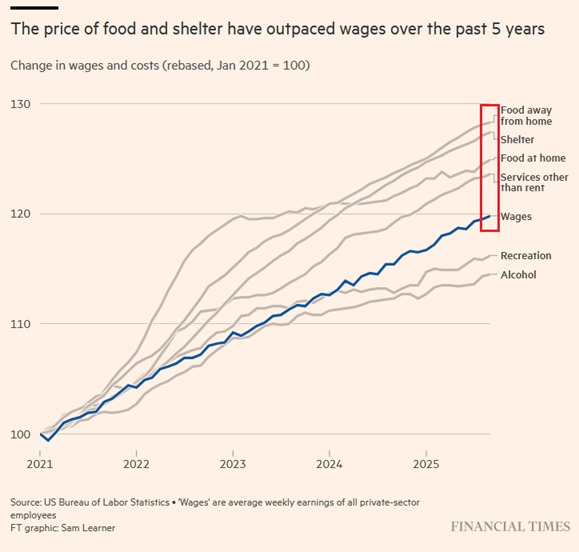
Overcrowding and homelessness are both increasing because -- after controlling for inflation – the price of housing is up and most wages are flat. The causes are not a mystery: elected officials who dance the tune of major campaign contributors.

While the housing crisis is already severe in US urban areas, the situation is particularly tough in the greater Los Angeles area because elected officials ultimately control housing policies. For them, their concerns are rarely their poorly housed constituents. Instead they parrot that false narrative that an (imaginary) housing shortage is the cause of rising homelessness and overcrowding.

This explanation is not only wrong, but it hides the real causes of both homelessness and overcrowding. As shown in the chart below, the price of housing has continued to increase, while most incomes have been flat for the past 50 years. In fact, Los Angeles has an ample supply of vacant houses and apartments. What it lacks is people with enough income to buy or rent them. The problem is simply a lack of money by the homeless and overcrowded, not the supply of housing. Nearly all of these groups would gladly move if they could afford to rent or buy. But they can’t afford existing vacant housing, so they remain homeless or over-crowded.

Homelessness Isn’t Caused by a Housing Shortage  
Until this situation is remedied with higher wages, real rent control, and the restoration of public housing, little will change.

There is a solution, but it is a shot across the bow of both major electoral parties and their claim that homelessness and overcrowding result from a housing shortage. They ignore the 16 million vacant homes in the United States, including many in the Los Angeles area, as well as an average local apartment vacancy rate of 5.1%.

The Remedies: First, the solution is already known. In addition to raises, it is real rent control to replace LA’s anemic Rent Stabilization Ordinance, plus the restoration of HUD public housing programs jettisoned during the Nixon, Reagan, and Clinton presidential administrations.

Second, in addition to reestablishing HUD public housing programs, California must end vacancy decontrol by revoking the Costa-Hawkins bill. Real rent control should mean that rents do not increase when tenants move out.

Third, in Los Angeles the cutoff date for rent stabilization should not remain 1978. Instead, rents should continually change, such as replacing 1978 with a sliding date, such as apartments built 15 or more year ago.

What are the real barriers? The barrier is the power of landlords -- as opposed to tenants - to shape national, state, and local legislation. Until this changes and tenants gain the upper hand, we will be subject to minority rule since renters far outnumber landlords.

The chances of positive changes trickling down from Washington are minimal. Elected Democrats don’t offer any credible housing solutions. As for Republicans, the Trump Administration proposes major cuts in HUD’s low-income housing programs, then adding work and service requirements. Internal HUD documents estimate that an additional 170,000 people may become homeless because of these changes.

This cure is worse than the disease!

The opinions expressed here are solely the author's and do not reflect the opinions or beliefs of the LA Progressive.

Saturday, December 27, 2025

Whence Housing Inflation?

 Answer: from the Fed's Quantitative Easing. Excerpt:

This paper examines the impact of quantitative easing undertaken by the Federal Reserve from 2020 to 2022, during which the Fed’s mortgage-backed securities (MBS) purchases ($1.33 trillion) were equal to nearly 90% of the growth in MBS ($1.50 trillion). Evidence suggests that housing’s unique role as an asset class is a factor explaining the rise in the cost of housing and hence overall inflation.

Mearsheimer's Latest Debunk of the Ukraine Narrative


Monday, December 22, 2025

The benefits of not being a jerk to yourself

 An entertaining and enlightening TED talk.

 
Some notes:
 
Loving kindness meditation is:

May you be...
happy, safe, healthy, live with ease

Finish the meditation by directing it to all beings everywhere'

Put your hand on your heart and tell yourself, "I've got your back," when self-critical

Demons are ancient fear-based programs trying to help me. Don't slay them, give them a high five when they cross your path. This is radical disarmament.

Conclusion: "The view is so much better when you pull your head out of your ass."


Sunday, December 21, 2025

In case you ever wanted to know how deceptive the "Paper of Record"--the NY Times--is... [petroleum edition]

The point of this rebuttal is to remind us that the NY Times' agenda isn't always the public's. Remember: The NY Times cheerled the US into a war in Iraq. 

The petroleum bias answer comes from this:


The rebuttal (lots of tweets assembled)

1. First: the elephant in the room that he doesn't mention explicitly but haunts the whole piece: climate change is real, we've already overshot and the only way to turn the corner is to leave fossil fuel in the ground. To ignore that is to talk about rocketry and ignore gravity. 

2. What he says about climate is patently false (more on that later) but to the extent he's saying "politicians shouldn't do the right thing unless it's popular", I'd note only that that is a toddlers view of leadership. If the popular kids are mean, should you be mean? 

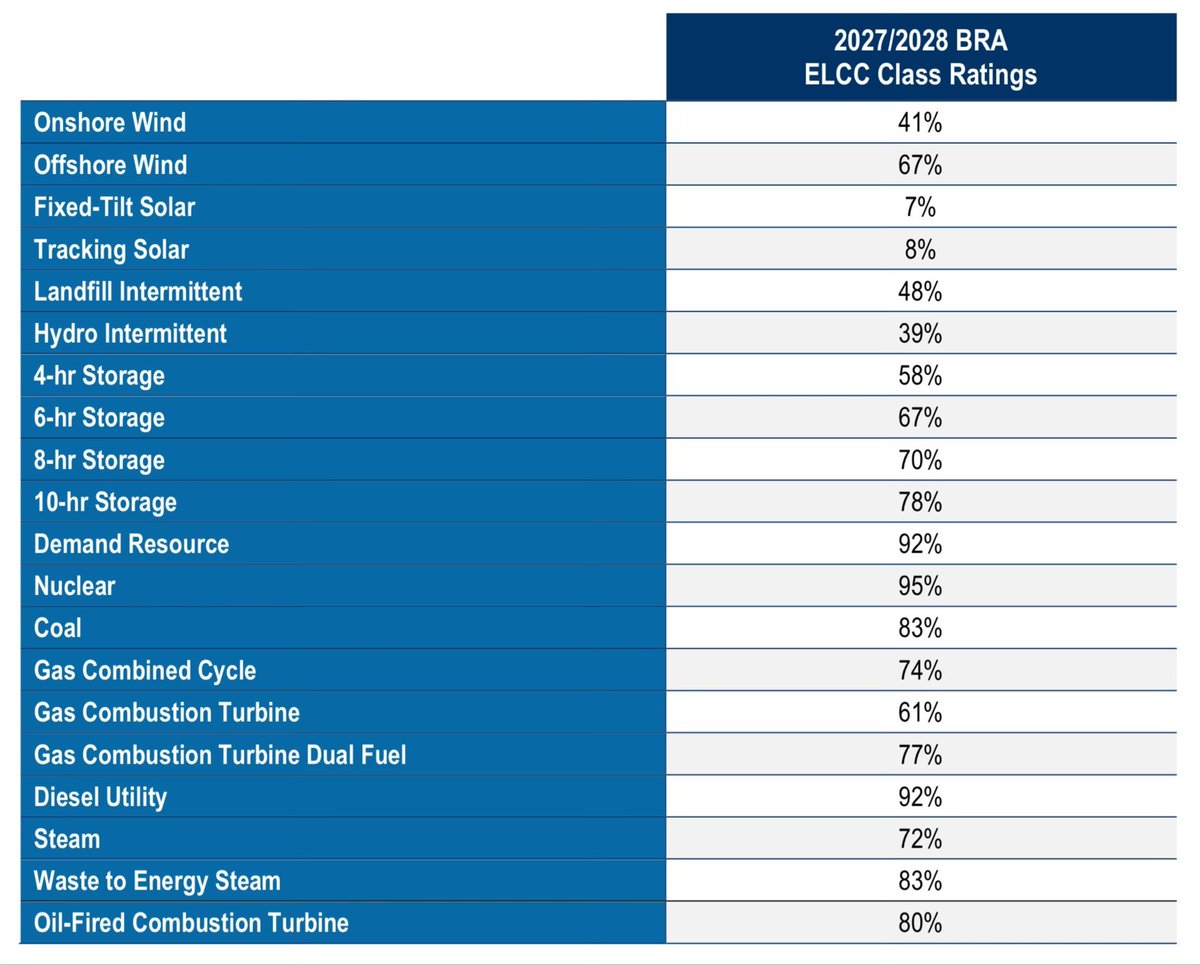
3. Leadership is about doing what is necessary, not just what is popular. Read literally anything our founders wrote about virtue, and the inherent risks to a society based on democratic processes to sustain the rule of law to the extent that unvirtuous people gain power. 

4. Yglesias instead seems to argue that politicians should only do what wins elections, virtue be damned. One wonders what he thinks of those foolish 1850s abolitionists. As Condleeza Rice once said, politics is the art of making the impossible inevitable. That ain't this. 

5. But enough on climate. This is an opinion piece and if MY's opinion is that we shouldn't act on climate at a scale sufficient to the threat there's not much I can do. Let's go to the facts. First, the idea that Obama won in 2012 because of his oil & gas platform. Really?
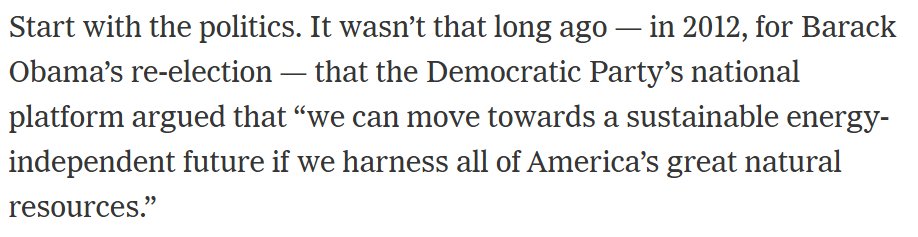

6. That election had a robust debate over the gulf war and the scope of the 2008 bailout. Romney was framed as an out of touch plutocrat. To the extent energy came up it was the criticism of the Dems for Waxman Markey cap & trade in 2009, not "thank you for drilling". 

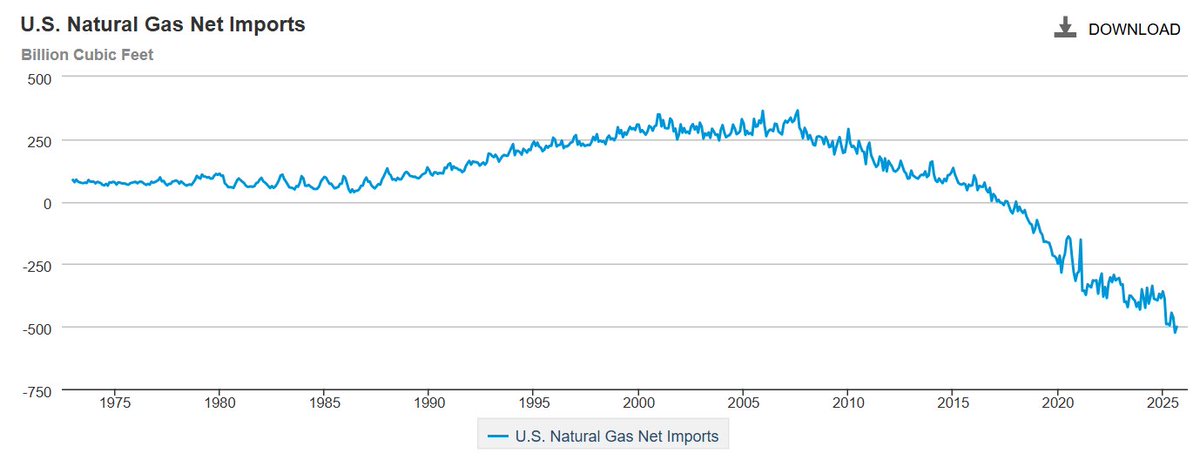
7. But even beyond the political conversation, you can't compare 2012 energy policy to 2025 without understanding the massive shift in US fossil energy production & net imports over that period. Look at the "net imports" line on this chart.


8. In 2012, the US was a net importer of oil and domestic production, after decades of decline was starting to tick up. Today, the US is a net exporter. Couple that with concerns about middle east politics in 2012 and you have a VERY different set of issues for US consumers. 

9. As a net importer, every incremental unit of domestic production reduced our exposure to foreign oil & associated price volatility. As a net exporter, every incremental unit gets shipped overseas. 

10. IOW, in 2012 new production benefited domestic producers AND consumers. But today, new production only benefits producers. That's a fundamentally different policy and political environment. And note also that domestic consumption is basically flat for the last 20 yrs. 

11. That's a good thing! We're just as warm, just as able to travel as we were 20 years ago, and rising vehicle efficiency, EV deployment, etc. is giving consumers more useful energy with less oil expense. That's good for consumers, even if it hurts producers. 

12. And if we want to talk about the politics, here's some easy math: there are a lot more voters who consume energy than there are who produce energy. If you're confused on that point, you might be a crappy pundit... 

13. And this isn't just true of oil. We've also moved from a net importer to a net exporter of natural gas since 2012. (Also because fracking.) Which again means that to take Yglesias' advice in 2025 is to prioritize energy producers over energy consumers.
 

14. The wealth transfer from natural gas is perhaps even more direct since gas - unlike oil - isn't quite a global commodity; the costs to liquefy and transport gas, per MMBtu are a lot higher than oil, which creates much higher local price disparities. 

15. As such, when US producers can swap European/Asian markets for the US markets and make a higher margin, even after accounting for shipping costs it puts significant upward pressure on previously land-locked domestic prices. 

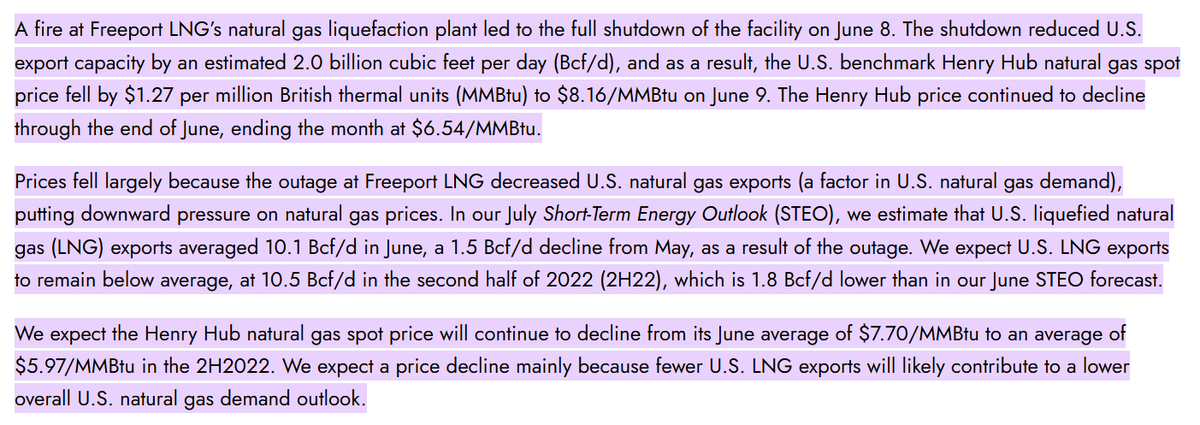
16. This is the reverse of getting off middle eastern oil in 2012. Now, instead of decoupling from global volatility we absorb it. That gets quantified whenever a US LNG export facility has an outage & domestic NG prices fall. Who ya rootin' for, Matt? .

U.S. natural gas supply and demand balance shifts amid outage at Freeport LNG - U.S. Energy Information Administration (EIA)https://www.eia.gov/todayinenergy/detail.php?id=53079#:~:text=A%20fire%20at%20Freeport%20LNG's,U.S.%20natural%20gas%20demand%20outlook

 
17. It's worth reading the entirety of what DOE had to say about the impact of that 2022 outage on domestic prices. These are massive price swings - and therefore massive wealth transfers from US consumers to US producers!
18. Because natural gas is used for so much of US power generation, increasing gas exports = higher gas prices = higher electricity. One climate negative impact of that is that after years of decline, we now are seeing an uptick in domestic power generation from coal.
19. This isn't because coal is cheap, or because we're building more coal plants. It's because when the price of gas goes up gas fired power plants are a little less competitive against other asset classes and the competition (in this case, coal) picked up the slack. 

20. So this goes back to point 10. When we are a net exporter, decisions to produce more help producers and hurt consumers. And in this case, are ALSO bad for the climate. It's lose / lose all around. 

21. And before team Yglesias responds by saying "yeah, but it's bad politics to run on climate and energy"... I'd point out that I've won 4 elections in a very purple district running on climate and energy. Pro-tip: leadership is possible! You don't have to be stupid to win! 

22. Speaking of climate. Let's now pick apart this word salad of stupidity. Specifically the assertion that US oil is "cleaner" than other countries and therefore it is environmentally virtuous for us to drill baby drill.
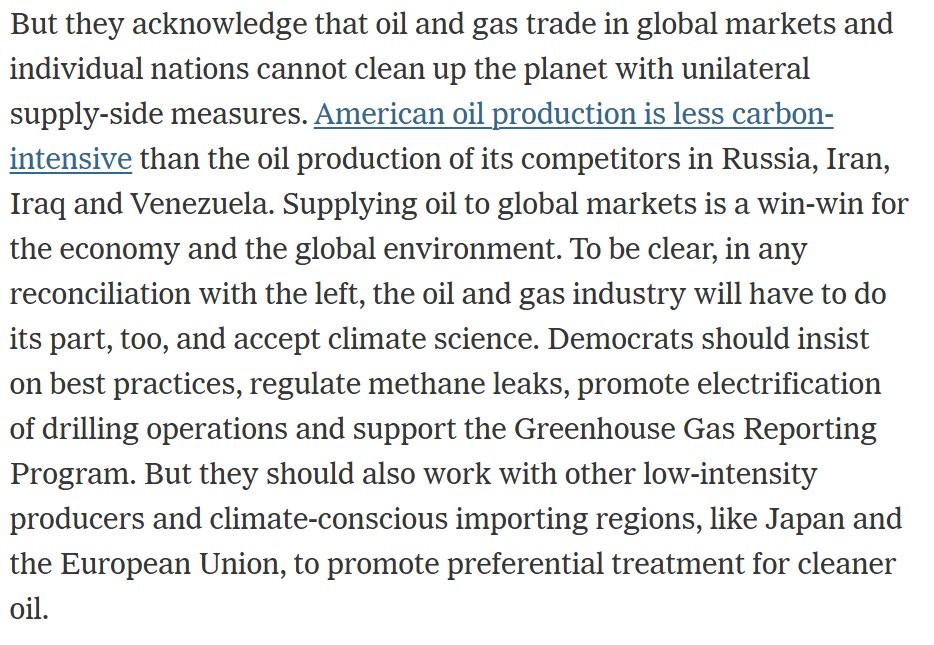

23. Here's the report he links to in order to prove his point, that compares the carbon intensity of various global oil production regions.

Report: U.S. Beats Competitors with Low Carbon Intensity OilThe United States is a global leader in minimizing greenhouse gas emissions from offshore production, according to a recent from the National Ocean Industries Association (NOIA). The report, commissi…https://www.energyindepth.org/report-u-s-beats-competitors-with-low-carbon-intensity-oil/

 24. Here's the chart. I don't know if he looked at it, and I certainly don't think he thought about it but I'd encourage you to as it refutes much of that word salad paragraph.


25. First, note who is the cleanest: Saudi Arabia. So when he says that we should "work with other low-intensity producers", he is essentially saying that we should maximize production in Saudi before bringing on US production. How does that help win elections in TX and OH? 

26. Interestingly, since the Saudis gave Kushner his PE fund and Trump his LIV tournament he's been quiet as they've kept the oil price under $70 which in turn has suppressed US rig counts. So maybe Trump is taking Yglesias' advice? How's that polling? tradingeconomics.com/united-states/…
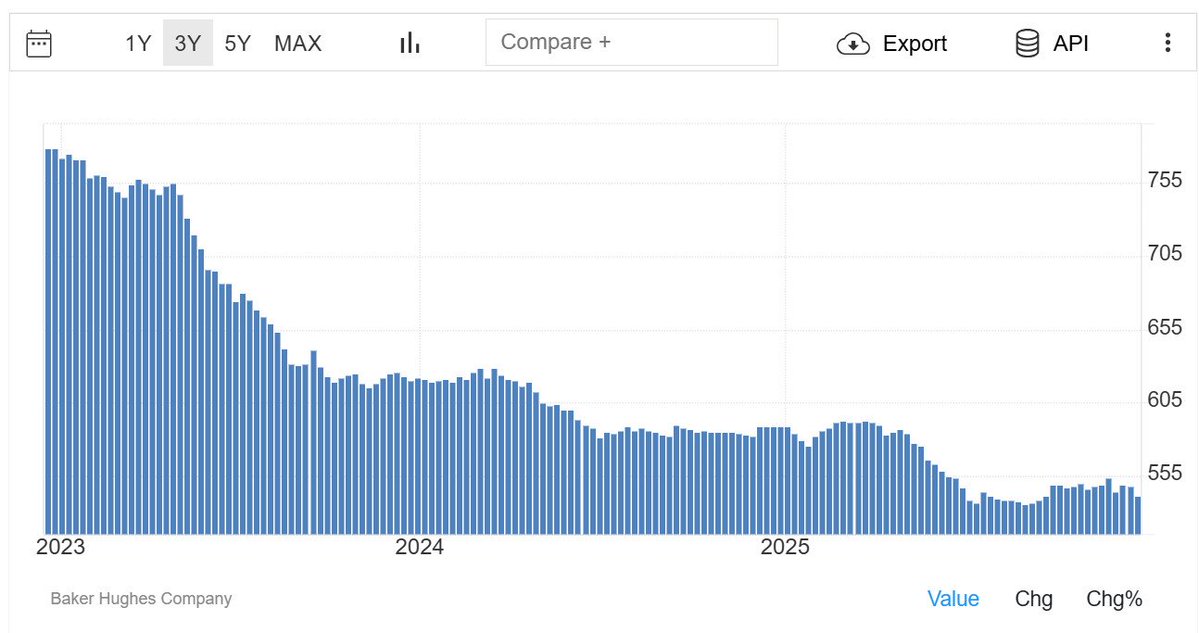
https://tradingeconomics.com/united-states/total-rigs

27. Back to the chart. Look at how much dirtier Canadian oil is than US oil. (Because tar sands are very energy intensive to extract). You know who pushed to stop imports of dirty Canadian oil into the US? Obama! Google "keystone XL pipeline" if you've forgotten that history. 

28. Recall that the oil industry (and the GOP) demonized Obama for blocking Keystone because they had spare refining capacity and wanted to make money exporting the resulting finished products. So again, this is about producers v consumers. 

29. Now look at the US bars on that chart. Bars is plural because US production is not monolithic. Conventional oil production (offshore gulf, southwest) uses relatively little energy to lift the oil to the surface and as a result is much cleaner than "other US" (aka fracking). 

30. Which means that if you're making the argument that US oil production is cleaner, you have to be honest about where the marginal production is happening. And in OH, PA and those other swing states he describes, it ain't from conventional drilling. 

31. On natural gas, his arguments are just as bad. It is true that at the burner tip a unit of natural gas emits less CO2 than a unit of coal. And if you have a coal mine and a gas well in your back yard, both of which are hooked up to your furnace that is a relevant comparison.


32. That's of course not the norm. And because methane is such a potent greenhouse gas (>80x as bad as CO2 for the first 20 years after release) even a minor leakage rate in the collection and distribution makes natural gas worse than coal from a global warming perspective. 

33. That's even more true for exported natural gas which also has to be liquefied since the liquefaction process is so energy intensive. Roughly speaking, you need nearly 120 units of gas to make 100 units of LNG. So more CO2 and magnified impacts of upstream leaks. 

34. And of course you also need to fuel the ship that transports the LNG - which means that environmental impact of exported natural gas is primarily driven by methane leaks and liquefaction / distribution. The burner tip comparison is just a vapid industry talking point.
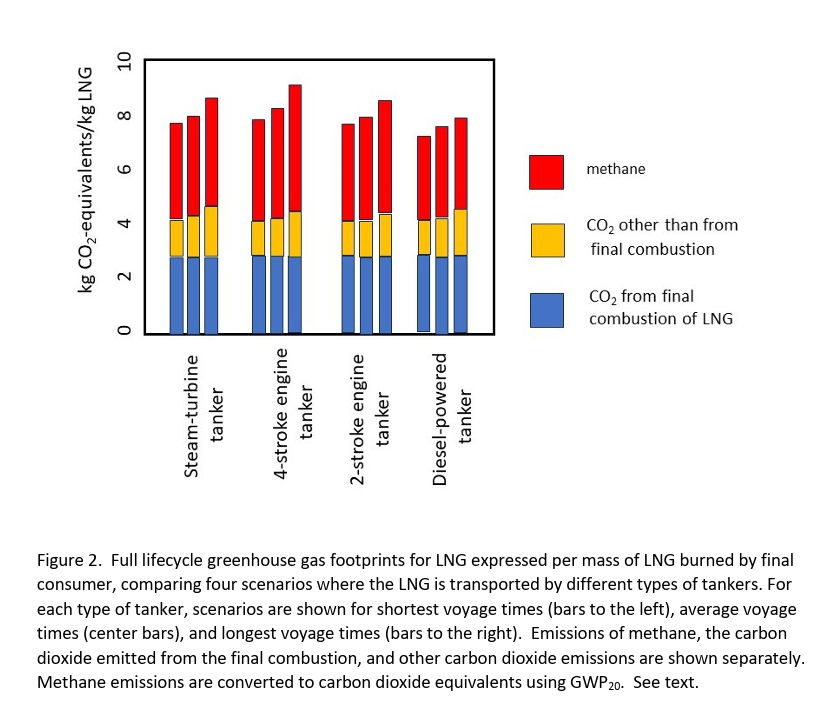
35. Source for that graph if you want to get into the details: research.howarthlab.org/publications/H…

36. Finally this. The mark of the fossil fuel shill who never loses the arrogance to walk into a room, say "the sun doesn't shine at night and its not always windy", drop the mic and leave, confident that no one else knows what they just discovered.
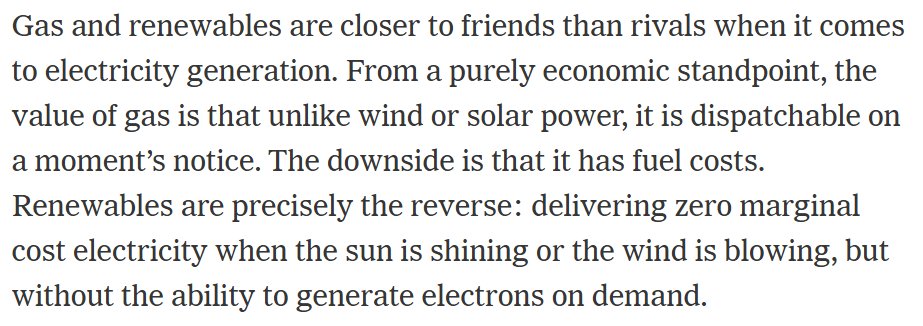

37. I will concede. Night is real. Some days I can't fly a kite. It is also true that sometimes coal trains are stuck, gas pipelines fail, warm weather derates thermal power plants and unplanned outages happen. 

38. Every utility manager and operator knows this. NERC standards explicitly require that in any given utility control area you cannot have a coincident failure mode that affects more than 10% of your load. The scary scenario (night time blackouts!) doesn't happen and won't. 

39. Moreover, wholesale power markets include variable time of use rates and capacity payments to pay a premium to sources that can ramp up on a moments notice. Here is a list of what PJM used last year (% is the likelihood that the given source will be there when called.)
 

40. So we have a grid with lots of stuff. The most reliable backup in that PJM analysis was nuclear and load sited demand reduction. Diesel gen sets. Pumped hydro. Battery storage is a big deal and a bigger one as costs fall and longer durations are available. Gas peakers too. 

41. Not shown here, but also a big deal is transmission to connect different parts of the system so that the wind in Iowa can power Chicago, or the sun in Florida, or the geothermal in Nevada, or the hydro in Oregon, etc.  

42. Point is, markets and existing regulatory structures also know that no source is available 24/7/365 and manage the grid accordingly. They don't learn anything from Yglesias insight about nighttime and you didn't either. 

43. If you're still reading at #43... thanks, I guess? But also this. :) Anyway, a final thought to wrap up. 

44. I've spent my entire career in the energy industry. As a consultant, as a manufacturer, as a power plant developer/owner/operator and as a legislator. There is something really optimistic about the moment we're in that pundits like Yglesias said was impossible 20 yrs ago. 

45. Specifically, we've decoupled economic growth from fossil energy consumption. Coal demand has collapsed. Oil use is flat. Natural gas use is growing but < GDP, even as standards of living have gone up. That's happened because of higher efficiency and decarbonization. 

46. We are, in a word, investing in energy productivity, getting more value out of less input. That is great news, for the same reason that higher returns on capital are good or increases in labor productivity good. Make more useful stuff with less input and we get richer. 

47. As Amory Lovins has said for years, no one wants a lump of coal, or a barrel of oil. All we want is a hot shower and a cold beer. And if we can get that heat and light and chilling without paying for (or burning) fuel, we're all happier... with one notable exception. 

48. That exception of course is the fossil fuel producer. They are hostile to energy productivity for the same reason John Henry didn't like the steam shovel. They can't compete with it. Wins for consumers come at their expense. Wins for the climate come at their expense. 

49. The game isn't over by far. But we are winning. That's something to be proud of. It's something to accelerate. It's nothing to take for granted. And it's certainly no time to take Yglesias' advice and fumble the ball so the other team won't feel so sad. /fin
Wednesday, December 17, 2025

Boston Tea Party... The Rest of the Story


Monday, December 15, 2025

Anti China Fake News


The details (from  a tweet):

I SUPPORTED THE so-called pro-democracy politicians in Hong Kong for many years. I knew the main members personally and happily stuffed my hard-earned cash into their collection boxes. But I increasingly felt something wasn’t right. Then I did some digging. And then I backed off as fast as I could. Here’s the story. . A NEW ASSISTANT As a South China Morning Post reporter in 1991, I noted the rise of a new political group called the United Democrats. They had an “executive assistant” who was always seen at the right hand of the leaders. His name was Tom Boasberg. So, not Chinese, but American. He was hyper-political, and his previous employer was the United States government. Many businesses in Hong Kong employed Americans, sure. We all liked Americans. But this wasn’t a business – it was supposedly a "grassroots" political party—and I thought it odd to have a foreigner at the top end of the noisiest political organization in the city. And when Boasberg moved on in 1992, I noticed that he was replaced by another executive assistant, a woman named Minky Worden. She too was American, she too was hyper-political, and she too was previously employed by the United States government: a coincidence. When Ms Worden left that role in 1998, the group took an another person in her place: a woman named Emily Bork. She too was American, she too was hyper-political, and she too previously worked for the United States government. A series of coincidences? (Ms Worden went on to become an enthusiastic player in the Uyghur genocide hoax. Her journalist husband Gordon Crovitz, with whom I worked directly, later went on to sign a contract to work on media monitoring with the Pentagon.) . FACTIONS For some of this period, I was a Legislative Council columnist for the South China Morning Post. I lived next door to Yeung Sam, a leading member of the so-called “pro-democracy” party, and soon learned there were factions within it. Everyone’s favorite (including mine) was a rough diamond called Szeto Wah who was noisily patriotic about China while believing that western democracy would be good for Hong Kong. (Yeung himself was unpopular within the organization.) But many of the other “pro-democracy” politicians, unfortunately, became closely tied in with anti-China groups funded by the US National Endowment for Democracy, which had taken over the CIA's “soft power” covert regime change duties. The NED had quietly started funding political parties in Hong Kong in 1990, but kept under the radar, using multiple other identities. Cash arrived in Hong Kong listed as “donations” from a non-existent body called the American Institute for Free Labor Development (set up by the CIA for money transfers). . EXTREMELY DANGEROUS The NED were and are extremely bad people. Working worldwide, they used the “pro-democracy” label as a cover to poison the public against local candidates who failed to be pro-Washington in any country. The NED successfully manipulated elections in Nicaragua in 1990 and Mongolia in 1996 and helped to overthrow democratically elected governments in Bulgaria in 1990 and Albania in 1991 and 1992, as intelligence historians noted. And they would eventually cause chaos in my peaceful, gentle Hong Kong. The NED did this by using their bottomless funds to blend Hong Kong’s “pro-democracy” politicians with two groups they funded to poison Hong Kong people against mainland China. One was called the Human Rights Monitor and the other was the Confederation of Trade Unions (not to be confused with the HK Federation of Trade Unions, which was a genuine trade union organizing group). . DESTRUCTION OF LEGCO The "pan-democrats" quickly lost the goodwill of the Hong Kong people by automatically vetoing every act the government did, causing massive delays in a city used to efficiency. Legco became dysfunctional, sometimes grinding to a halt. The physical violence seen in the Taiwan parliament was transferred to Hong Kong, with people such as Ted Hui throwing fists and foul matter into the parliamentary chamber (and becoming hated by the building's cleaners). . PROTESTS PREPARED OVERSEAS By 2012, this pro-US movement in Hong Kong was working with the Oslo Freedom Foundation (which, despite the name, is based in the US), in a multi-year operation to organize massive demonstrations in Hong Kong with the aim of destabilizing the city. The US plan was to present this foreign-organised anti-China insurrection as home-grown “pro-democracy” protests, trusting in the western mainstream media to excuse the horrific violence and hide the US funding. (Which they did.) A major aim was fearmongering. By forcing Beijing to send the tanks into Hong Kong, Taiwan would abandon its growing friendship with the mainland, and became once again a dependable part of the Pentagon's First Island Chain. . A FAILED OPERATION The rest is history. The Chinese refused to send in the tanks. The PLA stayed at home. The Hong Kong police managed to quell the riots without killing a single person (unlike in the six other uprisings in the world that same year, all of which led to multiple deaths). The operation failed. . DISGUSTED By 2021, many people in Hong Kong knew about the foreign forces' involvement and were disgusted with the pan-democrats. My friends and I, almost all of whom had been big fans for many years, became totally disillusioned with them, and with western-style democracy as a whole. The western mainstream press rigidly turned their faces away and refused to see any of this. And today, the China-hostile media, from Reuters’ James Pomfret to the BBC’s Danny Vincent, continue to fail to report the real story. Whether they are hiding it or are genuinely unaware of what is going -- that's not for me to say. But I will say that the catastrophic loss of trust in the western mainstream media is well deserved.


America's corruption


Sunday, December 14, 2025

Physician Burnout

Think about this the next time you complain to your doctor. From a real doctor in the comments in Naked Capitalism:

About PCP burnout – I am not meaning this as a rant. But I think it is important for people to understand the time pressure and world their general internists are facing.

This week – Monday the 8th of Dec through Friday the 12th of Dec – in my office hours of 9:30-5:30 PM every day, I saw a total of 108 patients myself. The MAs and PAs and RNs who work under me saw an additional 57. In the AM before the office, I have had an average of 3 people in the hospital whom I try to see every day at lunchtime. Because life since COVID has become so overwhelming, I now have hospitalists doing all the work, but I do all I can to see the patients. I have 11 people in nursing home care. So all 11 are seen once a week at various times where they can be fit. My office staff typically fields about 200-250 phone calls a day. I have very good staff but they are also involved with other MDs in my office. Of those calls, I have about 30-50 that I must deal with every day mostly by telling the staff what to do. There are all kinds of patients who demand to speak with me only about test results, etc…….and there are several who because of the severe nature of their results, I need to speak to. I typically try to do this 1 patient at a time in between visits. Despite how obviously crazy medicine has become, so many patients think when I call them it is time to have a visit – and these calls can often become very involved. I am looking at my leftover calls that I need to make from the week on this Sat AM – and the number totals 34. There is simply not enough time in the day to do this. When people do not get immediate feedback some of them can become explosively anger and yell at the staff – causing very high turnover at times. The staffing in modern internist offices has been cut to a third or so of what it was when I started – at the same time the admin bloat in the hospitals and the insurance companies I would guess is 5 times as high. I am plagued with an EMR that is simply tedious in every aspect. Bring back the paper charts and I would save an hour or two of clicks every day. My staff and I have to field every day about 10-12 insurance denials, almost all of which are very involved and are regarding critical meds and tests, etc. In all of this chaos throughout the day, 3-4 times daily I have to take 10-15 minutes to do peer-to-peer discussions with insurance companies about meds or tests. About 90% of the time they just prima facie approve stuff – demonstrating what a waste of time the entire process is – the other 10% are often heated battles that leave me absolutely drained and angry. At any given time, I have about a dozen fully-insured patients who have been denied care and testing with whom I have to spitball all kinds of ideas to keep them going. All the while, almost every day there is a curveball or two that no one sees coming that are often very time-intense. For example, a patient was sent to the NH for terminal hospice care on Friday. The hospital doctors forgot to turn off their ICD – defibrillator – so even though the patient was passed, their heat was not allowed to pass until I left my busy practice, ran to the NH, and turned it off myself. Critical mistakes like this in modern hospitals are just every day now. It is hard not to make them when there is a different physician every day on the case.

So, this AM on Saturday, I will do my best to work through as many phone calls as I can – knowing I will not get them all – and knowing that people will be screaming next week. I understand how expensive the insurance premiums are and I understand exactly how people feel they are due Cadillac service. But there is nowhere in the USA that is staffing their MD offices for this service. The 24 million dollar/year CEOs though and all the million dollar year C suite people in Big Hospital and Big Insurance have all the help they can dream up – coffee-pourers, armies of Ad people, Marketing, etc.

The students that come through this mess tell me that actually my office is one of the best run that they have seen- again – read the paragraph above and really think about that – but these students all see what a complete disaster this is and don’t just walk away – they run. Dermatology is becoming quite the draw. The best minds in medicine are literally wasted on Dermatology and there are so many of them.

People really do wonder why MDs are so burned out. And even a little psycho. I do not wonder at all. My goal every day is no longer to do the best I can do – it is literally not to let anyone die. And to do everything I can to minimize the anger and vitriol knowing there is nothing I can do to eliminate these bad feelings. The entire leadership of the profession knows all about these problems – I cannot think of a thing they have done about it in decades.

Saturday, December 13, 2025

Rock Star Feeds the Hungry


...worth reading the whole thing. A welcome contrast to the rock star self indulgence so widely publicized. Also: the Jon Bon Jovi Soul Foundation builds affordable housing units.

Friday, December 12, 2025

Sanders on Elections and Socialism : How We Win

Thanks to Duane Campbell for posting this:


Sanders on Elections and Socialism : How We Win


Over the weekend, Bernie Sanders spoke to the How We Win conference, a gathering of democratic socialist elected officials and their staff in New Orleans sponsored by the Democratic Socialists of America Fund, Jacobin, the Nation, and other partners. Below is a transcript of his remarks.

Thank you for inviting me to say a few words. Let me begin by thanking all of you for having the guts to run for public office. It’s a lot harder to go out and knock on doors to represent constituents with the problems they face seven days a week. So I want to thank you very much for that. Despite the horror in the White House right now, they’re out there all across this country. We’re seeing strong progressive growth. It is not just Zohran Mamdani in New York or Katie Wilson in Seattle. From coast to coast, you are seeing progressive democratic socialists standing up, taking on the establishment and winning elections.

And one of the great secrets of the corporate media is that right now in the House of Representatives, the Congressional Progressive Caucus has about one hundred members, including dozens and dozens of very strong progressives. That is the result of the hard work all us have done over the last number of years.

I’ve been asked to give you some advice. What I’m gonna tell you is probably what you already know. Number one, here is a radical idea — do your job that you were elected to do. Now, I’ll tell you a story. Here is the story. I was elected to be mayor of Burlington, Vermont; won it by ten votes way back in 1981. We had a strong foreign policy. We had exchange programs. We dealt with national issues. But I’ll never forget there was an article in the local newspaper and the report asked some guy, “But what does it mean? What do you think about having a socialist as your mayor?” And the guy said, “Well, I don’t know much about socialism, but I do know they’re getting the snow off of the streets a lot faster than they used to.”

You gotta do your job. If you’re on the city council, the school board, the state legislature, you gotta do it. And if you do your job well, people will give you the latitude to talk about many, many other issues. But don’t lose focus regarding the job that you are elected to do.

Second of all, establishment Democrats have the brilliant idea that the only people they can talk to are establishment Democrats. They literally have lists of people: “Don’t knock on this door; don’t knock on that door. Only on these.” I strongly disagree with that suggestion. Knock on every door in your district. And what you’ll find when you do that is you’ll have the right-wing people slam the door in your face. You’ll have some unpleasantness. But by and large, what you’ll find is that there is a lot more commonality of interest than you might have appreciated. In my view, the reason Donald Trump is president of the United States today is not because people voted for a trillion dollars in tax breaks for the 1 percent or massive cuts in health care. He is the president of the United States because of Democratic establishment candidates’ failure to provide a real analysis and agenda that meets the crises that we face today.

Establishment Democrats believe that you can tinker around the edges, you can tell the world how terrible Donald Trump is, and that’s fine. But right now, what the American people understand is that übercapitalism — an oligarchic form of society, which is what we have today — is a disaster for the working class of this country. We don’t have to tinker around the edges. We have to create a very new form of society.

So for just your average person out there, you are in many cases going nowhere in a hurry. You understand that with real inflation accounted for, wages are basically the same as they were fifty years ago, despite a huge increase in worker productivity as a result of all of the expansion of technology. And almost all of the gains of that new technology have gone to the 1 percent. And ordinary workers know that there’s something wrong with 60 percent of our people living paycheck to paycheck while Elon Musk owns more wealth himself than about the bottom 52 percent of American society. They know that.

Here is a radical idea — do your job that you were elected to do.

They know that there’s something wrong when we have a campaign finance system that is totally corrupt and allows billionaires in both political parties to buy elections. That’s a broken system. I say these things because you’re gonna have Republicans who understand this as well. They understand if you look at the basic necessities of life — just think for a moment: you’re living in the richest country in the history of the world, and it cannot even provide the basic necessities of life for working people.

Just take a look at the health care in your community. Talk about health care. Everybody will tell you that despite spending twice as much per capita on health care as any other nation, the health care system is totally broken. Everybody knows that. The educational system is largely broken, and the childcare system is a disaster. Kids can’t afford to go to college, or they’re leaving school deeply in debt. Public schools are under enormous pressure. Teachers are underpaid. They’re dealing with all kinds of disciplinary issues, kids who come from troubled families or are acting out in school. We are dealing with a situation where our food system, just nutrition . . . we are the most obese and unhealthy nation on Earth because you have a food industry that makes huge profit by selling our kids crap, and the price of groceries is soaring.

People understand that. I flew in from the National Airport in Washington; there was a four-hour delay because they couldn’t figure out how to de-ice the plane. All over the country you are looking at basic problems people are struggling with. The system is failing. Our job is not to run away from that reality but to offer a real alternative. Because in my view, what the future is gonna be about isn’t establishment Democrats. All over Europe, for example, the establishment parties are fading away. The struggle is going to be between the Trumpists of the world — right-wing extremism — and a democratic socialist alternative, which recognizes the problems that we face and provides concrete and real and bold solutions for working families.

So what Donald Trump does is go, “Yeah, we got a lot of problems. And the problem is undocumented people, the problem is the trans community, the problem is that we have Somalians who are ‘garbage.’” That’s what demagogues do. They take the problems that we face — often that they cause — and then you blame a powerless minority. Our job is to recognize the problems are real and to put the finger on the real cause of the problem, which is the greed of the oligarchs in this country. So that’s where we’re at now. And it ain’t gonna be easy. Especially with Trump in the White House.

To summarize, the American people know the system is broken. They are hurting. They can’t afford groceries. They can’t afford health care. They can’t afford education. They can’t afford a lot of things. And at the same time, the billionaire class has never had it so good. The establishment Democrats cannot talk about these things because, very often, they’re getting funded by the billionaire class. So what we have gotta do right now is get out into the streets. We gotta talk to our people — allpeople, not just people within our zone of comfort. And we’re gonna be providing real solutions to the crises that we face. So once again, what you have done is extraordinary. I thank you so much and congratulate you for getting out on the streets, for winning elections, and for standing up for working people.

An incredible (Chinese) love poem


Wednesday, December 10, 2025

The Obama Myth

From Naked Capitalism (here)

To get a better sense of what Obama was always about, please read the 2012 post, Exclusive: How Obama’s Early Career Success Was Built on Fronting for Chicago Real Estate and Finance. Its opening:

Barack Obama remains an icon to many on what passes for the left in America despite incontrovertible evidence that he does not represent their interests. There are many contributing factors, including his considerable skills as a speaker and his programmatic effort to neuter liberal critics by getting their funding cut.

A central component of the seemingly impenetrable Obama mythology is his personal history: a black man, son of a broken home, who nevertheless got on the fast track to financial success by becoming editor of the Harvard Law Review, but turned instead to working with and later representing a particularly disadvantaged community, the South Side of Chicago.

Even so, this story does not quite add up. Why did Obama not follow the usual, well greased path of becoming a Supreme Court clerk, and seeking to exert influence through the Washington doors that would have opened up to him after that stint?

A remarkable speech by Robert Fitch puts Obama’s early career in a new perspective that explains the man we see now in the Oval Office: one who pretends to befriend ordinary people but sells them out again and again to wealthy, powerful interests – the banks, big Pharma and health insurers, and lately, the fracking-industrial complex.

Fitch, who died last year, was an academic and journalist, well regarded for his forensic and archival work, as described by Doug Henwood in an obituary in the Nation. He is best known for his book Solidarity for Sale, which chronicled corruption in American unions, but his work that is germane to his analysis of Obama is Assassination of New York. In that, he documented the concerted efforts by powerful real estate and financial interests to drive manufacturing and low-income renters out of Manhattan so they could turn it over to office and residential space for high income professionals.

Fitch gave his eye-opening speech before an unlikely audience at an unlikely time: the Harlem Tenants Association in November 2008, hard on the heels of Obama’s electrifying presidential win. The first part contains his prescient prediction: that Obama’s Third Way stance, that we all need to put our differences aside and get along, was tantamount to advocating the interests of the wealthy, since they seldom give anything to the have-nots without a fight.

That discussion alone is reason to read the piece. But the important part is his description of the role that Obama played in the redevelopment of the near South Side of Chicago, and how he and other middle class blacks, including Valerie Jarrett and his wife Michelle, advanced at the expense of poor blacks by aligning themselves with what Fitch calls “friendly FIRE”: powerful real estate players like the Pritzkers and the Crown family, major banks, the University of Chicago, as well as non-profit community developers and real estate reverends.

Don’t take my word for it. Download the speech and read it. And then circulate it widely. And thank Michael Hudson, Fitch’s friend for over 30 years, for making this document available.

You can find the speech as an embedded document here.

The Happy Secret to Better Work

 Hilarious!


 (I've taken notes, too, since some of it goes by so fast)

The Happy Secret to Better Work
https://youtu.be/fLJsdqxnZb0

Creating lasting positive change (a 21-day practice):
- 3 Gratitudes
- Journaling (about at least 1 positive in last 24hrs)
- Exercise
- Meditation
- Random Acts of Kindness

Monday, December 8, 2025

US Interventions South of Its Borders

 Gosh, I wonder why we have so many political and military refugees crossing our borders.


Sunday, December 7, 2025

Local Public Policy Heartlessness

(c) by Mark Dempsey

Homelessness Heartlessness

The latest newsletter from Sacramento County Supervisor Rodriguez begins by saying that an appeals court has finally allowed local governments to destroy whatever meager shelter the homeless have managed to cobble together on public land, even if no alternative housing is offered. Supervisor Rodriguez is eager to permit homeless sweeps on private land, too.

Where will these people go once the police destroy their encampment? Ms. Rodriguez doesn't say.

Let's not be too hard on Ms. Rodriguez, though, after all, homeless people are at least a sanitation problem. But local governments are not helping there, either. One enterprising citizen paid for porta-potties at a homeless encampment, but local government prohibited that. Apparently, the unhoused must be a conspicuous threat to public health.

Reducing poverty is the key to solving the problem of homelessness. The majority of the unhoused are simply too poor to afford rents that have been rising faster than salaries in recent years--and 40% of the unhoused are employed. Should employers be allowed access to American markets when they employ people at such low rates that they can't afford life's necessities? Ms. Rodriguez doesn't say.

Image 

Ms. Rodriguez often states that the unhoused are mentally ill and/or addicted, and that is her excuse for the difficulty in solving this problem. These illnesses should also make them unsympathetic enough that most people will shun them, too.

Yet the majority are just poor. Self-medicating for the PTSD of homelessness typically occurs only after people lose their housing. Yes, there are mentally ill homeless, but, in a stunning demonstration of political heartlessness, the government-run asylums that previously housed them were closed without providing alternative housing.

The attack on poor people is generations-long now. US affordable housing programs were designed to fail from their inception, so currently, the US has its biggest homeless population since the Great Depression. Nevertheless, the consistent message from public policy makers is that the US isn't a "can-do"country. The poor are even at fault that they're mentally ill and addicted!

What happened to affordable housing? Nationally, the Nixon administration stopped the feds from building it directly. As his administration cut taxes on the wealthy roughly in half, Reagan cut HUD's affordable housing budget by 75%. 

This kind of heartlessness is bipartisan too. Clinton signed legislation with the Faircloth amendment that limited how much federal support is available for affordable housing. And there's always been the covert sabotage of underestimating maintenance for such housing so it deteriorates rapidly--particularly important when housing people whose attention to material things is limited.

Is there any local government interest in a more humanitarian response like free clinics that would free up money for housing? Or what about creating money with a public bank so we could build more affordable housing? That's right, banks don't lend deposits; by extending credit they actually create money. Several communities have found providing housing is cheaper than the cost of homeless sweeps and emergency room visits. The basic income guarantee--giving the poor money--has been successful too, when it's been tried in Stockton and Mississippi.

Sacramento's local governments' response to these alternatives: [crickets]. As for the most commonly proposed "remedies" for homelessness, veteran Los Angeles planner Dick Plotkin says "Loosening up local zoning codes to reduce homelessness and over-crowding does not work."

Police Heartlessness

In her previous newsletter, Supervisor Rodriguez described a ride-along with the local police in glowing terms. She believes police are the ones to handle the problem of crime, and, not incidentally, conduct those homeless sweeps. 

Although Hollywood says they always get the bad guy, in reality police solve less than 15% of crimes--13% in 2022 in California, and this is after public spending on police has increased more than four times faster than population growth since the early '80s. Police don't even solve the majority of murders.

Incidentally, instead of riding in a police car, no local leader has offered to live poor, never mind homeless, for any period of time. Barbara Ehrenreich's Nickled and Dimed describes what it's like living at the other end of the police baton. Executive summary: it's exhausting.

Could treating people better, rather than (heartlessly) relying on cops, courts, and cages encourage lower crime rates? The US cages people at five times the world's per-capita average--seven times the per-capita incarceration rates in France and Canada. Yet France and Canada also have lower crime rates.

One suggestive difference: The US has more than half a million medical bankruptcies annually. France and Canada have single-payer healthcare...and lower crime rates. Incarceration is expensive; the savings that would come from reducing it could certainly fund social programs that diminish crime more cheaply.

In fairness, the Sacramento County jail is full, but 60% - 80% of its inmates are just too poor to afford bail. This separation between inmates and their jobs and families is a powerful incentive for them to accept a (guilty) plea deal, even if they are innocent. So in Sacramento, you're guilty until proven wealthy, not innocent until proven guilty. Any local discussion of no-cash bail--only the US and the Philippines have cash bail--or supervised release? Nope.

Sprawl as a (Heartless) Ponzi scheme

According to the late Sacramento Supervisor Grantland Johnson, the Sacramento region is widely acknowledged throughout California as the most favorable to development interests--the land speculators--particularly those that want to make the agricultural land surrounding the already developed area into more Conventional Suburban Development--i.e., sprawl. The speculators can purchase agricultural land for a few thousand dollars an acre, and, when they get permission to develop it, sell it to builders for 50 to 100 times more. There's even a tax break for such real estate deals, so they get to pocket all their egregious profits.

Sprawl is particularly heartless. Not only does it lengthen commutes, but its longer roads, pipes and wires are also roughly twice as expensive to maintain as infill. The region has roughly 20 years' worth of unbuilt infill, but profits for developing that are far less.

So the Supervisors are creating an infrastructure time bomb. At some point, maintenance cost for outlying development will exceed tax revenue, and the public will, in effect, subsidize land speculator profits. 

Extending commuting not only contributes to global warming, but it also requires every driving-age adult to own a car, one of the most regressive "taxes" known to man, further impoverishing the poor. Oh yes, and sprawl also makes public transit virtually impossible without large subsidies. Not enough riders can walk to bus stops to make transit financially viable, and the public (rightly) complains their tax dollars that subsidize transit are misused.

But isn't sprawl what the public wants? The most valuable real estate in the region is the area around McKinley Park--pedestrian-friendly mixed-use, an alternative to sprawl. People actually pay premiums to live in areas that are not sprawl. 

Conclusion

The heartless consequences of these policies crush the poor and encourage criminality. All of what's critiqued here is optional. Options though they are, all of these demonstrations of heartlessness contribute to an environment that persecutes and immiserates its inhabitants.

Update: Not only is the Trump administration cutting funds for the homeless, Trump’s DC Occupation Costs 4 Times More Than It Would Take to House City’s Entire Homeless Population

Update #2: Alec Karakatsanis debunks myths about the Punishment Bureaucracy based on a debate with the otherwise well-informed Matt Stoller. Excerpt: "the empirical evidence shows that investments in things like housing, healthcare, education, and community connection are far more effective in producing safety. Thus, we have a policy issue in which the overwhelming popular opinion and scientific evidence are in accord. Seen this way, it’s an incredible achievement of propaganda that “conventional wisdom” in elite punditry is exactly the opposite...

"It should be a sobering moment of reflection for everyone involved in mainstream journalism that the conversations they curate about what is popular are so superficial. The best that can be said for mainstream pundits is that they are intentionally having a conversation about a demonized and poorly understood term—“defund”—in order to avoid acknowledging an enduring and longstanding consensus: people want less investment in repression and more investment in systems of care. Basically every single newscast and every single conversation happening in the political consultant and campaign class among Democratic Party figures is proceeding from a set of “conventional wisdom” assumptions that are wrong about what people want and that fly in the face of a scientific consensus."

Update #3: From Less Support More Arrests: Why America's Homeless Population is Growing "This crisis isn't accidental. It's intentional," said Eric Tars, Senior Policy Director at the National Homelessness Law Center. He explained that policies for homelessness are being designed to keep people homeless rather than help them." 

A little economic context

  pic.twitter.com/nMlYruKB51 — NO CONTEXT HUMANS (@HumansNoContext) January 9, 2026