
Naomi Klein
February 13 2019, 6:00 a.m. (in the Intercept)
“I REALLY DON’T like their policies of taking away your car, taking away your airplane flights, of ‘let’s hop a train to California,’ or ‘you’re not allowed to own cows anymore!'”
So bellowed President Donald Trump in El Paso, Texas, his first campaign-style salvo against Rep. Alexandria Ocasio-Cortez and Sen. Ed Markey’s Green New Deal resolution. There will surely be many more.
It’s worth marking the moment. Because those could be the famous last words of a one-term president, having wildly underestimated the public appetite for transformative action on the triple crises of our time: imminent ecological unraveling, gaping economic inequality (including the racial and gender wealth divide), and surging white supremacy.
Or they could be the epitaph for a habitable climate, with Trump’s lies and scare tactics succeeding in trampling this desperately needed framework. That could either help win him re-election, or land us with a timid Democrat in the White House with neither the courage nor the democratic mandate for this kind of deep change. Either scenario means blowing the handful of years left to roll out the transformations required to keep temperatures below catastrophic levels.
Back in October, the Intergovernmental Panel on Climate Change published a landmark report informing us that global emissions need to be slashed in half in less than 12 years, a target that simply cannot be met without the world’s largest economy playing a game-changing leadership role. If there is a new administration ready to leap into that role in January 2021, meeting those targets would still be extraordinarily difficult, but it would be technically possible — especially if large cities and states like California and New York escalate their ambitions right now. Losing another four years to a Republican or a corporate Democrat, and starting in 2026 is, quite simply, a joke.
So either Trump is right and the Green New Deal is a losing political issue, one he can smear out of existence. Or he is wrong and a candidate who makes the Green New Deal the centerpiece of their platform will take the Democratic primary and then kick Trump’s ass in the general, with a clear democratic mandate to introduce wartime-levels of investment to battle our triple crises from day one. That would very likely inspire the rest of the world to finally follow suit on bold climate policy, giving us all a fighting chance.
Those are the stark options before us. And which outcome we end up with depends on the actions taken by social movements in the next two years. Because these are not questions that will be settled through elections alone. At their core, they are about building political power — enough to change the calculus of what is possible.
That was the lesson of the original New Deal, one we would be wise to remember right now.
The New Deal was a process as much as a project, one that was constantly changing and expanding in response to social pressure from both the right and the left.
Ocasio-Cortez chose to model the Green New Deal after President Franklin D. Roosevelt’s historic raft of programs understanding full well that a central task is to make sure that this mobilization does not repeat the ways in which its namesake excluded and further marginalized many vulnerable groups. For instance, New Deal-era programs and protections left out agricultural and domestic workers (many of them black), Mexican immigrants (some 1 million of whom faced deportation in the 1930s), and Indigenous people (who won some gains but whose land rights were also violated by both massive infrastructure projects and some conservation efforts).
Indeed, the resolution calls for these and other violations to be actively redressed, listing as one of its core goals “stopping current, preventing future, and repairing historic oppression of indigenous peoples, communities of color, migrant communities, deindustrialized communities, depopulated rural communities, the poor, low-income workers, women, the elderly, the unhoused, people with disabilities, and youth.”
I have written before about why the old New Deal, despite its failings, remains a useful touchstone for the kind of sweeping climate mobilization that is our only hope of lowering emissions in time. In large part, this is because there are so few historical precedents we can look to (other than top-down military mobilizations) that show how every sector of life, from forestry to education to the arts to housing to electrification, can be transformed under the umbrella of a single, society-wide mission.
Which is why it is so critical to remember that none of it would have happened without massive pressure from social movements. FDR rolled out the New Deal in the midst of a historic wave of labor unrest: There was the Teamsters’ rebellion and Minneapolis general strike in 1934, the 83-day shutdown of the West Coast by longshore workers that same year, and the Flint sit-down autoworkers strikes in 1936 and 1937. During this same period, mass movements, responding to the suffering of the Great Depression, demanded sweeping social programs, such as Social Security and unemployment insurance, while socialists argued that abandoned factories should be handed over to their workers and turned into cooperatives. Upton Sinclair, the muckraking author of “The Jungle,” ran for governor of California in 1934 on a platform arguing that the key to ending poverty was full state funding of workers’ cooperatives. He received nearly 900,000 votes, but having been viciously attacked by the right and undercut by the Democratic establishment, he fell just short of winning the governor’s office.
All of this is a reminder that the New Deal was adopted by Roosevelt at a time of such progressive and left militancy that its programs — which seem radical by today’s standards — appeared at the time to be the only way to hold back a full-scale revolution.
It’s also a reminder that the New Deal was a process as much as a project, one that was constantly changing and expanding in response to social pressure from both the right and the left. For example, a program like the Civilian Conservation Corps started with 200,000 workers, but when it proved popular eventually expanded to 2 million. That’s why the fact that there are weaknesses in Ocasio-Cortez and Markey’s resolution — and there are a few — is far less compelling than the fact that it gets so much exactly right. There is plenty of time to improve and correct a Green New Deal once it starts rolling out (it needs to be more explicit about keeping carbon in the ground, for instance, and about nuclear and coal never being “clean”). But we have only one chance to get this thing charged up and moving forward.
THE MORE SOBERING lesson is that the kind of mass power that delivered the victories of the New Deal era is far beyond anything possessed by current progressive movements, even if they all combined efforts. That’s why it is so urgent to use the Green New Deal framework as a potent tool to build that power — a vision to both unite movements and dramatically expand them.
Part of that involves turning what is being derided as a left-wing “laundry list” or “wish list” into an irresistible story of the future, connecting the dots between the many parts of daily life that stand to be transformed — from health care to employment, day care to jail cell, clean air to leisure time.
Right now, the Green New Deal reads like a list because House resolutions have to be formatted as lists — lettered and numbered sequences of “whereases” and “resolveds.” It’s also being characterized as an unrelated grab bag because most of us have been trained to avoid a systemic and historical analysis of capitalism and to divide pretty much every crisis our system produces — from economic inequality to violence against women to white supremacy to unending wars to ecological unraveling — in walled-off silos. From within that rigid mindset, it’s easy to dismiss a sweeping and intersectional vision like the Green New Deal as a green-tinted “laundry list” of everything the left has ever wanted.
Now that the resolution is out there, however, the onus is on all of us who support it to help make the case for how our overlapping crises are indeed inextricably linked — and can only be overcome with a holistic vision for social and economic transformation. This is already beginning to happen. For example, Rhiana Gunn-Wright, who is heading up policy for a new think tank largely focused on the Green New Deal, recently pointed out that just as thousands of people moved for jobs during the World War II-era economic mobilization, we should expect a great many to move again to be part of a renewables revolution. And when they do, “unlinking employment from health care means people can move for better jobs, to escape the worst effects of climate, AND re-enter the labor mkt without losing” (her whole Twitter thread is worth reading).
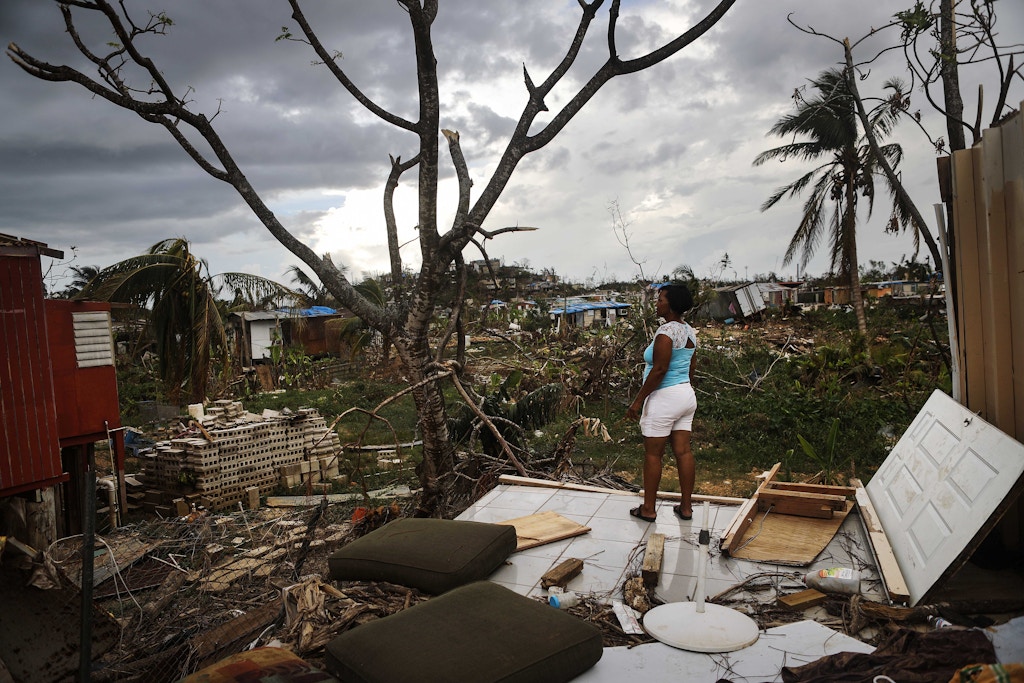
A woman stands on her property on October 5, 2017, about two weeks after Hurricane Maria, in San Isidro, Puerto Rico. Photo: Mario Tama/Getty Images
Investing big in public health care is also critical in light of the fact that no matter how fast we move to lower emissions, it is going to get hotter and storms are going to get fiercer. When those storms bash up against health care systems and electricity grids that have been starved by decades of austerity, thousands pay the price with their lives, as they so tragically did in post-Maria Puerto Rico.
And there are many more connections to be drawn. Those complainingabout climate policy being weighed down by supposedly unrelated demands for access to health care and education would do well to remember that the caring professions — most of them dominated by women — are relatively low carbon and can be made even more so. In other words, they deserve to be seen as “green jobs,” with the same protections, the same investments, and the same living wages as male-dominated workforces in the renewables, efficiency, and public-transit sectors. Meanwhile, as Gunn-Wright points out, to make those sectors less male-dominated, family leave and pay equity are a must, which is part of the reason both are included in the resolution.
Drawing out these connections in ways that capture the public imagination will take a massive exercise in participatory democracy. A first step is for every sector touched by the Green New Deal — hospitals, schools, universities, and more — to make their own plans for how to rapidly decarbonize while furthering the Green New Deal’s mission to eliminate poverty, create good jobs, and close the racial and gender wealth divides.
My favorite example of what this could look like comes from the Canadian Union of Postal Workers, which has developed a bold plan to turn every post office in Canada into a hub for a just green transition. Think solar panels on the roof, charging stations out front, a fleet of domestically manufactured electric vehicles from which union members don’t just deliver mail, but also local produce and medicine, and check in on seniors — all supported by the proceeds of postal banking.
TO MAKE THE case for a Green New Deal — which explicitly calls for this kind of democratic, decentralized leadership — every sector in the United States should be developing similar visionary plans for their workplaces right now. And if that doesn’t motivate their members to rush the polls come 2020, I don’t know what will.
We have been trained to see our issues in silos; they never belonged there. In fact, the impact of climate change on every part of our lives is far too expansive and extensive to begin to cover here. But I do need to mention a few more glaring links that many are missing.
A job guarantee, far from an opportunistic socialist addendum, is a critical part of achieving a rapid and just transition. It would immediately lower the intense pressure on workers to take the kinds of jobs that destabilize our planet because all would be free to take the time needed to retrain and find work in one of the many sectors that will be dramatically expanding.
This in turn will reduce the power of bad actors like the Laborers’ International Union of North America who are determined to split the labor movement and sabotage the prospects for this historic effort. Right out of the gate, LIUNA came out swinging against the Green New Deal. Never mind that it contains stronger protections for trade unions and the right to organize than anything we have seen out of Washington in three decades, including the right of workers in high-carbon sectors to democratically participate in their transition and to have jobs in clean sectors at the same salary and benefits levels as before.
A job guarantee, far from an opportunistic socialist addendum, is a critical part of achieving a rapid and just transition.
There is absolutely no rational reason for a union representing construction workers to oppose what would be the biggest infrastructure project in a century, unless LIUNA actually is what it appears to be: a fossil fuel astroturf group disguised as a trade union, or at best a company union. These are the same labor leaders, let us recall, who sided with the tanks and attack dogs at Standing Rock; who fought relentlessly for the construction of the planet-destabilizing Keystone XL pipeline; and who (along with several other building trade union heads) aligned themselves with Trump on his first day in office, smiling for a White House photo op and declaring his inauguration “a great moment for working men and women.”
LIUNA’s leaders have loudly demanded unquestioning “solidarity” from the rest of the trade union movement. But again and again, they have offered nothing but the narrowest self-interest in return, indifferent to the suffering of immigrant workers whose lives are being torn apart under Trump and to the Indigenous workers who saw their homeland turned into a war zone. The time has come for the rest of the labor movement to confront and isolate them before they can do more damage. That could take the form of LIUNA members, confident that the Green New Deal will not leave them behind, voting out their pro-boss leaders. Or it could end with LIUNA being tossed out of the AFL-CIO for planetary malpractice.
The more unionized sectors like teaching, nursing, and manufacturing make the Green New Deal their own by showing how it can transform their workplaces for the better, and the more all union leaders embrace the growth in membership they would see under the Green New Deal, the stronger they will be for this unavoidable confrontation.
ONE LAST CONNECTION I will mention has to do with the concept of “repair.” The resolution calls for creating well-paying jobs “restoring and protecting threatened, endangered, and fragile ecosystems,” as well as “cleaning up existing hazardous waste and abandoned sites, ensuring economic development and sustainability on those sites.”
This is a potential lifeline that we all have a sacred and moral responsibly to reach for.
There are many such sites across the United States, entire landscapes that have been left to waste after they were no longer useful to frackers, miners, and drillers. It’s a lot like how this culture treats people. It’s what has been done to so many workers in the neoliberal period, using them up and then abandoning them to addiction and despair. It’s what the entire carceral state is about: locking up huge sectors of the population who are more economically useful as prison laborers and numbers on the spreadsheet of a private prison than they are as free workers. And the old New Deal did it too, by choosing to exclude and discard so many black and brown and women workers.
There is a grand story to be told here about the duty to repair — to repair our relationship with the earth and with one another, to heal the deep wounds dating back to the founding of the country. Because while it is true that climate change is a crisis produced by an excess of greenhouse gases in the atmosphere, it is also, in a more profound sense, a crisis produced by an extractive mindset — a way of viewing both the natural world and the majority of its inhabitants as resources to use up and then discard. I call it the “gig and dig” economy and firmly believe that we will not emerge from this crisis without a shift in worldview, a transformation from “gig and dig” to an ethos of care and repair.
If these kinds of deeper connections between fractured people and a fast-warming planet seem far beyond the scope of policymakers, it’s worth thinking back to the absolutely central role of artists during the New Deal era. Playwrights, photographers, muralists, and novelists were all part of a renaissance of both realist and utopian art. Some held up a mirror to the wrenching misery that the New Deal sought to alleviate. Others opened up spaces for Depression-ravaged people to imagine a world beyond that misery. Both helped get the job done in ways that are impossible to quantify.
In a similar vein, there is much to learn from Indigenous-led movements in Bolivia and Ecuador that have placed at the center of their calls for ecological transformation the concept of buen vivir, a focus on the right to a good life as opposed to more and more and more life of endless consumption, an ethos that is so ably embodied by the current resident of the White House.
The Green New Deal will need to be subject to constant vigilance and pressure from experts who understand exactly what it will take to lower our emissions as rapidly as science demands, and from social movements that have decades of experience bearing the brunt of false climate solutions, whether nuclear power, the chimera of carbon capture and storage, or carbon offsets.
But in remaining vigilant, we also have to be careful not to bury the overarching message: that this is a potential lifeline that we all have a sacred and moral responsibly to reach for.
The young organizers in the Sunrise Movement, who have done so much to galvanize the Green New Deal momentum, talk about our collective moment as one filled with both “promise and peril.” That is exactly right. And everything that happens from here on in should hold one in each hand.
